
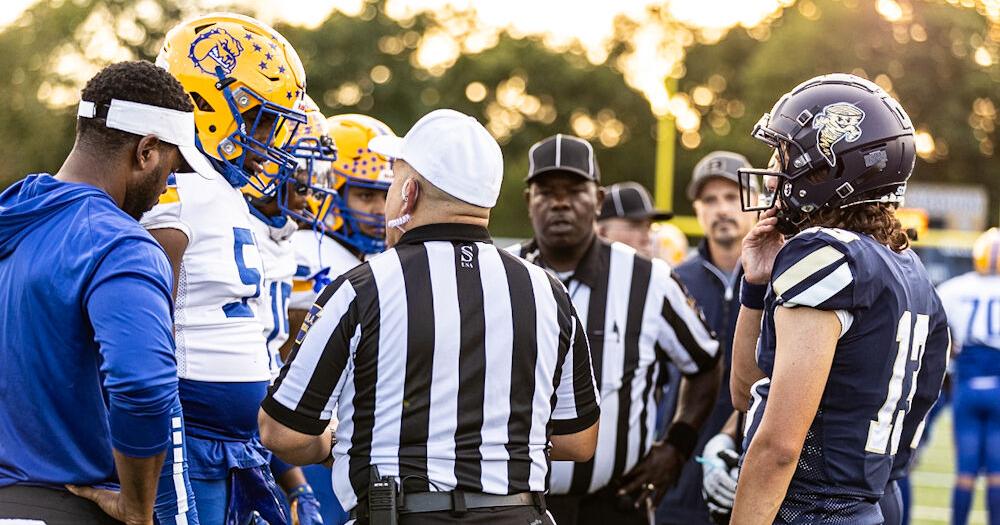
NEW WILMINGTON, Pa.-– On Friday nights, fans across Pennsylvania gather under the lights to watch high school football. Those beloved Friday Night Lights don’t happen on their own, however. For every game to run smoothly, there must be a full crew of officials on the field. And while western Pennsylvania is known for its deep football traditions, a serious problem is growing: the state is facing a major shortage of officials.
To discuss this issue, I sat down with John Mikulas, a longtime Pennsylvania Interscholastic Athletic Association (PIAA) official and Westminster alum, to talk about the demands of the job and the impact of the shortage.
Among one of Mikulas’s key points was the many different kinds of officials. Although spectators often refer to all officials as “refs,” there are actually several distinct positions on a typical crew.
“For Mercer County, District 10—that’s where I officiate—on a Friday night, we have five officials,” Mikulas explained.
Some areas use more, but District 10 usually works with five officials. Within that group, each official has a specific role. The referee is the chief of the crew—the one who makes announcements and wears the white hat. He is the only official with the formal title of “referee.” The others fall under the broader category of “officials.”
One of those is the umpire, who stands on the defensive side of the ball, typically behind the linebackers. Then there is the head linesman, responsible for the sideline. There is also the line judge, standing on the opposite sideline as the headlinesman. Finally, there is the back judge, lined up far beyond the play, and his job entails a lot of running to ensure he beats players to the endzone to call a touchdown and making sure no fights break out on the sidelines.
Despite needing officials for football to be played, it can still be easy to criticize them from the comfort of our homes or from the stands. The job of officiating is not as easy as it may seem.
One of the biggest challenges, Mikulas said, is mastering the rulebook. “You think you know football until they hand you that rulebook,” he said with a laugh.
Learning each official’s responsibilities and training your eyes to watch specific areas of the field can also be difficult. Communicating effectively and professionally with coaches is another challenge officials learn to navigate.
Despite all of the challenges, the PIAA officials still elect to put in the work and officiate games. Mikulas explained why he still chose to officiate, even with the difficulties.
“You get to stay involved, you get to help the community…[it’s] another way I can stay on the field and stay involved with the sport,” he said.
Beyond personal fulfillment, officiating is a form of community service. Games simply cannot happen without officials. Yet even with its benefits, the number of officials in the PIAA continues to decline.
“We need officials very bad,” Mikulas said. “[For] football, they make varsity teams play now on Thursday and Saturday, because we just don’t have enough guys or women to come out and support it and officiate full games.”
Without adequate officials, the Friday Night Lights we know and love is in danger. This fact has driven the PIAA to start recruiting officials to help boost the number of officials available.
While officiating on Friday Nights may not be for everyone, there are still other ways to help the shortage of officials. Referee and chapter president Jason Hoffman told me how fans can do their part to make a difference.
“Be a fan, but just don’t be so rough on us,” Hoffman said with a smile. He explained that while he understands fan frustrations, verbal abuse toward officials takes a real emotional toll.
While it’s always easy to complain about officials, it’s also a fact that without them, there is no Friday Night Football, so a bit of gratitude would go a long way for many officials.
If you think you have what it takes to officiate, visit the PIAA website and look under the officials tab for more information.