
This is a guest post by Samson Adeniyi, data scientist at the Children’s Hospital of Philadelphia.
Artificial intelligence is arriving fast in public life, and cities like Philadelphia are at a crossroads: Deploy these tools to automate the status quo or to reimagine how the government listens, responds and serves.
When done well, AI can make services more accessible, consistent and responsive. When done poorly, it widens the gaps and obscures accountability. The challenge isn’t just technical — it’s civic. Now is the time to face it.
The goal isn’t to replace staff; it’s to give them more time to focus on work that demands human judgment.
A new wave of AI technologies is ready to assist with municipal work. Philadelphia already uses AI on a limited basis. For example, to help triage requests through its 311 system, where machine learning tools assist in routing issues to the right departments, according to Melissa Scott, the city’s Chief Information Officer in the Office of Innovation and Technology.
Expanding these tools could improve efficiency across departments. For instance, chatbots can answer residents’ routine questions on city websites or helplines, giving staff more bandwidth for complex needs. New York City’s MyCity Chatbot demonstrates this well by drawing on data from various agencies to deliver quick, accurate information.
Similarly, summarization tools like Hamlet in Saratoga Springs help officials and residents stay informed by transforming long council meetings and planning documents into accessible highlights. And Maryland’s state government offers a promising model for workflow assistance: through a new partnership with Anthropic, the state is integrating AI tools that can streamline internal tasks, like checking form completeness or routing memos more efficiently.
The goal isn’t to replace staff; it’s to give them more time to focus on work that demands human judgment.
Used responsibly, AI can make government not just faster but better. It can help public servants focus more on people than on paperwork. And it can make city services more transparent and accessible to everyone.
But that kind of progress takes intention. If Philadelphia leads with fairness, openness and community involvement, it won’t just be a smart city; it’ll be a city that people trust and feel proud to call home.
A balancing act: innovation and responsible use
Just across the river, New Jersey offers a helpful example of humans and technology working together in the quest for the government to be faster and easier to navigate.
Its Office of Innovation developed the “Permit Drafter,” an AI-assisted tool that helps staff create detailed permit guidance for small businesses. Before this system, drafting a permit guide took about eight hours of research and writing.
Now, thanks to the assistance of the Permit Drafter, staff save roughly three and a half hours per guide. A strategist assembles the permit information, the AI writes a first draft, and then a human editor reviews and completes it. They even use a checklist to audit every draft for clarity and accuracy before publishing.
While New Jersey demonstrates how AI can improve speed and clarity, Pennsylvania has focused on laying the ethical groundwork.
In 2023, Governor Josh Shapiro signed Executive Order 2023-19 outlining ten core principles for using generative AI – including fairness, transparency and human oversight. As part of a pilot project, employees across 14 state agencies used tools like ChatGPT to draft emails and summarize lengthy reports. On average, participants saved over 90 minutes per day.
Even with those time savings, the executive order is clear: AI-generated content must be reviewed by a human before it can be used in any official context. Pennsylvania’s approach underscores that efficiency must never come at the expense of accountability.
Putting takeaways in action
Philadelphia can work from these.
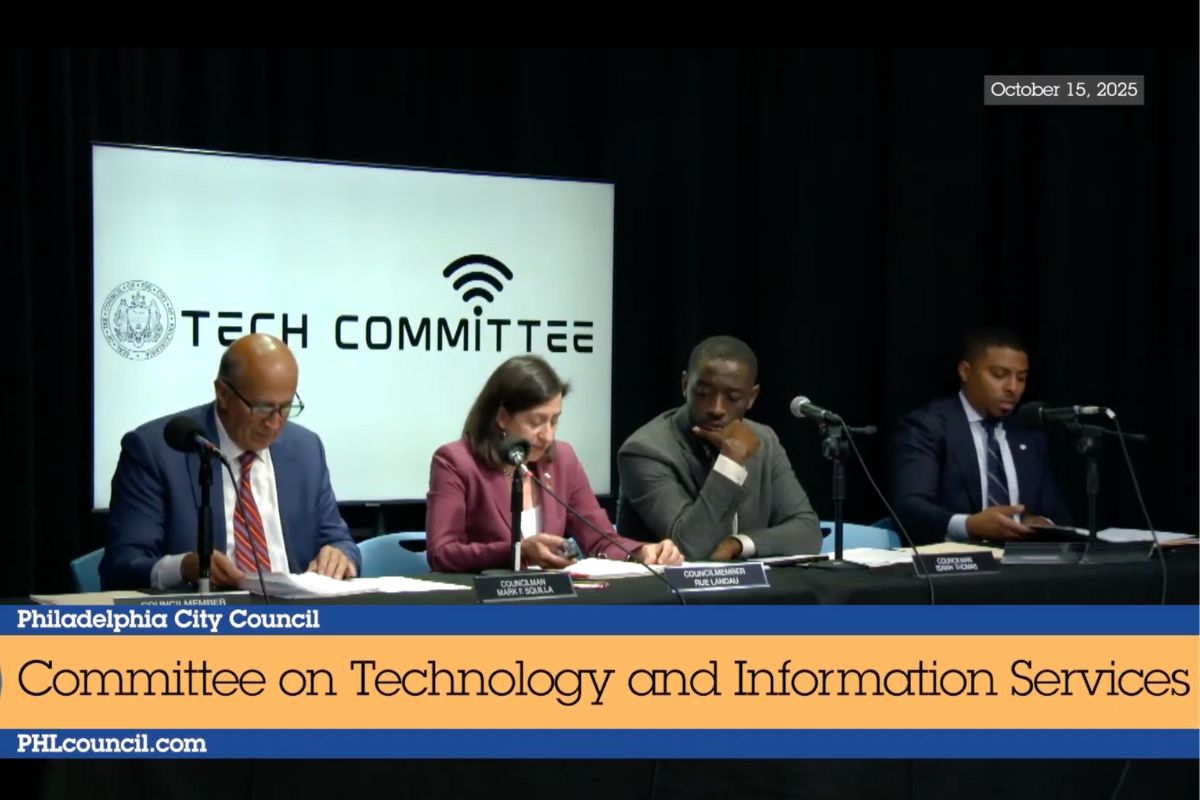
During a recent City Council hearing, officials outlined three bedrock principles for AI use: human judgment, public trust, and accountability. The city intends to issue plain-language rules in early 2026 and create an AI governance committee.
The council members have also asked that community experts join these endeavors. That’s wise. Technology utilized when it comes to people’s lives should at least include them in the process of shaping it.
Getting it right will require the city to balance effectiveness with equity. For instance, if Philadelphia creates a business service chatbot, it needs to be transparent about when users are interacting with a bot and include a seamless way to escalate to a human, if necessary.
Document summarizers can make budgets or housing plans more accessible, but should always be presented alongside the source documents, so citizens can consider the context in full.
There are steps the city can take now.
First, adopt municipal AI principles aligned with the state’s.
Second, start with low-risk pilot projects and evaluate their impact.
Third, involve local universities, civic tech groups and community organizations in governance.
Philadelphia is home to world-class research institutions and diverse neighborhoods, making it uniquely positioned to build inclusive, accountable innovation.