
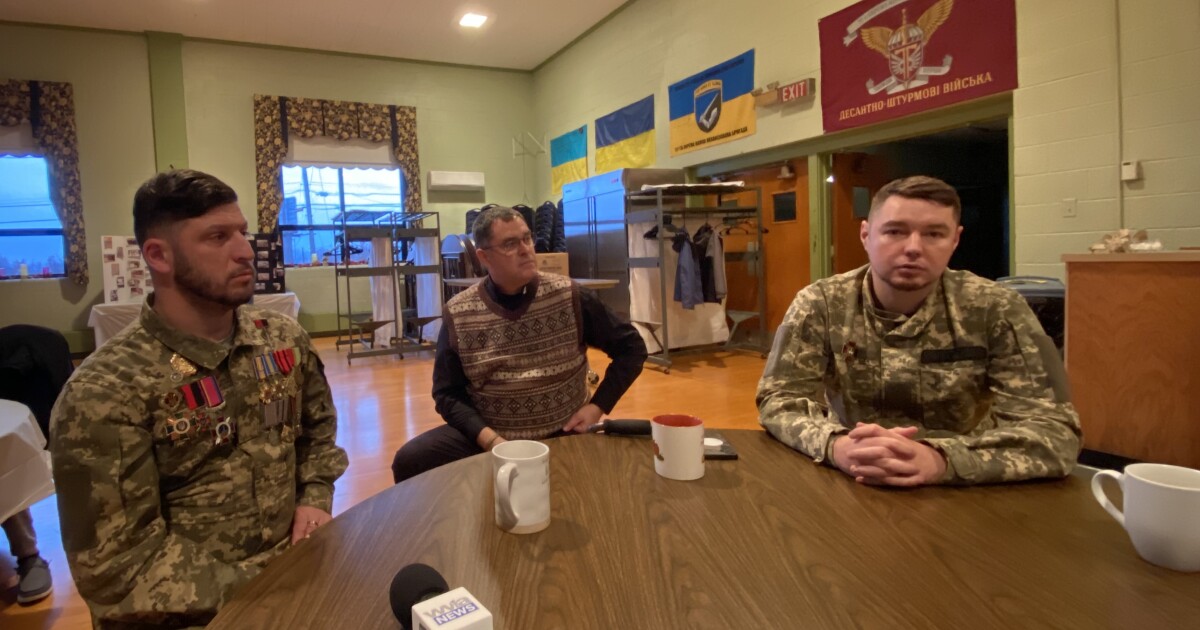
Russia’s unprovoked war against his country cost Ukrainian veteran Mykola Melnyk both legs, but he spends these days warning the world of potentially larger losses.
Defeat Russia’s “modern Nazi horde” now or expect to fight them later and perhaps repeat the mass American casualties of World War II, Melnyk, 40, said during a recent interview in Scranton with WVIA News.
Melnyk, a lieutenant, knows the number of Americans who died in World War II, probably better than most Americans: more than 400,000.
“Let me explain one thing, guys,” Melnyk said. “Look, we’re last fortress of democracy in Europe. We have a strong army. Not a country in Europe (has) … so strong (an) army. We can fight against Russia, but if we lost, unfortunately in Europe, maybe in a year or two, you’re forced to (fight) … I understand, maybe you all wait (for a) second Pearl Harbor, but help us today, because tomorrow, you (will not) have a Ukrainian army (as) your allies.”
Pleading for more help
Melnyk and fellow Army veterans Denys Haida and Oleh Bonchynskyi tour the United States spreading the warning. They sat for an interview last month in the church hall at St. Vladimir Ukrainian Catholic Church in Scranton.
On their tour, they meet with groups and caution of the consequences of Russia winning the war. They urge audiences to press the American government to keep sending Ukraine weapons.
They do not want the United States to send soldiers.
“Now, Ukraine needs weapons, only weapons,” said Melnyk, who speaks the best English of the three. “Please help us. Help us protect our civilians. Help us protect our children. Help us protect (the) entire democracy (of the) world. Because if you don’t do this, this very simple thing, you must fight in future.”
The roots of the war
Most of the world thinks the war began with Russia’s invasion in 2022, but Haida, Melnyk and Bonchynskyi remind that it really started in 2014.
In November 2013, protests began when Ukrainian President Viktor Yanukovych decided against aligning the country with the European Union and chose stronger ties with Russia instead.
Known as the Revolution of Dignity, the protests forced Yanukovych to flee the country. Russia responded by militarily seizing Ukraine’s Crimean Peninsula.
The ‘Nazi horde’
All these years later, Melnyk has no qualms about referring to the Russians as Nazis. He doesn’t excuse Russian citizens either for ignoring their country’s war crimes against Ukraine. He likens Russian citizens to Germans who ignored the Nazi regime’s abuses during Adolf Hitler’s rule, pretending they saw and heard nothing.
“And now every Russian citizen understands what they do in Ukraine,” he said, pounding his fist. “They killed our children. They kidnapped our children. They kill our civilians. You hear about Bucha?”
In the city of Bucha, a month after the war began, Russian soldiers killed hundreds for no reason other than they were Ukrainians, many of them children. Haida, nicknamed Wolverine and Cyborg for his defense of his country through the years, keeps his children in mind as he fights.
“It’s not just about my children but the future of my country,” Haida said.
‘Old, ugly dogs’
Americans can stop the war by helping Ukraine win it, the soldiers insist. Ukrainians fight “like old, ugly dogs,” Melnyk said.
After all these years of war, the Ukrainian army ranks as the best in Europe, he said. The American army doesn’t understand modern warfare as well as the Ukrainians and neither do other European nations, Melnyk contends.
When Russia flew 20 drones over Poland earlier this year, Poland shot down only four, or 20%. Ukrainians shoot down 95% daily, Melnyk said.
No surrender
The soldiers dismiss the 28-point peace plan that President Donald Trump unveiled last month after talking only with the Russians and with no serious input from Ukraine or other European countries. The plan calls for Ukraine to surrender territory Russia does not control.
“No, it’s our land. It’s our country,” Melnyk said. “You must understand. We fight, Ukrainian soldiers fight for three things — the graves of our ancestors, (the) memory of our fallen brothers and future for our children. If we lost, we have not these three things.”
Stopping the Russians isn’t enough, he said.
“We can’t stop them,” Melnyk said. “We can only win. You must understand Russians (are) maniacs and they never stop … We can fight for you, for freedom … I think American citizens hear us.”