
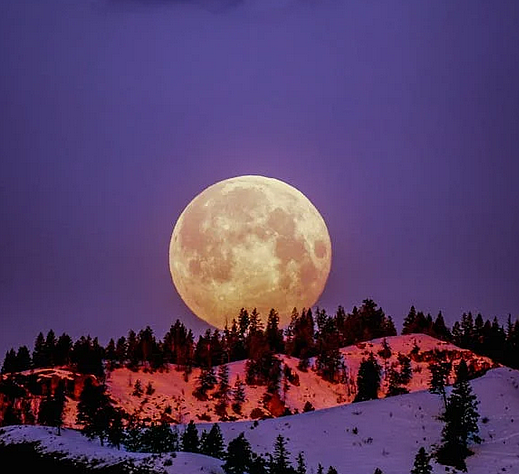
As winter nights lengthen across the Delaware Valley and the Poconos, the sky is poised to deliver a final celestial flourish for 2025.
On Thursday, the year’s last supermoon — the Cold Supermoon — will light up the night, peaking in illumination at 6:14 p.m. Eastern Time.
What is a supermoon — and why this one matters
A “supermoon” occurs when the full moon coincides with the moon’s closest approach to Earth in its orbit (perigee), making it appear larger and brighter than a typical full moon.
During a supermoon, the lunar disk may look up to 14% larger and about 30% brighter than the faintest or most distant full moon of the year.
The December full moon is traditionally known as the “Cold Moon,” a name rooted in the season’s chill and the long winter nights. According to astronomical sources, this Cold Supermoon will ascend higher in the sky than any other full moon of 2025, offering a rare viewing opportunity for observers across the Philly suburbs and Pocono region.
Thursday’s supermoon will be the highest rising December full moon until 2042.
When and how to watch
The moon will reach full illumination at 6:14 p.m. ET — just as dusk arrives across eastern Pennsylvania.For the best visual effect, watch for moonrise along the eastern horizon shortly after sunset. At that moment, the cold-moon disk will appear its biggest — a dramatic display especially striking near tree lines, rooftops or other familiar landscape features.No telescope or special gear is required, though a pair of binoculars will enhance detail. Skywatchers are encouraged to choose a spot with minimal light pollution, such as a rural backyard or a Poconos overlook.
What’s up for 2026 — Other celestial events to watch for
If you enjoy lunar spectacles, 2026 offers several more supermoons and seasonal sky events worth marking on your calendar.
According to published moon-phase calendars, the next full-moon supermoons visible in our region include the Wolf Supermoon 2026 (Jan. 3) and later in the year the Beaver Supermoon 2026 and Cold Supermoon 2026, among others.
In addition to full moons, 2026 brings a steady lineup of celestial opportunities: meteor showers, new-moon stargazing windows, and other seasonal events that make our skies worth watching.
Whether you step outside your back door, take an evening drive to a dark-sky locale, or simply look up after dinner Thursday, the Cold Supermoon offers a truly accessible — and beautiful — astronomical moment. With the moon due to blaze brightest and highest on Thursday, skywatchers across southeastern Pennsylvania should not miss what may be nature’s final full-moon gift of the year.
Make it a good night, and keep watching the skis … uh, skies.
 (Credit: NPHS Planetarium)
Take a Planetarium trip
If you are impatient for nature, grab at ticket to a public event at North Penn High School’s Planetarium.
According to its website, the main purpose of the planetarium is to educate the students of the North Penn School district in the field of astronomy. However, it also serves the community as a whole by offering programs open to the public and private groups by request.
The planetarium has a 30-foot dome and seats a maximum of 57 people. It is powered by a SSIA DigitalSky DarkMatter system that utilizes a Barco F80 Laser Projector and a fish-eye lens to produce 2.4k fulldome images, according to its website.
Programs are usually run once a month on Monday evenings at 7:30. Each program will consist of 45 minutes in the planetarium, followed by stargazing and telescope viewing when weather permits.
The cost of all programs is $11 per child and $13 per adult. While tickets are available at the door, you can register at www.northpenncep.org to ensure your seat.
 (Credit: NPHS Planetarium)
Upcoming NPHS Planetarium dates
(The following schedule was provided on the planetarium website)
Dec. 15, 2025: Wonders of the Night Sky: Why is the sky so bright in the winter? What secrets does the night sky hold? Let’s find out together in the Live Interactive Planetarium Program that will highlight the major celestial objects that can be seen at this time of year, including planets, constellations and deep sky objects. (Telescope viewing and stargazing follows, weather permitting)
Jan. 12, 2026: Sunstruck: Travel back to the beginning of time and experience the birth of the Sun. Discover how it came to support life, how it threatens life as we know it, and how its energy will one day fade away. This NASA funded fulldome planetarium show will take us on an exploration of our nearest star. (Live StarTalk, telescope viewing and stargazing follows, weather permitting)
Feb. 9, 2026: Earth, Moon & Sun: This planetarium show explores the relationship between the Earth, Moon and Sun with the help of Coyote, an amusing character adapted from Native American oral traditions who has many misconceptions about our home planet and its most familiar neighbors. His confusion about the universe makes viewers think about how the Earth, Moon and Sun work together as a system. Native American stories are used throughout the show to help distinguish between myths and science. (Live StarTalk, telescope viewing and stargazing follows, weather permitting)
March 16, 2026: Wonders of the Night Sky: What is that bright spot in the night sky? What secrets does the night sky hold? Let’s find out together in the Live Interactive Planetarium Program that will highlight the major celestial objects that can be seen at this time of year, including planets, constellations and deep sky objects. (Telescope viewing and stargazing follows, weather permitting)
April 20, 2026: Messengers of Time and Space: Modern astronomical surveys, like the upcoming Rubin Observatory Legacy Survey of Space and Time (LSST), will detect up to 10 million changes in the sky every night, with alerts generated within minutes. Yet, many of these alerts will require additional observations to understand the physical phenomena. Observatories providing this critical follow-up must become capable of responding quickly and efficiently. With the new improvements provided by the GEMMA project, Gemini will become a global leader in these follow-up observations, able to study the faintest, highest-priority targets. This planetarium show highlights how Gemini will work together with observatories that monitor the night sky for exciting astronomical events that change with time, like Rubin Observatory. Sometimes, light is not the only indicator of these short-term events. Audiences will learn how information can reach us through other messengers like cosmic rays, elusive particles called neutrinos, and even gravitational waves rippling through the Universe. (Live StarTalk, telescope viewing and stargazing follows, weather permitting)
May 18, 2026: Black Holes: What are they? Where do they come from? What happens as you get close to Black Holes? Join us for this Live Interactive Planetarium Program in which we delve into what makes black holes tick. We will even learn where to find one in the Milky Way! (Telescope viewing and stargazing follows, weather permitting)