
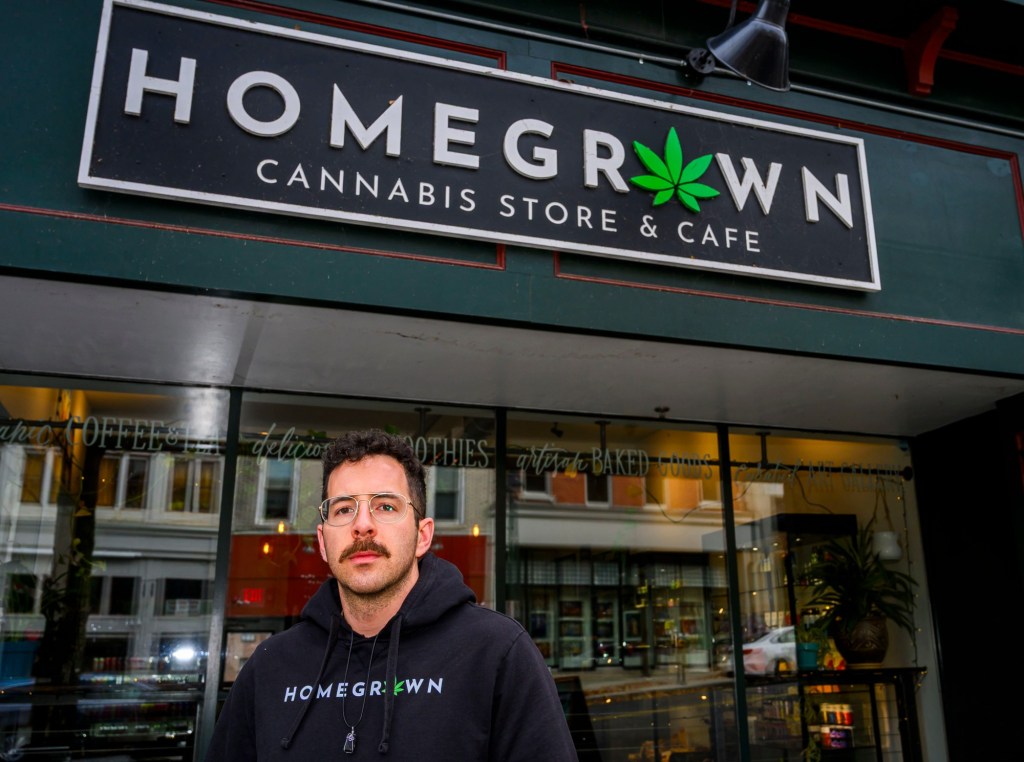
Nicholas Martens, who has been farming hemp and selling products derived from the crop for years, fears a recent change in federal law could ruin his livelihood, as well as deprive consumers who rely on cannabis-based products to treat ailments such as chronic pain and seizures.
A provision in the U.S. budget bill that reopened the government in November, after weeks of a shutdown, effectively bans all ingestible hemp products that have the potential to impair consumers as of November 2026, according to the U.S. Hemp Roundtable, a coalition of companies and organizations committed to safe hemp and CBD products.
It limits such products to .4 mg THC per container, which will affect more than 95% of hemp products, including Delta-8 and Delta-9 THC consumables, the organization said.
Martens, a Bethlehem resident, co-owns and operates two stores in the area with organic, “farm-to-table cannabis” merchandise, according to his website. His Downtown Easton store, opened in 2021, offers shoppers a variety of finished items and raw flowers, the latter with names like Platinum Panther and Blue Meringue, to make oils, topical creams and other products.
Martens believes the new spending bill ultimately will destroy the hemp industry, which has been legal since 2018. That would affect 350,000 jobs nationwide along with $28 billion in revenue, according to a study by Whitney Economics, a cannabis and hemp business consulting, data and economic research company based in Portland, Oregon.
“So what this means to me, essentially, is a major step back in the progress that we’ve made,” Martens said, sitting recently in his Homegrown Cannabis Store & Cafe on Northampton Street. “It’s devastating, not only to ourselves as a business, but to the community that depends on us and relies on this.”
Martens, who has another retail store in Stroudsburg and a farm that grows hemp in Monroe County, said his products are lab-tested and free of chemicals.
“We do not use any synthetic-based cannabis,” he said. “We are good actors in the industry.”
The 2018 U.S. Farm Bill legalized hemp and led to a proliferation of hemp farming and retail sales in Pennsylvania, which grew into a $1 billion industry.
Bryan Bohning, the owner of Der Wenig Bauernhof LLC (German for The Little Farm) in New Tripoli, Lynn Township, said Martens and others involved in Pennsylvania’s hemp and cannabis-product industries have every reason to be upset.
“We didn’t expect to get backdoored the way we did,” said Bohning, who grows hemp on about an acre of his 10-acre farm. “We thought this was going to be about getting air traffic controllers and food stamps back up. We never realized it was going to cost us our careers.”
Bohning, who is part of several organizations supporting legal, mainstream cannabis products, also hopes things can be clarified and resolved early next year.
He said after the Farm Bill passed in 2018, “bad actors” found a loophole enabling them to insert synthetic compounds into products that make them illegal.
Pennsylvania Agriculture Department spokesperson Shannon Powers said in an email that the new federal provision does not affect legal hemp production in Pennsylvania or the state Agriculture Department’s hemp program, but strengthens and clarifies federal and local law enforcement authority.
She said state officials are evaluating what impact the provision will have on its retail food safety inspections, as well as regulatory processes at the federal-agency levels.
Industrial hemp was a cash crop in Pennsylvania and elsewhere in the 18th and 19th centuries. Its production was curtailed after World War II amid a marijuana scare and became explicitly illegal in 1970 when President Richard Nixon signed the Controlled Substances Act, which classified all varieties of the Cannabis sativa plant as a Schedule 1 drug.
Contact Morning Call reporter Anthony Salamone at asalamone@mcall.com.