
On any given weekday morning, while most of us are dodging calendar invites for another work meeting that probably doesn’t have to be a meeting, Rob Lawless is eagerly logging on to yet another video call.
Listen to the audio edition here:
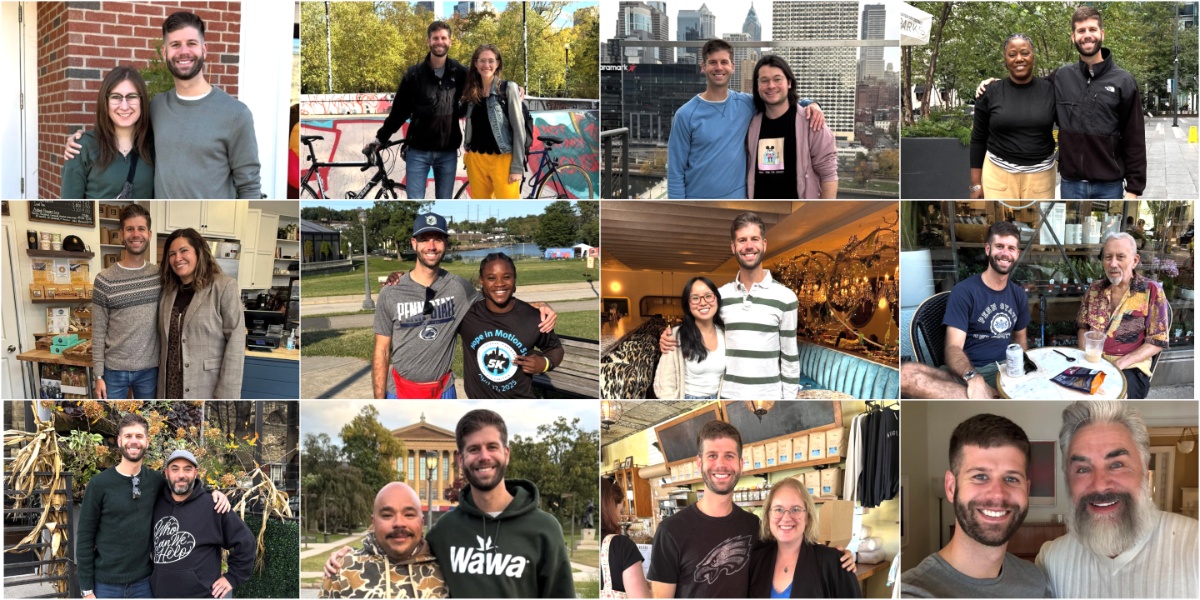
It might be with a 25-year-old Penn State University student who survived childhood cancer. Or a 61-year-old former construction worker who found God after being electrocuted. Or, a 33-year-old who dedicated his life to creating a muscular dystrophy drug for his younger brother. Lawless has taken each of these meetings, and thousands more in person and online, over the last decade. Since 2015, he has dedicated about three hours a day to meeting strangers, all in pursuit of a single, improbable goal: to have 10,000 one-on-one conversations with someone he’s never met before.
He’s reached more than 7,000 so far (7,296 to be exact; I’ll be 7,297 later today). And the project — equal parts human connection experiment, endurance test, and personal mission — has taken him through a global pandemic, across multiple continents, and into a new career as a keynote speaker. It has also revealed a solution to what he believes to be the true crisis of our era: finding genuine connection in an age of loneliness and AI.
“If one person can change the trajectory of your life …”
Lawless, 34, first saw the impact that a chance encounter could have when, as a freshman at Penn State, he met a junior named Brett. The pair were on the dance marathon team together, and Brett mentioned that he thought Lawless would make a good tour guide. Lawless initially wrote off the suggestion, but Brett continued to follow up until he eventually convinced Lawless to go for it. Lawless applied, got in, and quickly became close friends with his cohort of guides. They stayed his best friends throughout his four years of college and remain his close friends to this day.
After he graduated from Penn State, Lawless struggled to find connection and community. He longed for the familiarity of seeing friendly faces on campus — knowing that he knew their stories, and they knew his.
This is more than just a consequence of aging. Loneliness, especially among men and Gen Z, has surged — former Surgeon General Vivek Murtha called it an epidemic in 2023, noting that one in two American adults reported feeling lonely in a survey. The effects go beyond just feeling bad; it can lead to a greater risk of heart disease, anxiety and premature death. Especially since the Covid-19 pandemic, meeting people feels harder. Online life has replaced real-world community. And AI raises new questions about what makes us human.
 Lawless with 100-year-old new friend, Ruthe Kabler.
For Lawless, loneliness prompted him to think about Brett who, in introducing him to a friend group, completely changed the trajectory of his social life. “I was just very curious,” Lawless says. “If one person can change the trajectory of your life, what happens when you go out and meet 10,000 different people?”
This question led Lawless to start his ambitious project, Rob’s 10k Friends, in November 2015. At the time, he was working full time as a consultant for the software startup RJMetrics. Eight months after he started 10k Friends, however, the company was acquired and Lawless was laid off. Rather than look for a new job, Lawless wondered if he could take his project full time.
“I’d minored in entrepreneurship and I’ve always been interested in creating my own path,” he says. “And, to me, the dream [was] to just be able to meet new people all the time.”
“A blessing in disguise”
Slowly but surely, his gamble paid off. Over the past 10 years, Lawless has lived in three different states. He started a new career (more on that later). He received a ton of press (The Philadelphia Citizen first covered Rob’s project in May 2016, when he had only met up with 65 people). And, he got to learn and explore. Each meeting he had was not only an opportunity to get to know a new person, but an opportunity to find a new (to him at least) corner of Philadelphia.
“Oh, man, like 90 percent of what I know about the city I discovered through this project!” he gushes. “Cira Green, The Global Dye Works building, The Making Worlds Cooperative Bookstore & Social Center, Orkney Park, the roofs of some buildings, the Enterprise Center in West Philly (where they used to film American Bandstand!) … [even] the apartment unit I now live in!”
“Every person that you meet is a gift, and you never know what you’re going to get until you take the time to unwrap it.” — Rob Lawless
Lawless relished the opportunity the project gave him to explore the city. “I thought every single meeting was [going to] be in person and I was so pure about that until Covid,” he says. But when the world shut down, he had to adapt quickly — not only to keep the project alive, but to protect the people he interacted with daily. “[If] one person in your community got [Covid], they were on the news,” Lawless remembers. “[I could already see] the headline being ‘Guy Meeting 10,000 People Gets Covid.’ It was such an easy thing to spread, and I didn’t want that.”
The pivot to virtual meetings turned out to be transformative. “It was a blessing in disguise,” he says. “I now [have] met people from over 90 different countries around the world, and I still regularly talk to people outside of the U.S.”
“The FRIEND Framework”
Lawless believes that the quickest way to reach a place of understanding is to lead with curiosity and respect. “If someone has differing opinions than me, I’m not there to tell them why they’re wrong. I’m there to understand the experiences that have led them to have those opinions,” he says. “I think connecting with other people is realizing that who you are meeting in that moment on the surface is the culmination of an entire lifetime of experiences. And it’s your job to go and be curious and dig up what those experiences are.”
He thinks that, because of social media, people judge each other too quickly before they’ve really gotten a chance to understand each other’s backgrounds. “The best example that I can give is: I grew up in the suburbs of Philly, so I think the Eagles are awesome and I think the Cowboys suck. It’s just natural; it’s how I’m conditioned to be.
Someone who grows up in Dallas thinks the Cowboys are awesome, and they think the Eagles suck. We are both just two people who are passionate about our local sports team. So we’re basically like the same person, with differing views because of the experiences from our childhood.”
Over time, he’s developed his own conversational structure, which he calls the “FRIEND framework,” which is designed to foster understanding and connection. The framework involves asking about Family and Relationships, someone’s Industry and Education path, their entertainment or hobbies, and their Needs and Dreams for the future. As a conversation goes on, Lawless searches for gaps in the timeline. Maybe he’s talked about their family now and knows they are married with kids. But he doesn’t know about their upbringing. Or maybe he has learned what their hobbies were as a teenager, but not what they are now.
Through exercising the muscle of connecting, he has found a few questions that always seem to do the trick. “I love asking people, ‘If your identity was a pie chart, what would be the categories that make up who you are, and what would be the percentages?’ This leads to much better answers than the question, ‘What do you do?’ I also enjoy asking people: ‘Is life in balance right now and you’re just working to maintain that balance? Or are there dials you’d like to turn up and others you’d like to turn down — if so, what are they?”
“Meeting people is such a novel experience. You’re learning something new with every conversation that you have,” he reflects. And, in return, the people he meets with feel that someone is genuinely interested in them. Where the meetings are a chance for Rob to learn, they are equally an opportunity for his new “friend” to feel truly seen and heard.
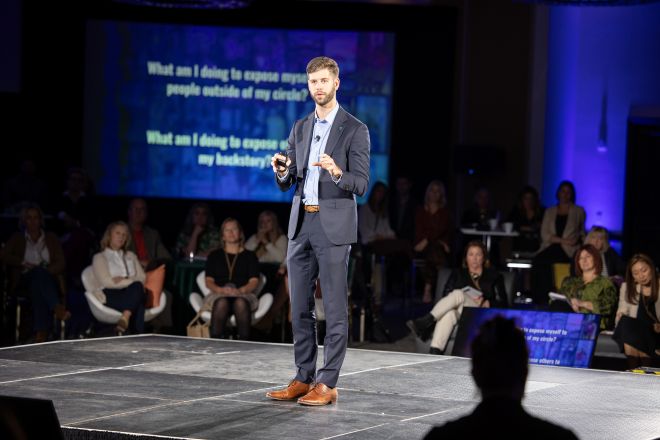 Lawless onstage. “I plan to speak until the day I die.”
Though the interactions themselves rarely exhaust Lawless, the logistics sometimes do. “I’ve probably been canceled on, rescheduled on last minute or no showed over a thousand times. So that’s like a thousand hours of my life,” he calculates.
And, the pipeline of strangers isn’t as easy to maintain as it once was. In the early years, he regularly met 80 to 90 new people each month. Now, between traveling for work and what he describes as a more saturated social media landscape, finding people can be surprisingly difficult.
The financial strain was real, too. When he was first laid off in 2016, he wasn’t sure how he could monetize the project. By 2018, he had $500 to his name; by 2019, only $200. The turning point came when he met a woman named Michelle Poler (meeting #2812) for his project in August of 2019. Poler, a keynote speaker, introduced him to the world of paid speaking engagements.
Lawless found that, especially after Covid, many companies were desperate to seek and promote connection. Co-workers were feeling estranged from one another and were anxious about networking with their peers. Lawless, who did his first paid speech in April of 2021, realized that he could speak about the importance of fostering authentic connections. He’s spoken at sales kickoffs about how to build rapport with clients and colleagues, and the importance of not only reaching out when you need something from someone. He’s spoken with HR departments about engagement and retention of talent.
“If someone has differing opinions than me, I’m not there to tell them why they’re wrong. I’m there to understand the experiences that have led them to have those opinions.” — Rob Lawless
“People will struggle to leave companies if they have really good friends there. How do you create those deeper levels of connection with each other? You have to move beyond your work roles and responsibilities,” he advises. Now, he says, companies are especially concerned about maintaining humanity in the age of AI.
Lawless has now done almost 100 paid speeches, and it is his main source of income. The speaking circuit has sent him to conferences in India, Germany, and around the U.S., often thanks to introductions from people he originally met through the project.
“I’m only a speaker in service of the project. And the project helps me learn what to say on stage,” he says. While he didn’t originally see this career for himself, he now cannot imagine his life without it. “I plan to speak until the day I die.”
“Everyone is just doing the best they can.”
Lawless does a weekly reflection for his Patreon page, where he’ll list three things he learned from meetings each week and one person that stuck out to him. He’s never at a loss for source material. Once, he learned from a Russian woman that Russia actually suffered the greatest number of casualties in World War II. Lawless, who learned about the war from the American history perspective, had never heard this before. He thought that the U.S. had lost the most soldiers. “It was a reminder that what we are taught in U.S. history is different than what Russian people are taught in Russian history,” he reflects.
Other meetings have introduced him to new hobbies, new friends, and new branches of his career. A woman from Colombia sparked his love of the French pop band L’Impératrice. “I’ve realized that if you’re on a quest to interact with your favorite things in life, you know what your favorite things are now, but there are so many things that would be a favorite of yours – you just don’t know they exist yet because you haven’t come across them,” he muses.
And many stories have left lasting emotional imprints.
Tulsi Vagjiani (meeting #5374), who lost her entire family in a plane crash and survived with severe burns, taught him “about finding confidence and resilience.”
Chris Gellenbeck (meeting #1300), who survived being run over by a boat, taught him “the difference between a problem and an inconvenience.”
Stephanie Shelthon (meeting #6319), who lost her daughter to a murder-suicide, gave him much needed perspective during a week when he had been feeling sorry for himself.
These stories — and hundreds like them — reinforced his belief that “everyone is just doing the best they can with the resources that they have.”
 Lawless and Porter Thompson, age 5. “Every person you meet is a gift.”
As he nears the final stretch, Lawless is thinking about how the project can expand beyond him. He imagines helping newcomers to Philadelphia feel welcomed with happy hours and other events, the way college freshmen instantly bond with their class because of new student orientation. He imagines being a professor one day who will assign students to learn from each other’s backgrounds instead of textbooks. He imagines fostering belonging at scale.
“People should be building their network before they need it,” he says. True connection, he believes, requires practice — not passive waiting. His advice: join a club with recurring meetings to build the “foundation plus frequency” needed for friendship. Attend a run club. Volunteer. And set a small, achievable goal.
“We’re coming up on 2026. People will have goals to go to the gym three days a week. People will have goals to read one book a month. I think people should have a goal to meet one new person a month,” he advises.
He’s made many new friends himself over the course of the project. Just last month, Lawless ran the half marathon with a guy he’d met through his project. He’s now texting another new friend to find a time to grab a beer. And he’s learned to prioritize old friends as well. “I used to think that success was like career success, financial success. And now I define success by the amount of time I spend with the people that I care about. So I’m more likely to hang out with my college buddies than I was before, and to put in time with my family when I have the opportunity to do so,” he says.
Over the past 10 years, he’s met people from almost 100 countries. The youngest, Porter Thompson (meeting #1000) was 5 years old. The oldest, Ruthe Kabler (meeting #6568) was 100. He’s met different religions, genders, sexual orientations, political affiliations, and races. And he knows he still has so many people to meet, and so much to learn. “If someone sees a lack of any type of representation in my project, then please reach out and help me fill it!” he pleads.
“Every person that you meet is a gift,” he says, “and you never know what you’re going to get until you take the time to unwrap it.”
 MORE CITIZENS OF THE WEEK