
During the three-plus years that I’ve been hosting this podcast, I’ve welcomed a diverse range of guests. They’ve exhibited demographic diversity, of course, but also other forms of diversity—including diversity of opinion and experience.
So I was embarrassed when I recently noticed that although I’ve interviewed more than a dozen current and former judges, only two have sat on state courts (and by the time I interviewed them, those judges—Rolando Acosta and Debra Wong Yang—had left the bench). Put another way, I have not, until today, hosted a sitting state-court judge—a considerable omission, considering the significance of state courts. As noted by the National Center for State Courts, “State courts play a critical role in our democracy, handling about 96 percent of all legal cases in the United States.”
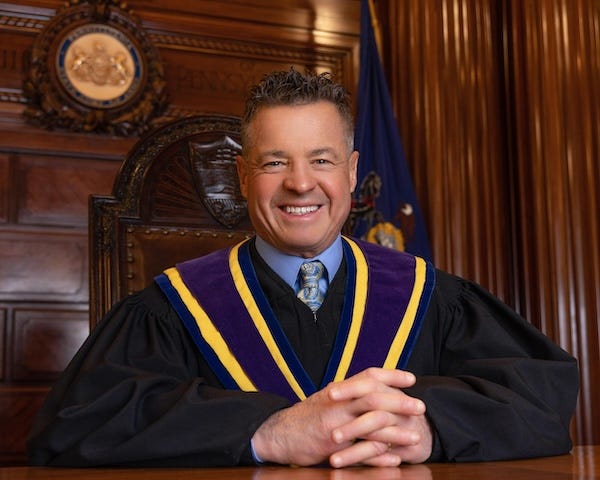
I set out to remedy this gap—and was delighted when Justice David Wecht, a longtime friend, agreed to join me. He’s a timely guest: last month, he and two of his colleagues were reelected to the Pennsylvania Supreme Court, for which I named them Judges of the Week. Why? Their court is one of the most important state courts in the country—for reasons I discussed with Justice Wecht on the episode.
In our conversation, we also covered the justice’s interesting path to the Pennsylvania high court; why he believes young (and not-so-young) lawyers should get involved with their communities; certain unique features of the Pennsylvania Constitution, as well as its relationship to the U.S. Constitution; and, of course, his recent reelection to the Pennsylvania Supreme Court.
Congratulations to Justice Wecht on his reelection—and thanks to him for joining me.
Show Notes:
Prefer reading to listening? For paid subscribers, a transcript of the entire episode appears below.
Sponsored by:

NexFirm helps Biglaw attorneys become founding partners. To learn more about how NexFirm can help you launch your firm, call 212-292-1000 or email careerdevelopment@nexfirm.com.
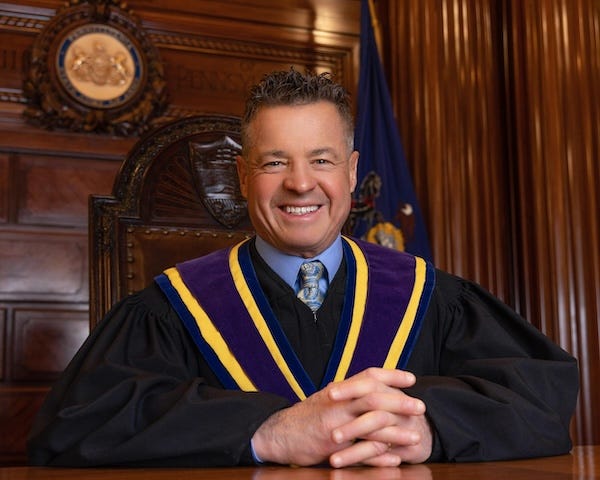 Justice David Wecht (courtesy photo)
Three quick notes about this transcript. First, it has been cleaned up from the audio in ways that don’t alter substance—e.g., by deleting verbal filler or adding a word here or there to clarify meaning. Second, my interviewee has not reviewed this transcript, and any errors are mine. Third, because of length constraints, this newsletter may be truncated in email; to view the entire post, simply click on “View entire message” in your email app.
David Lat: Welcome to the Original Jurisdiction podcast. I’m your host, David Lat, author of a Substack newsletter about law and the legal profession also named Original Jurisdiction, which you can read and subscribe to at davidlat.substack.com. You’re listening to the eighty-sixth episode of this podcast, recorded on Monday, November 24.
Thanks to this podcast’s sponsor, NexFirm. NexFirm helps Biglaw attorneys become founding partners. To learn more about how NexFirm can help you launch your firm, call 212-292-1000 or email careerdevelopment@nexfirm.com. Want to know who the guest will be for the next Original Jurisdiction podcast? Follow NexFirm on LinkedIn for a preview.
Back in May 2016, while speaking to a group of matrimonial lawyers in Hershey, Pennsylvania, I had the pleasure of meeting Justice David Wecht, who was also speaking at the conference. At the time, he was a few months into his tenure on the Pennsylvania Supreme Court. I was very impressed by his talk, and he struck me as a jurist worth watching.
In the intervening years, Justice Wecht has become a leading light in the world of state high courts. Last month, he won reelection to the Pennsylvania Supreme Court, in one of the most high-profile judicial races in the country—and one that could have implications for national politics. Why? Pennsylvania is a key swing state—and its high court regularly resolves consequential election-law disputes, under the laws and constitution of the great state of Pennsylvania. Without further ado, here’s my conversation with Justice David Wecht.
Justice Wecht, thank you so much for joining me.
David Wecht: Thank you, David. It’s a great pleasure to be with you here. I’m really looking forward to talking with you.
DL: So as I do with all my guests, I’d like to begin with your background and upbringing. You are a Pennsylvanian through and through, but I believe you were not born in the Keystone State?
DW: Yes—I was born in Baltimore, Maryland. My parents were living there after they got out of the military.
DL: And what did they do after the conclusion of their service?
DW: My dad’s service ended a little before my mom’s, and they were on base in Alabama, so they moved up to Baltimore where my mother’s mother was living, and my mother was able to transfer to Andrews Air Force Base in Maryland, so she was able to finish her service duty at Andrews. And then eventually, when they were both done, they got married, and I was born in 1962 in Baltimore. I think within the first year of my life, they moved back to Pittsburgh, where their wedding had occurred, and where my father had been born and raised.
DL: And what did they do in Pittsburgh for their work?
DW: Well, my father had obtained his M.D. at Pitt before he went into the military, so he already had his medical degree and was able to get an LL.B. at Maryland Law School in Baltimore. And then when my parents came back to Pittsburgh, my dad enrolled at Pitt Law School and got his J.D., so he actually had two law degrees as well as a medical degree. When he first got back to Pittsburgh, he had three jobs: he was working as a pathologist at the Veterans Administration Hospital in Pittsburgh, he was working as a medical-legal advisor for the district attorney in Allegheny County, and he was also working as a forensic pathologist in the Allegheny County Coroner’s Office. My mother at the time was raising us—in fairly short order, three siblings were born, so there were four of us. And then my mother, years later, would go back and get a Master of Public and International Administration and also a law degree at Pitt.
DL: You mentioned that your father was a pathologist. My mom, coincidentally, is also a pathologist, at least by training. Your dad was a very well-known pathologist as pathologists go, right?
DW: Yes, yes. So my mom and dad, like I said, when they came back to Pittsburgh, my dad was developing his career in forensic pathology, and he also had this legal background, and he got involved with an outfit called the American College of Legal Medicine. He was asked to give a paper at their convention about the newly released Warren Commission report—this was, I guess, in early ‘65 or so. So he agreed to deliver this paper. He went down to the public library in Pittsburgh, and he read the report cover to cover. I think he said it was 17 volumes, if I’m not mistaken, something like that, and it had no index. So when he was done reading, he returned the books to the librarian, and she asked him what he thought of it. He said, “It’s wonderful. I just suggest you move it from the nonfiction to the fiction shelf.” He was the foremost critic of the single bullet theory, and he testified in the Congress about the Kennedy assassination, etc.
DL: So I’m curious—your parents both had law degrees, although your mother obtained her law degree later, but your father by then had his two law degrees. Did that influence your decision to go into law? What prompted you to go to law school?
DW: My parents never steered me in any direction. I know my father had been steered by his father into becoming a physician, so there was never any question that my father was going to become a physician. He developed interest in law after that. For me, I never received any pressure at all from my parents to pick any kind of calling. I think I gravitated to law by default, more or less because I enjoyed advocacy and argument while in college, both written and oral advocacy, and I enjoyed the back and forth in that regard. It wasn’t really until I was in law school that I found it fascinating and actually came to appreciate the idea of actually practicing law. I loved law school, and I loved my summer experiences.
DL: Where did you work during those law school summers?
DW: Well, back in those days, David—and I say back in those days because my kids and other young people tell me you can’t do this anymore—but back in those days, at least, you could split your summers between different law firms. So I took advantage of that because I had a clerkship after, and I wasn’t beginning my clerkship until Labor Day after graduation. So I had three summers to work with, not two. I worked at six different firms in five different cities, because I really didn’t know where I wanted to be.
DL: Where did you clerk?
DW: I clerked for Judge George MacKinnon for a year in the federal courthouse in D.C., on the D.C. Circuit. In addition to the circuit work, two of the other interesting aspects were he was the presiding judge on the special panel under the Ethics in Government Act that appointed and supervised independent counsel—those were the days of Lawrence Walsh, if you remember that name, and the office that handled the Oliver North investigation, etc.—and he also was a member of the U.S. Sentencing Commission. So I did some work on that with him, and that was an interesting experience.
And there were some colorful characters there. I got to witness some of the tension between Judges Laurence Silberman and Abner Mikva, and that was interesting. And Judge Spottswood Robinson was still around, so I got to sit there like a fly on the wall and listen to him and Judge MacKinnon. They were both older gentlemen talking about stuff in the old days, like Robinson talked about Brown v. Board and his role in that. And MacKinnon had been a congressman and he had been attorney general of Minnesota and he had been a football coach—so he had a lot of interesting stories, and it was an interesting year.
DL: It sounds like a great clerkship.
DW: It was a good year. I enjoyed it. I think as a litigator—and I don’t know if this would hold true for the law students and young lawyers who listen to your podcast, but I think if you want to be a litigator, certainly if you want to be a trial lawyer, I think clerking in a district court, or God forbid, a state court, would be perhaps more relevant. But it was a good experience, and certainly clerking can be a valuable thing. I work closely with my law clerks, and I hope the experience is valuable for them.
DL: And this is a little bit of a digression, but I know you’ve been a supporter of the Legal Accountability Project, and I’m gathering that you share the concerns of Aliza Shatzman and others about the proper treatment of judicial staff.
DW: Yes. I know, from reading and hearing about Aliza Shatzman’s work, that there have been some terrible stories around the nation of things that have happened to law clerks. And it’s been really important to me, throughout my judicial career—at the trial court, the intermediate court, and the Supreme Court—to have a collegial, open, and very professional relationship with my clerks. I really want my law clerks to challenge me; that’s how I can get better, and we have wonderful discussions.
And there is an “ivory tower” element, to the extent we have the time and luxury on the Supreme Court to really drill down and talk about law. That wasn’t the case when I was a trial court judge, when you’re drinking from a fire hose and really handling things on the fly. So my law clerks and I have wonderful discussions. And don’t forget, as a state supreme court, we are dealing not only with constitutional and statutory law, but with common law as well. So we have to think about the common law of Pennsylvania: what it is, what it has been, and what it should be.
DL: So let’s double back a little bit. You finished your clerkship on the D.C. Circuit. What was your first job after that?
DW: Well, I almost accepted a job from Steve Susman at Susman Godfrey in Houston because he was such a great recruiter and such a great guy, and I was this close, but I just couldn’t make the leap to Texas, even though I love Texas. I didn’t have any connection there. I had no family. So I passed up that job. And by the way, ironically, a year later one of my brothers moved to Houston for a fellowship in neurosurgery and was there for several years. He’s since been back in Pittsburgh for a long time—but had he already been in Houston, I probably would’ve accepted.
So I accepted a job at Williams & Connolly, and people often say, “Well, gee, did you meet Edward Bennett Williams?” He had passed on, sadly, but his spirit still imbued the place, and many of his close partners were playing significant roles at the time.
My very first trial was on day two. On the first day, I got my legal pads and a tour of the office, and I was told, “No matter who you’re talking to, here we call everybody by their first name.” So I got in at about 7:45 in the morning on my second day, and at 7:58 a.m., the LED on my phone lit up, and it said “B.V. Sullivan Jr.” So I felt like a schmuck, but I picked up the phone and I said, “Hello, Brendan.” He was the most famous lawyer in America at the time. And anyways, he sent me to Fort Meade, Maryland, and a client of his had been stopped by an MP on the base for all manner of traffic offenses, I guess, and I went up there and I tried the case against a JAG lawyer. A U.S. district judge would ride circuit through there once a week, to hear anything they had going on, and I won my first acquittal. Luckily, the JAG lawyer was as inexperienced as I was.
DL: Wow, that’s crazy—you had a trial in your first week as an associate?
DW: The second day.
DL: That is crazy. I know Williams & Connolly (and Susman Godfrey) pride themselves on giving associates early experience, but second day is a little unheard of.
DW: It was just a small matter. Basically, I think the guy rolled through a stop—he was bidding on a government contract, he was a businessman, a client of Sullivan’s, and he went up there to bid on a government contract, and as I recall (it’s a long time ago now), the MP charged him with everything short of homicide. I think it was basically a “driving while Black” situation. So it was grossly overcharged. So in winning the acquittal of whatever these charges were, I had the tailwind of the U.S. district judge coming in highly skeptical of why this poor guy was charged to begin with.
DL: Where did you go after Williams & Connolly?
DW: I was at Williams & Connolly for about four and a half years—overlapping there, by the way, with Elena Kagan, who was brilliant and funny, although she wasn’t there that long. And I came back to Pittsburgh after four and a half years at Williams & Connolly, and that was 1993. I had accepted a job with a litigation boutique, a firm that had spun off from what was then Kirkpatrick & Lockhart, later K&L Gates. So it was a great opportunity to work for top-notch clients, but in a small setting where you went to court a lot. The firm I went to has long since merged into larger firms, after I left. But I was there for a little over three years, and then I left to start a firm with my mother and father in late ‘96.
DL: That must have been wild. Were you doing mostly litigation, I’m guessing?
DW: Yeah, mostly litigation. The same accounting firm that I had represented when I was at Williams & Connolly continued to send me work through my various moves. When I moved home to Pittsburgh, which is where I had grown up, I think they probably found it economical to send me some matters that maybe a larger firm wouldn’t handle as economically—or maybe they were just under the misimpression that I could do the work competently. So I continued doing work for them all the way up until I became a judge.
But I had a variety of other cases. Once I got back to Pittsburgh, I took a bunch of court appointments and tried a bunch of criminal cases, which was really nice of my boss at the boutique to let me do; he was losing money on that gig, because I was just handing him whatever the court paid me for my work on these criminal cases. So he was taking a loss, but I was trying a lot of cases that way. Almost all of them were county prosecutions. I had a couple of CJA cases in federal court, but almost all of my criminal cases were county cases.
And I started to also develop some clients of my own, because I was now back in my hometown. I was just another yuppie lawyer in the Beltway when I was in D.C.; I had almost no clients when I was at Williams & Connolly, but they had great clients, so that was fine with them. But being back in Pittsburgh, I could be a grown-up in the sense that I could actually have clients of my own. So I did civil and criminal litigation, really a variety of things. And then my boss, who was a Republican, had no problem with me getting involved in politics, even though I was a Democrat. I had an interest in politics, so I volunteered on campaigns.
And for those of your listeners who are interested in politics—be they Democrat, Republican, or whatever, or not sure what their party affiliation would be—I would encourage people to get involved in their community. Some of it may be political, but some of it may be non-political. Number one, it’s a great way to meet people; you might meet your future spouse or future best friends. It’s an enjoyable way to pass the time, focused on community interests and activities that appeal to you.
The other thing is, it’s a great way to get clients and get business referrals. But also then on the political side, if you do have a political interest, it may lead you into campaign roles, volunteer speaking, being a surrogate speaker for somebody, or being involved in campaigns. So ultimately what happened for me was a countywide position opened up, and I ran for it and I won that. And that changed my direction. I can tell you about that if you want.
DL: Yes, please do.
DW: Well, the position that opened up was called the Register of Wills, and it’s sort of a little bit like surrogate in New York—I took the bar in New York a long time ago, so my memory’s not that clear, but for those of your listeners who are wondering what the surrogate is, it’s sort of like a probate judge, but not a judge per se. But the reason I’m mentioning this is that when I won that office, it turned out that what proved interesting to me was judging the will contests. People who were contesting a will—making allegations of fraud, forgery, duress, coercion, incompetence, unclean hands, etc.—would come before the Register of Wills for a hearing. And adjudicating those hearings, ruling on objections, writing opinions—it totally changed my orientation. I had never thought I would ever want to be a judge, ever, and that caused me to become interested in the judicial career. So that was really a career-changing and a life-changing experience for me.
DL: Are you the managing partner of a boutique or midsize firm? If so, you know that your most important job is attracting and retaining top talent. It’s not easy, especially if your benefits don’t match up well with those of Biglaw firms or if your HR process feels “small time.” NexFirm has created an onboarding and benefits experience that rivals an Am Law 100 firm, so you can compete for the best talent at a price your firm can afford. Want to learn more? Contact NexFirm at 212-292-1002 or email betterbenefits@nexfirm.com.
So I’m guessing that experience as the Register of Wills inspired you to take your first judicial post.
DW: Yeah, what happened is I was practicing law, I was the elected Register of Wills, which is countywide—for Allegheny County, the second-biggest county in Pennsylvania—and I had run and won the position of vice chair of the Pennsylvania Democratic Party. So I got ahead of myself and I ran first for the state Superior Court. It’s a statewide intermediate appellate court; our intermediate courts are statewide here. I leapfrogged the trial court in that sense, and I ran and I lost—that was the one time I lost, in 2001, and all the Democrats lost that year. In the wake of the 9/11 terrorist attacks, all the Republican candidates won, and I give them credit; I don’t know what that says about the Democratic voters, but all the Republicans won those. I lost the statewide election that year by less than 50,000 votes, I think.
It was sort of depressing at the time, but it turned out to be a good thing because in early 2002, I was asked to apply for a vacancy on the trial court, because there was a vacancy by reason of a retirement. I was nominated along with two others for three vacancies on our countywide trial court, called the Court of Common Pleas. The governor—then it was Mark Schweiker, a Republican governor—nominated all three of us for those. And we went up and the Senate met with us, the senators in Harrisburg, the state senators. It was all very nice and positive; it looked good. But then the Senate went home for Christmas, like three weeks early, so those nominations died.
So I was gearing up to run again for the Superior Court, the statewide, intermediate appellate court—because our elections for judge are only in the odd years. And then I got a call in January from the new governor, Ed Rendell. He said, “Congratulations—I’m making you a judge.” And it was like 10:30 at night. I said, “Governor, thank you. Can I think about it overnight?” And he said, “Call so-and-so in the morning.”
So I went home and talked to my wife, and it was sort of a “bird in hand versus two in the bush,” because if I had said, “No, thank you, I’m running for state superior court,” I had no reason to know whether or not the governor would say, “Well, too bad, you’re not on my slate.” So I accepted with gratitude and took the appointment—and then I had to run immediately to keep it. This is a long way of saying I was appointed and began serving in February of ‘03 with confirmation from the Senate, because they did immediately confirm the new governor’s nominees, and then I had to run to keep it immediately, and I was able to win that. So I served on the Court of Common Plea for almost nine years.
DL: How then did you journey from the Court of Common Pleas to your current spot as a justice of the Pennsylvania Supreme Court?
DW: I served for several years in the family division of the Court of Common Pleas, and the last two years of that, I was the administrative judge overseeing the family division. And then I moved over to the civil division, and there was a vacancy on the Superior Court in the 2011 election. So I ran for that, and this time I won that position in the 2011 election.
The Superior Court is the intermediate court. Pennsylvania has a peculiar system. As I said, all of our judges are elected at all levels, and on the intermediate level, we have two statewide elected courts. The Commonwealth Court, established in the 1960s, is a unique entity that handles all government appeals, all matters relating to the state government, and it also has some original trial jurisdiction, by the way—so it’s an interesting entity. The Superior Court hears all the other appeals: all the criminal cases, all the family law cases, all the wills and estates cases, and all the civil cases that don’t involve state government as a party. It’s the busiest appellate court in the country; at the time, we were deciding about 8,000 appeals a year. So I served on that court for four years, and then in 2015, I ran and was elected to the state supreme court.
DL: And what inspired you to run for the Pennsylvania Supreme Court?
DW: Well, there were three seats that year. It was a historic year because never before had three seats opened at the same time—and it was unlikely that was going to happen again in anybody’s lifetime, so far as we could see. I had worked both in the political system and in the county row-office system and in the trial court, in both family and civil divisions, and in the Superior Court, handling all manner of appeals throughout the docket, so I felt that there wasn’t anything in the work of the Supreme Court that I had not become familiar with. And also I had been involved in the rule-making process, because I had served on the Domestic Relations Procedural Rules Committee. In fact, I might’ve been talking about that in Hershey when I met you at the matrimonial academy talk all those years ago, when you and I were both kids.
DL: And there were three seats open. What was that like as a race?
DW: Well, that was an interesting situation, David. Some of your listeners will remember that there had been a period of some unfortunate turmoil on the Supreme Court of Pennsylvania. Two of the justices had to resign because of some problematic emails—not criminal, but problematic—and another justice had been convicted of a crime. So there were three vacancies. In fact, there was a fourth one, a justice had timed out chronologically because we had an age limit, but the fourth seat did not go on the ballot until the 2017 election because it didn’t open up in time to be on the ballot. But it was the only time in Pennsylvania that three seats were on the ballot to be elected at the same election. (I suppose it might’ve been the case when the court was first created, but I’m not even sure about that.)
So at the time, the total spending on the election was record-breaking. I think between the seven candidates in the general election—because there were three Democrats, three Republicans, and one independent, so seven candidates for three seats—I think I read that the total spend was something like $17 million. At the time, that was a record-breaking number—and now, of course, that’s very just quaint. It’s almost a laughable thing, because Wisconsin’s race, at the beginning of the year, was $100 million for one seat, in terms of total spending. So you just get a sense of how this campaign spending has just exploded in the years since Citizens United.
DL: I’m curious—people have talked about the U.S. Supreme Court’s incredible shrinking docket—on the Pennsylvania Supreme Court, how many cases a year do you decide, roughly?
DW: We do hundreds of cases. I can’t remember how many published opinions we have, but beyond our published full opinions, we’re issuing orders every day disposing of matters in all of our courts and also on emergency dockets around the state, as well as rulemaking procedures. We also have death-penalty appeals; we have the death penalty in Pennsylvania. Nobody has actually been put to death in Pennsylvania since 1999, but we still have the death penalty. The governor doesn’t sign death warrants, nor did his predecessor, but we are required to adjudicate those, and those are intensive; we’re required by law to do an independent, searching examination of those matters. We do a lot more than the 65 or 70 cases—what is SCOTU.S. doing these days?
DL: It’s around 60—and I think some recent terms might even have dipped below that.
So in terms of your work as a jurist, is there a particular opinion that you’re most proud of? And this can be a majority or a dissent or a concurrence or what have you.
DW: I love all my children, David. It’s funny: I actually have more fun with concurrences and dissents because of course you’re liberated to have at it, and you don’t have to whip votes. So I’ve had a lot of enjoyment working on concurrences and dissents over the years. But to answer your question, I suppose the cases where I think our court adds value, so to speak—well, at least in one dimension where we add value, are cases where we’re explicating and expounding on Pennsylvania constitutional provisions. There’s plenty of jurisprudence out there on the U.S. Constitution—and we are required to, and we do every day, read and write about the U.S. Constitution. But when all is said and done a hundred years from now, nobody’s going to care what we said about the U.S. Constitution because they’re looking at what SCOTUS said and wrote about it.
But with the Pennsylvania Constitution, we are, decision by decision, shaping the jurisprudence about what its clauses mean. And our Pennsylvania Constitution is the ancestor, not the descendant, of the U.S. Constitution. It was written in the same year, in the same building, as the Declaration of Independence: 1776 in Independence Hall in Philadelphia. And along with the Virginia and Massachusetts constitutions, it was the source of so much of what’s in our U.S. Constitution. So we look at things in the Pennsylvania Constitution, and some of them did not find their way into the U.S. Constitution—the constitutions of the states being longer than the U.S. Constitution, consistent with our model of federalism.
So we have many clauses where there is no cognate or correlate in the U.S. Constitution—such as the Free and Equal Elections Clause, when we struck down gerrymandering, or the Thorough and Efficient System of Public Education Clause. I wrote the majority in the William Penn School District case, where we struck down the old precedent, which had essentially nullified the clause and held that it doesn’t really mean anything unless the legislature wants to do something about it, and we held, “No, the clause means something, and if Pennsylvanians are being denied their thorough and efficient system of public education, they can sue.” And that clause goes back to William Penn himself, our founder. So I do have satisfaction in having authored the majority in the William Penn School District case. So every day is a joy, I enjoy all the cases, and they run the gamut.
DL: Well, you have 10 more years, I guess—because congratulations on your recent reelection to the Pennsylvania Supreme Court, which happened earlier this month, actually. And the race received national attention, perhaps in part because of some of the things you allude to. You have a body of state election law, and Pennsylvania really is, I think, at this point the largest battleground state—because states that used to be battlegrounds, like Ohio and Florida, are no longer battlegrounds. More than $16 million was spent on this race. Were you surprised by how much attention and money the race attracted, or did you kind of see that coming?
DW: I wasn’t really surprised because unfortunately, our acrimonious polity now drives everything into these hyperpartisan situations. These retention elections were designed in our constitutional convention in the 1960s here in Pennsylvania. They are nonpartisan; they were designed to be, and they are, nonpartisan. There’s no party affiliation listed, and it’s a yes/no vote. The model was always meant to be devoid of party strife. Unfortunately, the nature of our system now is that everybody views every single election as having to cram people into a partisan silo. And then, of course, the flow of out-of-state money into any election is enormous, as well as in-state money. So I wasn’t really surprised to see this, especially after Wisconsin.
DL: So there’s been a lot of talk about whether something should be done about the U.S. Supreme Court in terms of restructuring it—term limits, mandatory retirement, what have you. I believe that on your court, you actually do have a mandatory retirement age, right?
DW: Yes. It used to be 70, and now it’s 75.
DL: Are you up against this at some point?
DW: I’m 63. So the answer to your question, David, is if I seek retention in 2035 and if I win that, then I’d be eligible to serve two more years through 2037, but then my seat would be vacant as of New Year’s 2038, and it would be filled in the November 2037 election. But my wife might tell me long before that, “Hey, buddy, you’re done. Go make some money doing mediation. Who knows….”
DL: Fair enough. So let me ask a question about a specific opinion. I think your most famous opinion is probably your opinion in Commonwealth v. Cosby, in which your court overturned the 2018 sexual assault conviction of disgraced comedian Bill Cosby. You took a lot of flak for that ruling. Was that a difficult decision for you and your colleagues to issue?
DW: Not really, because the conduct of the Commonwealth was so egregious. If I say to you, “Mr. Lat, I’m not sure I can convict you. I’m not sure I can get a guilty verdict beyond a reasonable doubt. But I really want to get some kind of justice for this victim, and beyond her, for other victims of this man, so I’m going to make you a deal. I’m going to promise not to prosecute you, if you will testify in these depositions in these civil lawsuits and waive your Fifth Amendment right against self-incrimination.”
And you do that, and you testify about your activities, and you end up paying millions of dollars in settlements as a result of your admissions against interest in these depositions. And then I leave the office, and my successor as DA comes in and says, “Oh, that promise doesn’t bind me,” and then my successor charges you and gets you convicted, based upon the testimony that you would not have given had I not made you that promise—that’s not America. That’s not the due process of law. And our system doesn’t exist just to protect good people; it exists to protect bad people, because once we have a different constitution for bad people, then we don’t have a constitution at all.
DL: So I think you’re totally right about that, and I would urge people to go back and read your opinion and the opinions of your colleagues. But I am curious: unfortunately, a lot of people don’t understand the way law works. They just want outcomes. Did you get flak in this latest election for that—for example, from people who don’t understand the nature of due process and just thought, “Oh, you let this terrible person free,” what have you?
DW: Some. There were mailers against us that referred to letting sex predators out, although they didn’t specifically target me, and they only had the name of the Cosby case in the bottom margin. So they didn’t do as much with that as I guess they might have, had they decided to focus on that.
But yeah, over the years… I’m not unaware. I remember there were some complaints out in the public sphere at the time of the decision, as one would expect—and people have a right to complain. I’m not in the business of making people happy. And I’ve known for a long time that our greatest decisions arose in cases involving people who were not really savory characters. We have the Miranda warnings: Jose Miranda was a rapist, and he died in a bar fight. Escobedo [of Escobedo v. Illinois] was a bad guy. Clarence Gideon [of Gideon v. Wainwright] was not a model citizen.
So think about it: if we only were going to develop our legal rules and our principles based upon cases that involve people of sterling character, our law would be pretty sparse. And when you’re a judge at any level, you have to have a sense of principle and have enough courage and integrity to not worry about pissing people off. And I’ve always believed that justice is a process, not a result. It’s about applying rules fairly and predictably and uniformly, and letting the result take care of itself. And most of the time, the fact-finder will, in a fair process, arrive at a result that in the fullness of time we’ll acknowledge was probably pretty close to something we would call justice. But if we pick in advance the result we want, the outcome we want, and then we go back and we jury-rig the process to drive that result, we’ve corrupted the whole system, and we’ve done the law of great disservice. That’s not justice.
DL: So I think that’s a great note on which to conclude our substantive conversation. I now wanted to shift to our little speed round. These are four questions, and they’re standard for all my guests.
My first question is, what do you like the least about the law? And this can either be the practice of law or law as an abstract system.
DW: So the answer to your question is I love it all. Now, when I was a lawyer, I remember some pretty nasty discovery disputes, and every now and then, you lawyers out there listening to this run into a really nasty person on the other side who is being obstreperous in discovery, and that does happen. So I do remember that, and in the fullness of time, things get rosier, and you don’t remember the worst of those encounters. But some of those can get pretty bad—so I would say, looking back in the rearview mirror, that wasn’t my favorite part, some of the discovery disputes. Luckily, that’s way, way back in the rearview mirror.
DL: My second question is, what would you be if you were not a lawyer—or in your case, not a judge?
DW: Well, it’s funny you asked that, because I mentioned I did have one electoral loss, in the 2001 election. And shortly after that, my wife and I went down to Florida for a few days, and we were pushing our baby around in the stroller on a beautiful day, and our two little ones were… we had three little kids at the time, then later we had a fourth. And I saw this guy pull up to a house, and he had flip-flops on, and he was totally relaxed, and he grabbed some pool chemicals out of the back of his truck and he walked to the back of his home, and he was maintaining pools, and he seemed really happy. And I said to my wife, “You know what? What if we just move down here, and I buy a used truck, and I just maintain pools, and we’ll open a coffee shop?” And she said, “Let’s think about that.” So we thought about that for a while, and then we came home, and I got the call that I mentioned to you earlier, asking whether I would be interested in applying for a trial-court vacancy. So, roads not taken: I could have been a great pool boy.
DL: My third question is, how much sleep do you get each night?
DW: I get six hours or so on the weeknights, and seven or eight hours on Friday night and Saturday night.
DL: My last question is, any final words of wisdom, such as career advice or life advice, for my listeners?
DW: I know it seems trite, but for your listeners, particularly those who are—and I know there are many of them—in the earlier part of their careers: don’t rule out anything. There are so many things that a law degree, that a legal education, opens up for you, and I would encourage you not to wear blinders. Something may end up coming available for you that you never were interested in. I had a law clerk who wanted to be a litigator, years ago, and I said, “So, did you get any offers?” He said, “Well, I got this offer from this firm, but it’s doing ERISA.” And I said, “ERISA, is that a lady’s name?”—no, I knew what ERISA was—but I said, “Go ahead, take the job, get your foot in the door, and over time they’ll let you move to litigation.” He takes the job, and I bump into him six months later. I ask, “How are you doing? Did you get to move to litigation?” He says, “No, I love ERISA. I’m now teaching CLEs on ERISA.”
You don’t know what’s going to appeal to you, so don’t reject opportunities out of hand. And maybe there’s a lawyer at a firm or an office where you’re working who’s doing some kind of work that substantively you didn’t think you had a background or an interest in, but that person proves to be a mentor for you, proves to be kind to you, proves to give you opportunities, and that may lead you to an area of practice or work that you hadn’t anticipated. And I would argue that everybody should pour their heart into what they do, work intelligently, and not worry about what other people tell them they should be doing. Somebody may say, “You should be doing X, Y, Z kind of work,” or, “This is the hot area,” or, “This is the area that is the sexiest or has the partner who’s the flashiest or makes you the most money.” Pursue what really appeals to you and be bold. We only get to go around once. Make it happen for you. Please yourself. Don’t worry about pleasing anybody else or fitting into their cookie-cutter mold of what they think you should do.
DL: Speaking of things that are very pleasing, I’ve really enjoyed the opportunity to interview you, Justice Wecht. Thank you so much for joining me.
DW: It was a pleasure, David. Thanks for calling me. All the best to you and your listeners. Happy Thanksgiving.
DL: Oh yes, that’s right! Although they will be hearing this after Thanksgiving.
DW: Oh right. Happy Christmas, and any other festivals that any of you observe. And David, you and I are talking before Thanksgiving, so enjoy your sojourn in Pennsylvania.
DL: Yes, I will be in your great state on Thursday! Thanks again, Judge.
Thanks so much to Justice Wecht for joining me. And congrats again to him on his recent reelection to the Pennsylvania Supreme Court.
Thanks to NexFirm for sponsoring the Original Jurisdiction podcast. NexFirm has helped many attorneys to leave Biglaw and launch firms of their own. To explore this opportunity, please contact NexFirm at 212-292-1000 or email careerdevelopment@nexfirm.com to learn more.
Thanks to Tommy Harron, my sound engineer here at Original Jurisdiction, and thanks to you, my listeners and readers. To connect with me, please email me at davidlat@substack.com, or find me on Twitter, Facebook, and LinkedIn, at davidlat, and on Instagram and Threads at davidbenjaminlat.
If you enjoyed today’s episode, please rate, review, and subscribe. Please subscribe to the Original Jurisdiction newsletter if you don’t already, over at davidlat.substack.com. This podcast is free, but it’s made possible by paid subscriptions to the newsletter.
The next episode should appear on or about Wednesday, December 10. Until then, may your thinking be original and your jurisdiction free of defects.