
READING — 2025 has been quite a year in terms of the economy.
The implementation of tariffs, Federal Reserve interest rate actions, talk about inflation, mortgage rates — all led to discussion and some uncertainty for consumers and businesses.
What will 2026 bring?
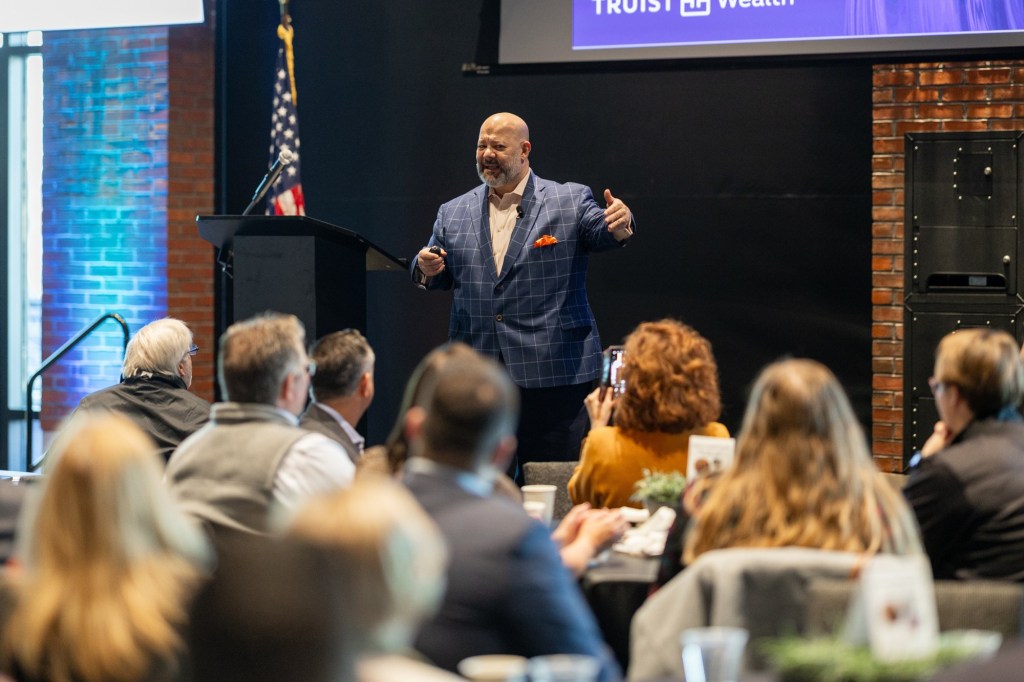
The Greater Reading Chamber Alliance offered its annual Economic Forecast Breakfast for the region’s business community, with insight offered by Michael Skordeles, head of U.S. economics, senior vice president, Truist Services Inc.
Skordeles started his Dec. 3 talk by saying that during 2025, the economy has been “a bit sloppy in a lot of respects.”
“Some of it, yes, is tariffs. Some is behavior because people are trying to adjust to tariffs — maybe preordering goods before tariffs hit, that sort of thing,” he said.
He added that due to the federal government shutdown, which lasted 43 days before ending Nov. 13, a lot of economic data was delayed. Now, he said, that information is starting to come in.
He also pointed out the loss of income during that period for several million furloughed federal workers.
“Plus, don’t discount the fact that those several million federal workers didn’t stop to get a coffee, didn’t go to breakfast, didn’t get their hair cut. That is a real loss of income not just for those federal employees, but for other service sector employees as well,” he said.
Moving into 2026, Skordeles said he expects to see a 2.3% uptick in growth during the year. While that number is below average, he said, “it is an uptick from the 1.8% that I think we’re going to achieve for the full year of 2025.”
He outlined four reasons for the expected uptick:
• Tax incentives for consumers and businesses
• Federal Reserve rate cuts lowering borrowing costs
• Tariff stability, though not full clarity
• Continued artificial intelligence- and tech-led capital spending
There are some risks to that growth, he said, including stumbles in the labor market, inflation that hamstrings the Fed, reigniting trade tensions and additional government dysfunction.
“Nonetheless, I think we’ll see an uptick in 2026,” he added. “I wouldn’t be surprised if it sticks around that average for the next couple of years.”
TARIFFS
While acknowledging that the U.S. has its highest tariff rates in 90 years, Skordeles stressed that what has been subject to tariffs and the impact on the economy is greatly different today than it was 90 years ago.
“We were an export dominated economy and today we are massively a service based economy,” he said.
He stressed that there are challenges ahead with tariffs. The Supreme Court is expected to rule on President Donald Trump’s implementation of tariffs by using the International Emergency Economic Powers Act of 1977.
“But spoiler alert — tariffs aren’t going away,” Skordeles added. “Business is prepared for and has adjusted to and adapted to new trade policy and a shifting dynamic globally, not just in the U.S. — so we’ll have a little bit more stability there.”
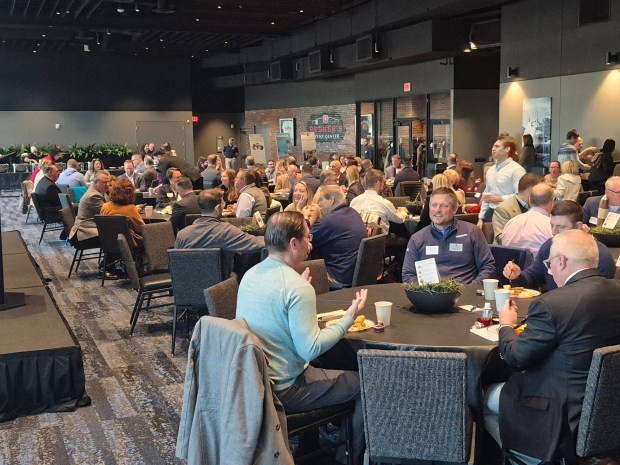 The Greater Reading Chamber Alliance presented its annual Economic Forecast Breakfast on Wed. Dec. 3. An estimated 140 attendees heard 2026 insights from Michael Skordeles, head of U.S. economics, senior vice president, Truist Services Inc. (DONNA ROVINS – MEDIANEWS GROUP)
TAXES
Skordeles sees some tax savings in 2026 that are pro-growth for businesses. On the consumer side, he estimates a 44% increase in federal tax refunds overall in 2026.
“That is not a small number,” he said. “The difference between 2025 and 2026 is roughly the size of another stimulus check.
He did acknowledge that the vast majority of the increased refunds will go to higher income earners, mostly due to changes in state and local taxes.
THE FED
The Federal Reserve’s easing of rates should help lower lending rates. Skordeles said there is a misconception, however, when talking about the Fed lowering interest rates and its impact on mortgage or credit card rates. A 1% decrease by the Fed, he said, does not translate to a 1% reduction in interest rates.
As to when the Fed may issue its next rate cut, Skordeles said it is likely December (at its Dec. 10 meeting) or January, “not both.”
“Especially because of the backlog of economic data I was talking about. Most of our data is stuck in September. We’re not going to get some of the October stuff or November by the time they meet,” he said.
The sad part, he added, is “it’s not about the mortgage rate — it’s about the cost of the house.”
The median sale price of existing single family homes is up 54% from Dec. 2019. Skordeles said in his presentation. New single family home prices, while down from the 2022 peak, are still 25.5% above Dec. 2019.
“They can’t afford the cost of the house,” Skordeles said. “Forget what the mortgage rate is. You can make it zero — they still can’t afford it.”
He added that there is also a shortage of single-family homes in the U.S.
Skordeles estimates housing will remain an issue for the next five years, or maybe longer.
ARTIFICIAL INTELLIGENCE
The AI boom, Skordeles said, “is real.”
In his slides he listed nine companies: Apple; Alphabet; Amazon; Meta; Microsoft; Nvidia; Tesla; Oracle and Intel — saying they are worth more than the rest of the companies in the S&P 500.
“They have hundreds of millions in actual revenue, and real contracts,” he said. “This is real transformational stuff. It didn’t just start in 2025 and it’s not going to end in 2026. This is a long-term trend.
INFLATION
Skordeles said he expects to see an increase in the consumer price index by the end of this year. The increases he expects are in home furnishings, some food items, footwear, car parts and tires.
Gas prices are stable, he added, which is a positive for inflation and consumers.
SPENDING
Consumers, Skordeles said are still spending. Retail and food service sales, hit an all-time high in September, despite a drop in auto sales.
“People are still spending, and this is the reason why — income and wages continue to grow much faster than inflation,” Skordeles said.
The pre-pandemic long-term average for earnings growth was 2.4% per year. The average hourly wage growth for 2025 is at 3.8%.
“Hourly employees are doing better. Their incomes are up. That is why we’re continuing to see spending,” he said.
People are paying their bills, he said, and while delinquencies have seen an uptick, the number are at roughly pre-pandemic levels.
“That’s not to say there aren’t people struggling,” he said.
The Greater Reading Chamber Alliance’s Economic Forecast Breakfast, held at the Redner’s Event Center at First Energy Stadium in Reading, attracted about 140 attendees, the agency said.