
By SUSAN JONES and MARTY LEVINE
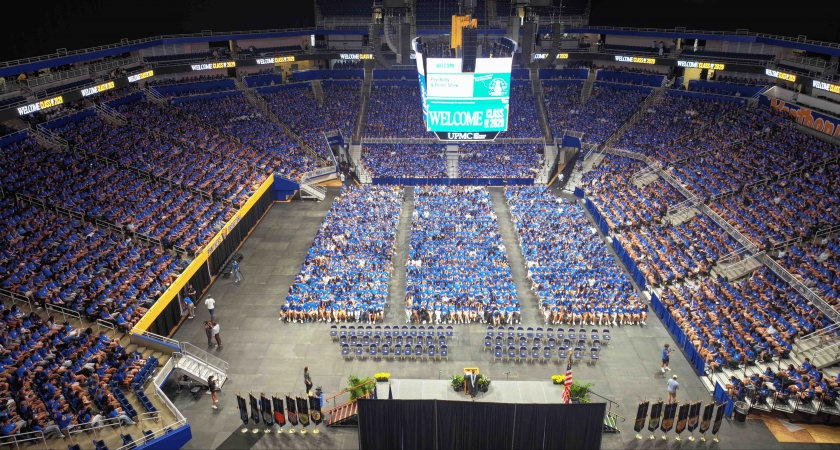
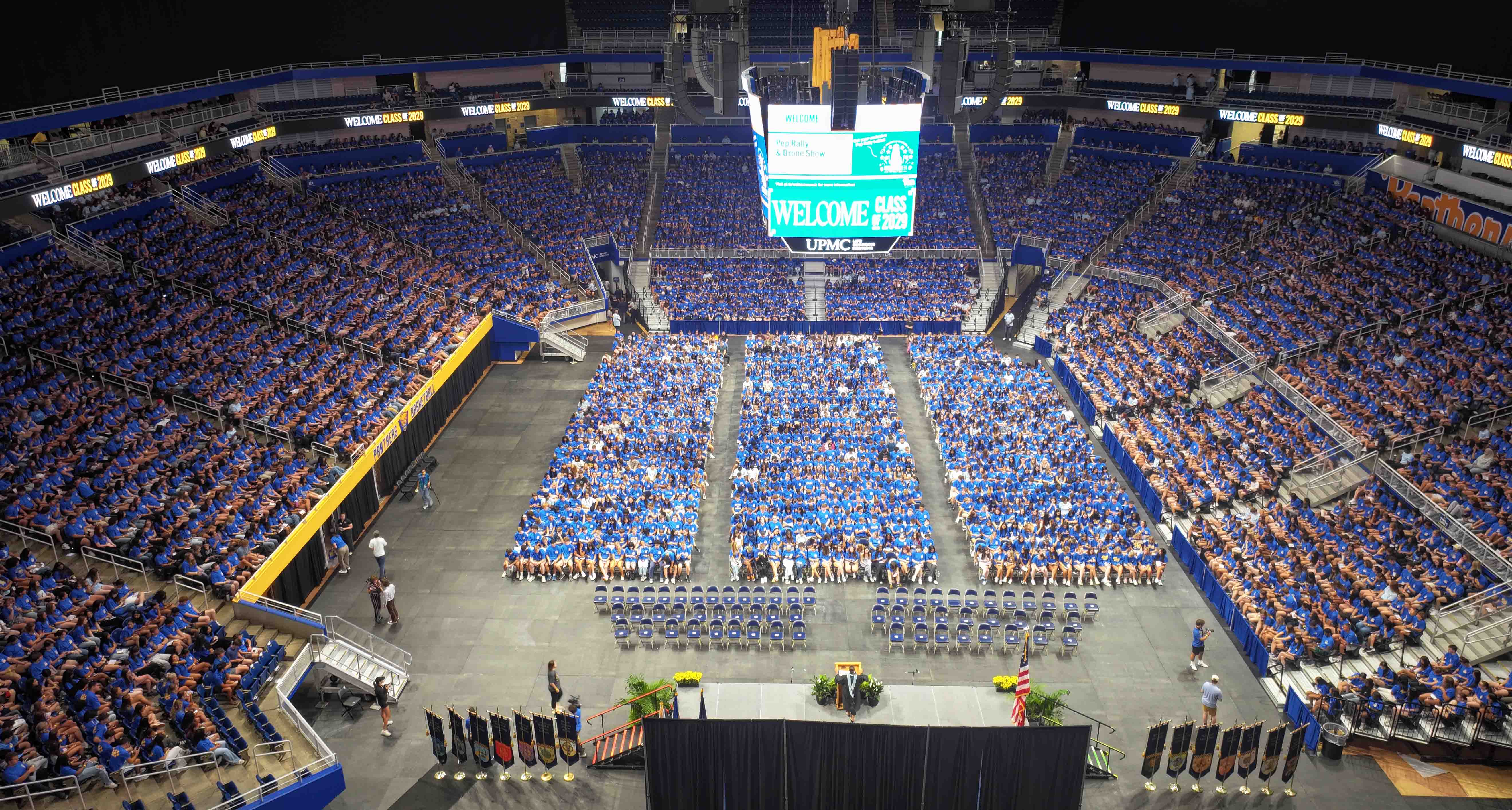
We’ve all heard the numbers by now — 1,300 more first-year students this fall than last, a 25% increase — and heard about the hotel space Pitt is renting to house this record-size class.
But what other impact is this large leap in first-year students having at Pitt’s Oakland campus? This has been a topic of discussion at several Senate committee meetings and watercooler conversations.
As one person asked at a recent Senate Budget Committee meeting, “Is the really large incoming class a good thing or a bad thing, given the costs of finding a place for first-year students to be?”
Thurman Wingrove, Pitt’s controller, replied that the University definitely has had to reconfigure existing dorm space — from singles to doubles and doubles to triples — as well as lease hotels and apartment complexes.
“So there definitely is an additional cost,” he said. “But I think overall, the growth in enrollment, between the tuition, the housing, the dining revenue that comes through, it’s still a net overall gain for the University. But given our shortfall in housing, it does eat into that a bit.”
Amanda Brodish, assistant provost for institutional research and analytics, pointed out that the overall number of undergraduate students on the Oakland campus has only increased about 4.5%. The total for degree-seeking undergraduates this fall is 21,227, which is inching toward the Plan for Pitt goal of 22,000 by 2028.
The large incoming class “replaces the largest undergraduate graduating class we had on the Pittsburgh campus ever this past spring,” she said. “And had we enrolled the same number of students that we had in our first-year class in prior years, our undergraduate enrollment would actually have fallen relative to where we were last year.”
Space concerns
The availability of additional classrooms and instructors to handle the surge in first-year enrollment throughout those students’ years at Pitt were hot topics at the October meeting of the Senate’s Educational Policies Committee.
Adam Lee, vice provost for undergraduate studies, said he began working with the registrar’s office in the spring to look for open classrooms and found “we were able to accommodate” the new student demand, he said.
In fact, he advised, using the registrar’s office to find the best location for a course results in better classroom choices than working only through your department. “There is a lot of classroom availability, actually,” he said, if classes are scheduled outside of the most popular times between 10 a.m. and 2 p.m. “There is room to work outside that constraint.”
He also said, “We’re not always placing things in size-appropriate” classrooms when the choice is open to anywhere. Laboratories, of course, can be more of an issue thanks to the need for specialty spaces.
Lee allowed that there would be added pressure on first-year courses this year, but said, “I wouldn’t anticipate that this is the new normal.”
The larger-than-usual incoming class was “based on externalities,” Lee said. A higher proportion of the students who were accepted by Pitt — out of the record 65,000 who applied — chose to come here. Lee credited Pitt’s “increasing brand strength” for the unexpected uptick, including Forbes magazine’s choice of the University as a “New Ivy” this year.
Dietrich School demand
The Dietrich School of Arts & Sciences, the largest school of campus, has the bulk of the first-year students — about 882, according to Derek Fischer, senior director, undergraduate studies and the College of General Studies. In addition, the school must accommodate students from other schools who are completing the general education requirements.
“We undertook a variety of options to ensure that we had enough capacity in courses to meet the increased demand,” Fischer said. “For example, in some courses, we were able to increase enrollment caps when classrooms could accommodate more students and the increased numbers in the courses wouldn’t negatively impact the quality of the course or instruction. When able, we also added more sections of courses. So, we tried to ensure that we had sufficient capacity in a number of ways.”
Fischer also said the registrar’s office “was a great partner” in helping to find spaces that could accommodate increased class enrollment if the originally assigned room was not large enough.
“Of course, with more students, there are more demands on services but, again, we’ve tried to be as proactive as possible in figuring out ways to meet the increased demand,” he said. “We feel like we’ve been successful in doing that but continue to monitor things and make adjustments, as needed.”
Sybil Streeter, a psychology faculty member in the Dietrich school, reminded people at the Senate Educational Policies Committee meeting, “The fact of the matter is that we’ve got a surge of about 35% in first-year students who are going to be here for four years. I see departments scrambling” to accommodate them. Her department had already created another section of the Introduction to Psychology course for 400 students, she said.
“The crunch for us is going to come as those students move up and through upper-level classes that don’t have the ability to expand,” Streeter added.
Fischer said that the school “continues to work with our departments to ensure that proper planning is happening for future terms, because as this class persists, it’s impact will also be felt with upper-level courses within the discipline.”
Faculty and staff workloads
So what does this all mean for faculty and staff?
At the Educational Policies meeting, committee member Lorraine Denman, a French & Italian faculty member, asked whether the provost would be increasing the budget for part-time instructors. Vice Provost Adam Lee responded that deans and the provost “are looking to address” this issue.
So far, there’s been no increase in faculty, according to the University Fact Book. In the Dietrich School, there were actually 20 fewer faculty members than last fall, when the census was taken at the end of October. Overall, the number of faculty was down 80 people, from 5,702 in fall 2024 to 5,622 in 2025. When the Schools of Medicine and Law, which do not admit undergrads, are removed, the decline in the number of faculty is 129.
A spokesperson for the Union of Pitt Faculty said the union is “aware of significant enrollment cap increases for several courses in the Dietrich School. We were able to negotiate workload consideration for the affected faculty members and assurance that these increases will be taken into consideration on their annual evaluations this year.”
The union encouraged any bargaining unit faculty members who have seen an increase of 10% or more in the enrollment cap for a course they are teaching this semester to reach out to the union local’s griever, Marcy Pierson (mpierson@pitt.edu), a teaching associate professor of music.
Derek Fischer, of the Dietrich School, said advising loads for those dealing with first-year students did increase slightly this year, when compared to last year.
“However, we feel like we’re still in a manageable spot with advising loads, even with more students entering this fall,” he said. “We try to be as proactive as possible when aligning our personnel resources with known or expected changes. When it became clear that we would likely welcome a much larger class, we were able to get some additional advising positions approved and/or vacancies from departure filled in a timely manner.”
Amanda Brodish, of the provost’s office, said at the Educational Policies meeting that “the Office of the Provost has been working closely with academic advisors within all of the schools to really support the advising process for first-year students, to create a more consistent experience for those students, and I think that served us well with this increase in that first-year class.”
Dining issues
The Pitt News in late October quoted some workers at The Eatery who said there’s been a noticeable increase in students at the dining hall, and that understaffing is a big issue, resulting in some staff working longer shifts.
John Longo, vice president of operations for Chartwells Higher Education, which manages Pitt’s on-campus dining, said that staffing levels are continuously evaluated based on student demand and operational needs. He did not provide any specific numbers on whether Chartwells has added staff.
“As student traffic and dining patterns shift throughout the academic year, … we adjust our staffing levels to ensure we are meeting those needs,” he said. “This flexibility allows us to maintain consistent service and quality for our guests.”
Chartwells worked with the University in preparation for the large incoming class to understand what the volume would be and adjusted staffing levels, expanded menu offerings and optimized service hours and locations to meet increased demand, Longo said.
While the Pitt Eats team is “dedicated to providing timely service across all campus dining locations. During periods of high demand, service may take a few extra minutes,” he said.
Because the stations at The Eatery focus on fresh, plated-to-order and personalized meals, service times can get longer. Longo said the peak hours are now displayed at the entrance to The Eatery, to help students plan their visits.
“Our team works to ensure all stations are consistently replenished throughout mealtimes,” he said. “Batch cooking at each station allows us to maintain high-quality offerings while producing food throughout the day. Plate counts are closely monitored at every station, and production logs are reviewed daily to guide adjustments and meet demand efficiently.”
Pitt also has contracted with Carlow University so that Pitt students can use their meal plans at any of Carlow’s three dining spaces, which are also run by Chartwells. But a Pitt spokesman said this wasn’t done because of overcrowding at other dining locations, “It was to provide Pitt students — especially those on the western side of our campus — with additional places to use their meal plans.” Carlow students have been able to use their meal swaps at Pitt since 2022.
One of the spaces Pitt is leasing this year is the Hampton Inn at 3315 Hamlet St., which is just a couple blocks from Carlow. It houses around 250 first-year students in double rooms.
Susan Jones is editor of the University Times. Reach her at suejones@pitt.edu or 724-244-4042. Marty Levine is a writer for the University Times. Reach him at martyl@pitt.edu or 412-758-4859.
Have a story idea or news to share? Share it with the University Times.
Follow the University Times on Twitter and Facebook.