
By SHANNON O. WELLS
As recent blasts of wintry weather already make traditional fall already seem like a distant memory, a presentation by Bob Chamberlain, Pitt’s emergency manager, on how Pitt approaches adverse winter-weather events seems particularly timely.
Pitt’s Interim Policy on Closure and Class Cancellation, released in 2019, forms the foundation of the process, he noted during his report to the Campus Utilization, Planning and Safety committee at its Dec. 2 meeting.
“We do conduct a review of the protocols and conduct tabletop exercises annually with all Pitt’s senior leadership,” he said. “A lot of people think we were reactionary, just make this stuff up as we go along, but it’s not. We do have a deliberate process for class cancellation and closure.”
Chamberlain provided a rundown on the University’s weather-related safety strategies at CUPS meeting, which also included a discussion on pedestrian safety concerns (see related story) and the Office of Facilities Management’s snow-removal procedures.
Chamberlain provided some definitions of commonly used “winter weather” terms used when events arise:
• Advisory indicates “a significant inconvenience, kind of like we have out there now.”
• Watch suggests conditions are favorable for severe weather, “like if temperatures dropped right now and it was continually snowing.”
• Warning means severe weather is occurring or imminent, “something that’s really going to affect our operations,” he said.
Once a weather advisory is received from the National Weather Service (NWS), Chamberlain’s department continues to track the weather “just to make sure it’s not getting worse,” while contacting Ted Fritz, vice chancellor for public safety and emergency management, and campus public safety officials. That’s to “let them know that, for situational awareness, we have some bad weather coming (in about 48 hours).
“If the weather continues to degrade, (NWS) will put out a weather watch, … and we continue to track the weather,” he said, noting that Fritz, Pitt Police, the Office of Facilities Management, and other entities are brought into the discussion.
Around this point, Fritz will usually notify Dwayne Pinkney, executive senior vice chancellor for administration and finance, of what’s going on.
“We’ll start addressing winter weather tips on driving, on walking around here, being vigilant … You’ll see a lot of messaging coming out at safety.pitt.edu about 48 hours from a big event.”
If the weather escalates within 12 hours of a predicted storm, “we’ll have another Teams meeting with the key players and discuss possible courses of action,” Chamberlain said. “That’s when we’ll also go out on a messaging campaign saying, ‘Hey, we see adverse weather that’s going to affect operations here the next 12 hours.’
“We’ll continue to track it in about three hours from an actual event, or that next morning we’ll have another Teams meeting with those key individuals to determine if we’re going to pull the trigger and say, ‘Hey, we’re going to activate the cancelation or closure policy.’”
What he called the ”hasty decision-making process” comes into play when storm systems are moving particularly fast.
“That’s when I’m sitting in my office in the middle of the day, and I receive an adverse weather warning from (NWS), or Pitt leadership decides, ‘Hey, the weather’s getting pretty bad out here. The roads are getting icy, and we’re making the decision to release the faculty, students and staff early for safety reasons,’” he said.
“If that happens, first thing we do is usually contact the NWS telephonically, just to make sure they’re not hyping everything up.”
If a significant storm is considered imminent, Fritz and Pinkney are brought back into the discussion, with Pinkney keeping Chancellor Gabel and Provost Joe McCarthy informed.
Pitt Police will send out an ENS message, but not before public safety communications and University communications “have put stuff on their website, because you don’t want to send out an ENS message, but then have nothing to fall back on,” Chamberlain said.
The Office of Student Affairs also is notified because they have a “robust social media platform,” he explained.
Snow management
Laura Zullo, vice chancellor in the Office of Facilities Management, said the “magnitude of what’s expected will certainly impact our response.
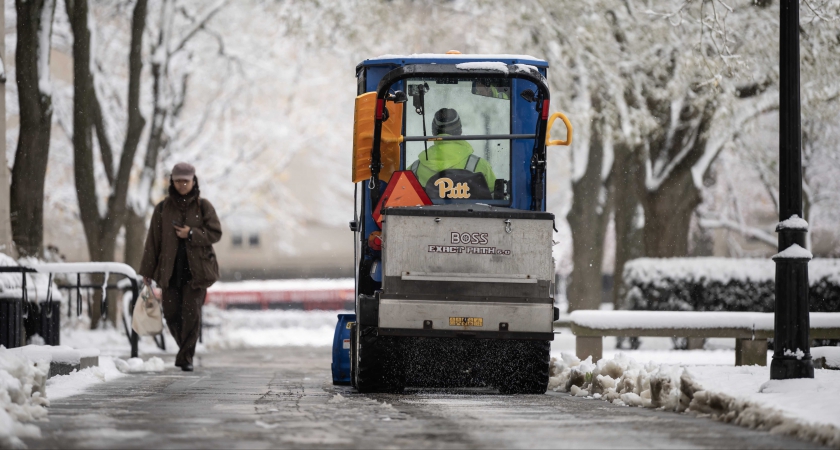
“We do have about 33 groundskeepers who are considered essential employees, and they are (required) to report when called in for inclement weather. Our goal is to provide timely and thorough maintenance in terms of snow removal and control on our streets,” she said of all sidewalks, steps, ramps, parking garages, loading docks, “anything that’s under our responsibility, our expectation is to eliminate any slip hazards.
“If it’s someplace that a pedestrian can be walking, it needs to be maintained,” she added, noting that significant events call for a two-phase approach, starting with clearing one path on sidewalks. “We’ll clear all the ramp areas, maybe one side of the staircase first, just to get an initial path. Especially, we try to do that along a handrail, then after we’ve made the loop once, we’ll take a second pass.
“Once things start to slow down and we can catch up more, we’ll go back and clean up the remaining areas fully,” she said.
Using a “zoned approach” prioritizes ADA ramps, steps, curb cuts and any sloped areas, followed by high-traffic building perimeter sidewalks and some parking lots. “We do use our custodians and laborers to augment our team when it’s a big event.”
In addition to NWS reports, Facilities and Management uses a service called WeatherWorks, “and that’s kind of specific to clearing, (and) treating snow and ice,” Zullo said. “It provides additional detail on the impact of what the weather event might be on pavement — what the freeze temperature, what the ground temperatures are, and things like that. So, that’s helpful.”
If a barrage of snow and ice is inevitable, her department’s crew members have a pre-scheduled, mandatory time to arrive on campus. One recent weather event had crews arriving at 4 a.m. For unforeseen events, crew members will be called as needed to come in “as soon as they can get there to respond to those conditions.
“Until campus is cleared, they’ll be here,” she said, noting accommodations are made to help crew members out if they’re on campus for long stretches. “I’m really proud of the crew. They do a great job.
“You can tell the difference when you come into Oakland — at least from where I drive in from — that we do take it really seriously and try to do the very best to keep the campus safe.”
Shannon O. Wells is a writer for the University Times. Reach him at shannonw@pitt.edu.
Have a story idea or news to share? Share it with the University Times.
Follow the University Times on Twitter and Facebook.