
By MARTY LEVINE
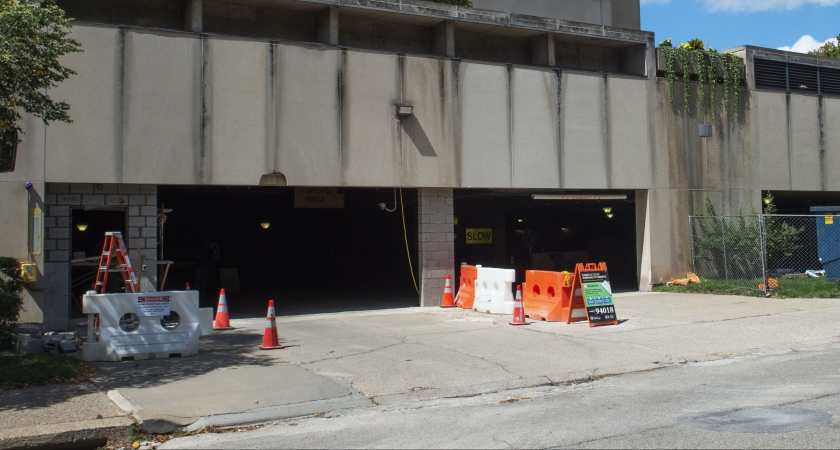
Pitt parking garage renovations and construction on the University Line bus rapid transit project will continue into at least 2027, Pitt Mobility and Pittsburgh Regional Transit officials said at the latest Staff Council Spotlight on Nov. 21.
“Yes, it’s time: Soldiers and Sailors (garage) will be going under renovation, projected to begin in 2027,” said Jonathan Pearson, director of mobility. “I do not have any firm numbers of how many spaces will be eliminated at a time. All of us understand that that garage really needs to continue to be open,” he added, considering its use by both Pitt employees and by many prospective students and their families visiting campus.
The School of Computing and Information garage is still closed for renovations, and work on the garages at Centre Plaza Apartments and Posvar Hall is being spread out over a few years, Pearson said: “Our goal is to keep … doing small portions,” including “another major portion of the project next summer.”
The number of parking spaces on campus, due to the elimination of the O’Hara Street garage for the new Recreation and Wellness Center, is still nearly 200 fewer than pre-pandemic levels, he said. There are 4,543 campus parking spaces, with 3,163 people currently on the wait list, which is reviewed monthly, he noted.
But the number of permits on hold — allowed during the COVID era — is down to 58 today from nearly 500 a year ago, Pearson said. “You need to reactivate your permit or give it up,” those individuals are now being informed.
Asked when there will be more parking offered on campus, Pearson noted that Pitt’s master plan includes the possibility of turning the former site of the Fitzgerald Fieldhouse into parking.
“All this work that is being done is needed,” he said. “Unfortunately, projects do come with challenges.”
Amy Silbermann, Pittsburgh Regional Transit’s chief development officer, said construction on the University Line bus rapid transit (PRTX) project between Oakland and downtown Pittsburgh will stretch into 2027, with “no estimate” when in 2027 it will be completed: “We are still in a place where a lot of things could change” in the plan, she said.
“Yes, we are broadly on schedule,” she added. “We know we have more than 12 months” of construction to go. PRT expects in the spring to be able to announce broad opening dates for bike lanes.
PRT’s work early in 2026 will include eliminating the contraflow lane of buses headed away from downtown on Fifth Avenue. Those outbound buses will all be moving over to Forbes Avenue, likely in February 2026, she said.
The project, when completed, should shorten travel times slightly between Oakland and downtown, but more importantly reduce the current “unreliability” of commute times, with buses bunched together and the lead buses overcrowded, Silbermann said. “There had previously been much variation” in travel time for passengers, she reported.
During the current construction, temporary bus stops — platforms in the street next to the curb — are in place to allow those with mobility issues to reach the bus door more easily. These will eventually be removed when buses can get close to the curb once again.
“There’s a lot of ground dug up right now. … We’re doing a lot of subsurface work” for safety and accessibility at, eventually, 45 intersections in Oakland and Uptown, Silbermann said. That includes ADA compliant curb ramps and crosswalks; new traffic signals; accessible pedestrian signals with push-button activators; pedestrian countdown signals; and expanded sidewalks and shorter crosswalks in some locations.
There will be 24 new glass-paneled metal bus shelters, including one already finished at Atwood Street, that feature ADA-compliant loading zones; fare-vending machines; emergency phones and security cameras; bicycle racks and screens displaying the next bus arrival status.
There also will be “significant bicycle infrastructure (work) going on.” Bicyclists on Fifth Avenue in Oakland, she said, will have a new, protected, bidirectional bicycle track in place of the existing counterflow bus lane, while bicyclists traveling through Uptown will travel outbound with traffic on Forbes Avenue and inbound on Fifth Avenue.
Stormwater infrastructure is going into 18 places on the University Line: 13 spots with underground storage trenches and five locations with trenches topped by rain gardens.
Pearson outlined other mobility developments, including:
Bicycling: There are now eight free bike rooms on campus, with the ninth to open soon at Pitt’s new building at Fifth and Halket, along with 48 bike lockers and about 400 bike racks with a capacity for more than 1,600 bikes. The University is replacing its coat-hanger-style racks with inverted U-shaped racks that offer space to lock bicycles in two places.
Pedestrian safety: The Fifth Avenue and Bigelow Boulevard intersection now allows pedestrians to cross in all directions, including diagonally, when walk signs are on. “All the feedback that my office has gotten has been very positive,” he said. “Fifth and Bigelow is much safer now.” At Terrace and DeSoto streets, bike lanes have been installed, and lanes have been marked where cyclists will be in the normal travel lanes, while city parking enforcement is monitoring for illegally parked cars, especially since they block sight lines for pedestrians watching for moving cars.
Buses: The University continues to offer fare-free PRT bus rides with a Pitt ID (via a mobile app or ID card), with last fiscal year’s ridership of 3,685,823 approaching pre-COVID levels of 4,302,511. “The plastic card is not going away,” he said. PRT is also discussing the possibility of widening Bates Street, with perhaps a dedicated bus lane, Pearson reported. “I hope it gains traction and comes to fruition,” he said.
Carpooling: Pitt Mobility is working with Pitt Digital to develop a commuter matching app to increase carpooling. “There are definitely employees who live near each other” and could take advantage of this, he said, perhaps meeting at a PRT park-and-ride lot. “I think this would be a great offering in the future.”
POGOH: These publicly available bicycles “have been a huge positive to the University,” Pearson said. Pitt still offers free 30-minute rides: 1,100 people took advantage of one of these in the first year they were available, while 400,000 free rides are projected to be taken this year.
Marty Levine is a staff writer for the University Times. Reach him at martyl@pitt.edu or 412-758-4859.
Have a story idea or news to share? Share it with the University Times.
Follow the University Times on Twitter and Facebook.