
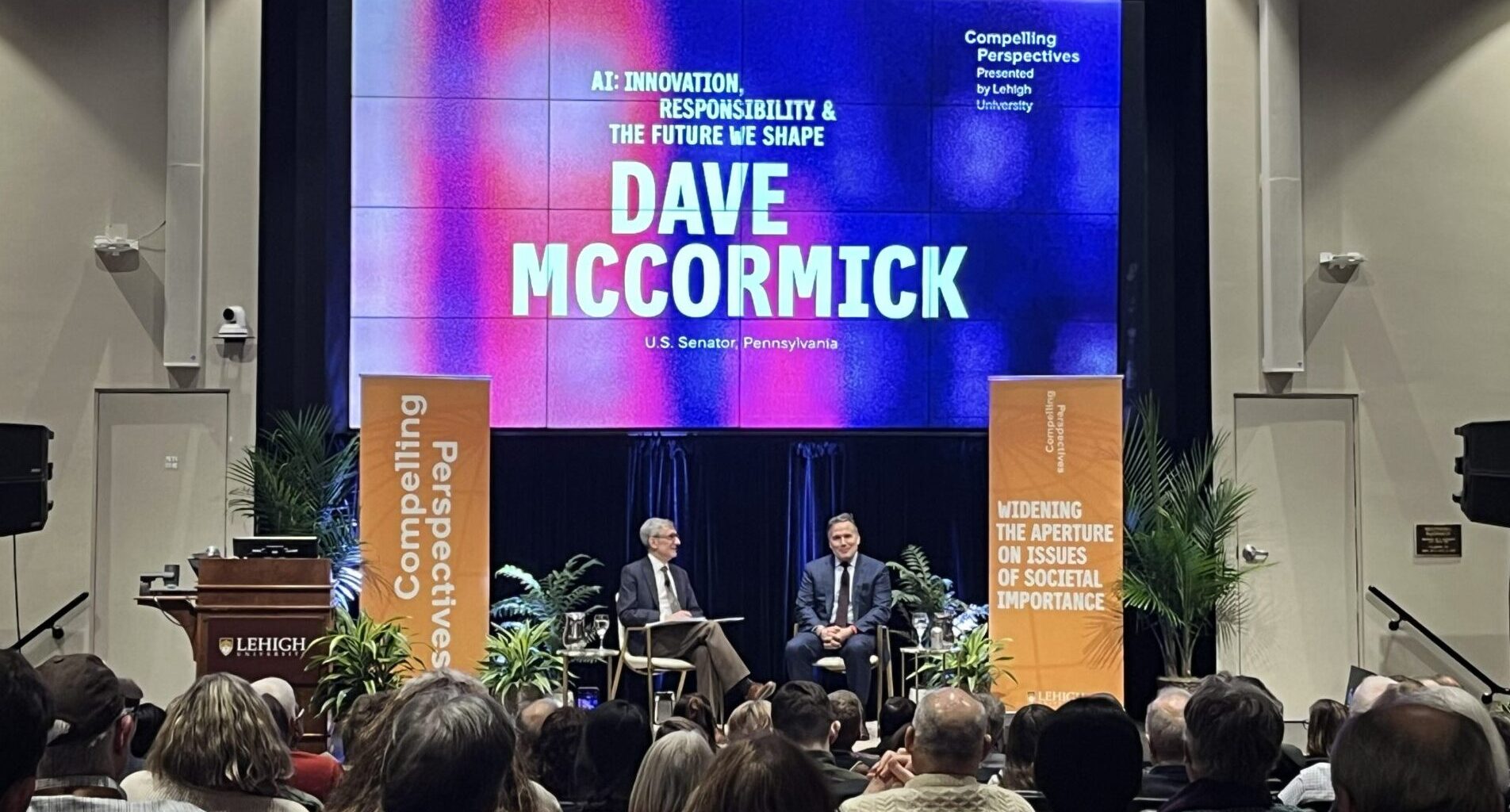
U.S. Sen. Dave McCormick (R-Pa) believes the development of artificial intelligence is the most important occurrence of this lifetime.
While this was the core idea of his discussion with President Joseph Helble on Thursday evening, McCormick addressed various political topics, including universities’ role in regulating AI, Pennsylvania’s increased investment in data centers, and the importance of upholding bipartisan civil dialogue.
McCormick visited Lehigh as the second guest in this year’s Compelling Perspectives series, where selected speakers with a range of views are invited to engage in critical discussion. This year’s theme is “AI: Innovation, Responsibility and the Future We Shape.”
McCormick was elected to his first Senate term in fall 2024. Previously, he graduated from West Point in 1987 and served in the Army in the Middle East during the First Gulf War. He then began a career in business before assuming various government positions including Under Secretary of the Treasury and the Deputy National Security Adviser. Prior to assuming elected office, he was the CEO of the investment firm Bridgewater Associates from 2009-22.
After discussing his background, Helble asked McCormick about his views on talent, technology and data, which he refers to as critical contests in the race for global supremacy.
McCormick said he believes those three aspects are of utmost importance because technology is the foundation of progress, attracting talent is the main driver of innovation, and data is a new strategic currency.
He said it’s crucial to take part in bipartisan conversations to improve and sustain these sectors. McCormick said this is especially important in Pennsylvania where he represents people with a range of political ideologies, including those who did not vote for him.
“We’re the swingiest of swing states,” he said. “You can’t get anything done without working across the aisle.”
Helble then asked McCormick how he believes the U.S. can improve the number of students attaining STEM degrees, particularly in comparison to China.
To address this, McCormick said the government should invest more in research and development.
He also said it’s important for the country to prioritize attracting immigrants and talented individuals who choose to stay in the U.S. and drive innovation.
“The narrative is we’re a country of immigrants, and we want to be welcoming to legal immigration,” McCormick said. “We probably need to reform our immigration program, because we need to make sure that we continue to be that shining city on the hill that attracts the most spectacular talent in the world.”
Throughout the topics discussed, McCormick emphasized the importance of maintaining a balance between the government and the private sector.
He said the private sector should drive innovation without the government stepping in to be a source of capital for failing businesses. Rather, the government should focus on creating and sustaining an ecosystem that attracts talented people.
“The private sector is going to drive most of this innovation if the government helps create the ecosystem where it will work,” McCormick said.
On Nov. 24, the White House announced the Genesis Mission, a plan to incentivize private sector participation in AI-driven scientific research, among other AI focused objectives.
Helble said the Genesis Mission lacks a distinction of how higher education is involved in AI research. He said this worries him because universities have long been originators of technological breakthroughs.
McCormick said he thinks there are three sectors he sees as core to the research system: federally funded research facilities, the private sector and, in an ideal world, universities.
However, he said Americans are generally losing faith and trust in higher education institutions, particularly in elite universities.
McCormick said he instead believes universities are carrying out politically-motivated research causing students to not be exposed to conflicting ideas across the political spectrum.
Helble disagreed with McCormick, and said while universities have lacked transparency in the past, particularly in areas involving costs and financial aid, there needs to be more of an understanding from the public and the government that universities are going to be “messy.”
“(Universities) are going to be a little bit messy, chaotic, and I think that’s great to have a process that lets ideas emanate from the faculty,” Helble said. “Not every idea is going to be a great one, but it allows us to find ways to do the best in the full range and see what fits.”
The two then discussed budget cuts to the National Science Foundation, which often funds university faculty research. The NSF’s budget has been reduced from around $10 billion to $3.9 billion for 2026, according to their Congressional Budget Request.
McCormick said he supports this cut because he believes there is a lack of transparency in the NSF’s funding methodology, particularly in how it calculates indirect costs and personal work.
“We have to make sure that the taxpayers know they are getting a fair deal,” McCormick said.
He said this is also why he supports the increase in the endowment tax of larger private universities.
Helble said while it is understandable McCormick is concerned about the ways well-funded, elite universities use their funding, he’s unsure the money would be put to better use in the hands of the federal government. He said that could cause the funding to get lost in the federal budget, and it could be more useful for universities to be able to directly invest it in infrastructure and research.
In response, McCormick said he wants universities to be able to accomplish those investments, but he doesn’t believe this is something they can be trusted with currently.
“Once we have people running these institutions who are good people with good values and want the right things, and want to design and compact it, it’s going to be much better,” McCormick said.
When the discussion opened up to questions from attendees, Carol Obando Derstine, ‘22G, who is running for Pennsylvania’s 7th Congressional District, asked McCormick what his plans are to safeguard working families and small businesses from paying for data centers.
Pennsylvania has seen an increase in data center development, including a $20 billion investment in July being the largest private sector investment in the state’s history, according to Pennsylvania’s Department of Community and Economic Development.
In response, McCormick weighed the net good and bad of being a state that’s a “winner” of AI innovation in the energy sector. He said the positives include job creation and improved economic activity that increases wages.
He said his biggest concern is not getting the timing right, with the potential for a spike in energy demand happening before the capacity is fulfilled. McCormick said he believes the best way to mitigate that possibility is by having a dedicated power source that exceeds the center’s needs and puts additional energy on the grid.
Julie Wright, ‘25, asked how McCormick can ensure investing in data centers is something Pennsylvanians want and are engaged in.
McCormick said he believes the reason Pennsylvania is investing in data centers is to be at the forefront of a moment of enormous change that could bring prosperity to its citizens.
He said it’s important to consider negative externalities, such as an increase in energy prices, but it’s also necessary to weigh the genuine positive impacts it could have on the community.
“I want to be able to stand up and say that I’m convinced the opportunity is good for everybody, and that it’s not giving great advantages to a certain set of wealthy people and not helping everybody,” McCormick said. “I know others are not convinced yet, and I think it’s a totally legitimate debate for us to be having.”
In a following interview with The Brown and White, McCormick discussed more specifically the roles a university plays in the future of AI and how to uphold civil dialogue at higher education institutions.
McCormick said universities must determine the best way to ensure students receive the benefits of AI without losing the ability to think rigorously.
He said universities must step back and ensure they are creating good thinkers who don’t need to rely on AI to solve problems.
McCormick also said higher education institutions are uniquely positioned to expose students to new ideas and that they play a large role in creating a space where students can engage in civic discussions.
He said students should intentionally seek out people they disagree with to understand differing perspectives.
“I will engage in a civil discussion with anybody about anything, even if they’re totally against me,” McCormick said. “I think that’s what’s required to gain an understanding.”