

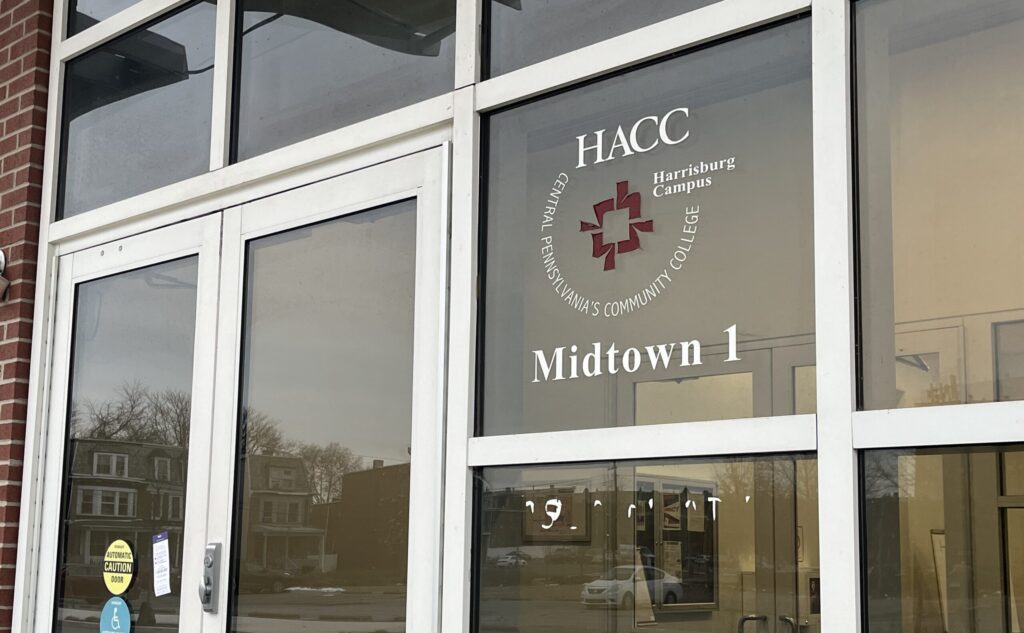
A Midtown HACC campus in Harrisburg on Dec. 8, 2025. Unionized faculty had a two-day strike in November, a rarity for Pennsylvania’s community colleges. (Whitney Downard/Pennsylvania Capital-Star)
With frustration mounting, unionized faculty at a central Pennsylvania community college came to an unusual decision in the early days of November this year: they were going to pressure HACC administrators at the negotiating table by leaving their classrooms for a two-day strike.
But while nearly every community college in Pennsylvania has a union, picketing professors are a rarity in the commonwealth.
Such collective action doesn’t happen on a whim, as Chris Lilienthal told the Capital-Star. Lilienthal works as the assistant director of communications with the Pennsylvania State Education Association, which represents roughly 1,000 local union associations at K-12 schools and community colleges.
 Harrisburg Area Community College
“Strikes are very rare, both in the community college setting or the higher education setting, as well as in the K-12 setting,” said Lilienthal, speaking generally. “It’s really a situation where the negotiators on the teachers (or) faculty side have really hit a wall and they’re not getting anywhere with the school or college.”
The full union membership votes on whether to pursue a strike — a decision union chapters at HACC and Luzerne County Community College made last month. But while HACC’s professors spent two days striking, unionized faculty at Luzerne Community College avoided such action when contract negotiations restarted.
Similarly, the Community College of Philadelphia was able to reach a contract with faculty before a strike occurred last spring.
“Our members, they don’t want to go on strike; they want to be in the classroom,” said Lilienthal.
Lilienthal said negotiations for first contracts with new unions can often be lengthy, but called the three-and-a-half year process at HACC “very unusual.” The community college has campuses in Harrisburg, Lancaster, York, Gettysburg and Lebanon.
Negotiations took several, contentious turns, including arrests, alleged violations of transparency laws and accusations of union-busting.
Despite the rocky road, union president Christine Nowik said she’d do it again.
“I would absolutely advise it. I advise it for any industry at this point. Collective power is, at this point, the only power,” Nowik told the Capital-Star.
Nowik, an English professor at HACC’s York campus, became president roughly one month ago, just before the strike began.
For their part, HACC administrators said they were “grateful” to reach the agreement, which was unanimously approved by the Board of Trustees last week. Most releases since the Oct. 2 vote by the union authorizing the executive committee to strike have included minimal updates, instead emphasizing the following “core principles” in a contract:
Prioritizing student successSupporting the affordability of its offeringsProviding all employees with comparable benefitsIncreasing wages for all employees while ensuring fiscal stability, as outlined in the College’s strategic plan Background
The National Center for the Study of Collective Bargaining in Higher Education and the Professions reports that the number of unionized faculty grew 7.5% between 2012 and 2024, while graduate student employee unionization increased by 133%.
The center, based out of Hunter College in New York City, tabulated 902 collective bargaining units in higher education into a lengthy directory, including student and staff agreements. Each state governs and funds their community college system in a unique manner, complicating efforts to neatly categorize schools.
The states with the highest numbers of unionized faculty are California (93,705), New York (87,848) and New Jersey (25,549). Over three-quarters of Hawaii’s faculty (76%) have union representation.
Pennsylvania has 17,786 faculty members that are part of a union, roughly 26% of all faculty.
Faculty members at public, two-year institutions – like HACC – were slightly more likely to belong to a union than not — whereas public and private schools were the opposite. Fifty-two percent of faculty at two-year institutions belong to a union, compared to 33% of public, four-year faculty members and 8% of those teaching at private schools.
According to the center’s directory, just one of the commonwealth’s 15 community colleges doesn’t have a faculty union: Erie County Community College.
SUBSCRIBE: GET THE MORNING HEADLINES DELIVERED TO YOUR INBOX
The Pennsylvania State Education Association represents six community colleges, while the remaining eight schools have affiliates under the state chapter of the American Federation of Teachers.
Lilienthal said salaries and benefits were common motivations for organizing, whether at a community college or a K-12 school, alongside working conditions like classroom sizes.
“They’ve put a lot of time and a lot of money into becoming those professionals and into building those professional credentials. They deserve to be paid commensurate with that,” said Lilienthal.
The union at HACC represents faculty members at all five campuses. Though compensation and benefits played a role in the decision to form a collective bargaining unit, Nowik said working conditions became “untenable,” pointing at HACC administrators.
“The trajectory of this style of leadership has not been a good fit for the organization,” said Nowik. “It’s morally injurious for us not to push back on the things that we know are directly harmful to students.”
Moving forward
Pennsylvania has a long history with the labor movement and remains a strong union enclave, allowing for collective bargaining under both the Pennsylvania Labor Relations Act and the Public Employee Relations Act. The Bureau of Labor Statistics estimates that 12.4% of working Pennsylvanians are represented by a union.
Despite this familiarity, Nowik said that central Pennsylvania didn’t have the same approach, contributing to the list of reasons why HACC is one of the last schools to unionize, despite being the largest and oldest community college in the state.
Need to get in touch?Have a news tip?
Most peer schools appear to have established their collective bargaining units back in the 1970s.
“This faculty here has been so beaten down and stripped of any voice and power. That feels very disconcerting; it feels very unsettling,” said Nowik.
Union membership has been falling nationwide for decades, but Nowik said she believed that Generation Z would turn the tide, in part due to frustrations related to power inequality and wage disparities.
“If you are not looking at that landscape and seeing that the only pathway to sustainability for our public institutions is through collective action, then you need to do your research,” said Nowik.