
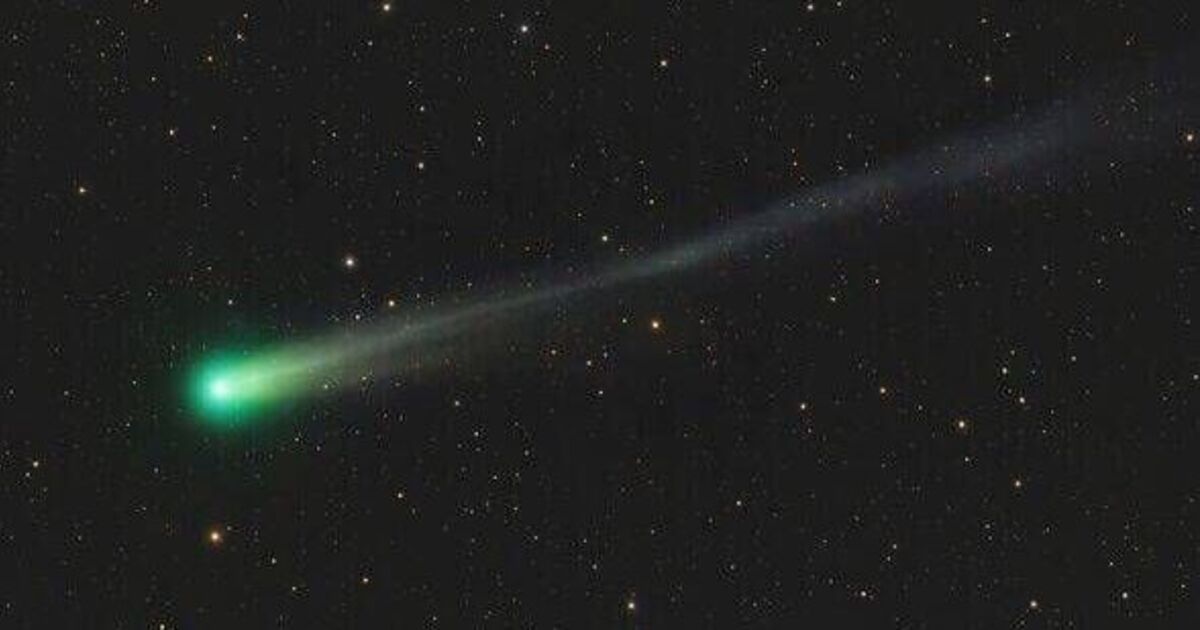
Publishing his findings in the Journal of the British Astronomical Association, planetary researcher Mark Matney has pinpointed a comet spotted by Chinese stargazers in 5BC as the likely culprit.
Since historical evidence points to Jesus’s birth occurring around 6BC or 5BC, the timeline appears to align perfectly. Additionally, Mr Matney’s analysis indicates this comet would have become visible during a June morning in 5BC.
Mr Matney explained that travelers heading south toward Bethlehem would have observed the comet appearing to move ahead of their path. His research concluded: “A comet candidate has been presented that can explain all aspects of Matthew’s pericope. A comet orbit can be constructed that both fits the Chinese observations and passed very close to Earth in early June.
“On one particular June day, this comet could have moved in such a way as to appear to ‘go before’ someone travelling from Jerusalem to Bethlehem and then ‘stop’ nearly overhead for about two hours.
“This unusual comet motion would have occurred during daylight, when ancient people would normally travel…the candidate presented here corresponds to all aspects of both the Chinese observations and the descriptions of the Star in Matthew.”
This marks yet another instance of a scientist applying scientific analysis to the life of Jesus. Earlier this year, British anthropologist Dr Paul Warner made bold claims about discovering Jesus’ body and the Ark of the Covenant beneath the Great Pyramid of Egypt.
After presenting his discoveries to the Egyptian Supreme Council of Antiquities, Dr Warner asserted that these ancient relics had been concealed within a dual cave system deep within the pyramids.
He suggested that these artifacts might be located behind a stone block that seals the subterranean chamber’s southern corridor, though he acknowledged that additional research would be needed to validate his hypothesis.