
A Painter’s Secrets
The Barnes Foundation
October 19, 2025–February 22, 2026
Philadelphia, PA
Henri Rousseau, an artist known for his dreamlike jungle scenes and uncanny portraits of identical mustachioed men, has long fascinated art historians. Yet his life and work remain, at heart, enigmatic. Henri Rousseau: A Painter’s Secrets, now on view at the Barnes Foundation (and traveling to the Musée de l’Orangerie in Paris next year), resists the impulse to decode him. Instead, through an incredible curatorial feat bringing together nearly sixty major works, the exhibition revels in his strangeness, the peculiar poetics that make Rousseau’s art as confounding as it is delightful. It’s a show that chronicles the absurdities for both pleasure and reflection and embraces the fun of not knowing. And, it’s a show that is only fitting to be shown at these two institutions, which together hold the most significant collections of his work in the world.
Perhaps the most persistent misconception about Rousseau is that his celebrated jungle scenes—teeming with monkeys, tigers, and lush tropical foliage—were inspired by firsthand experience. In fact, Rousseau never left France. His visions of the exotic were assembled from sources close to home: the botanical displays at the Jardin des Plantes, illustrated books, and taxidermy. Unlike contemporaries such as Paul Gauguin, who traveled abroad and exoticized the cultures he encountered, Rousseau’s imagined jungles are less colonial fantasy than childlike invention—celebrations of the imaginative rather than appropriations of the foreign. Amazingly, Rousseau did little to correct the myths surrounding his supposed travels, allowing the fiction and mysticism to add to his persona.
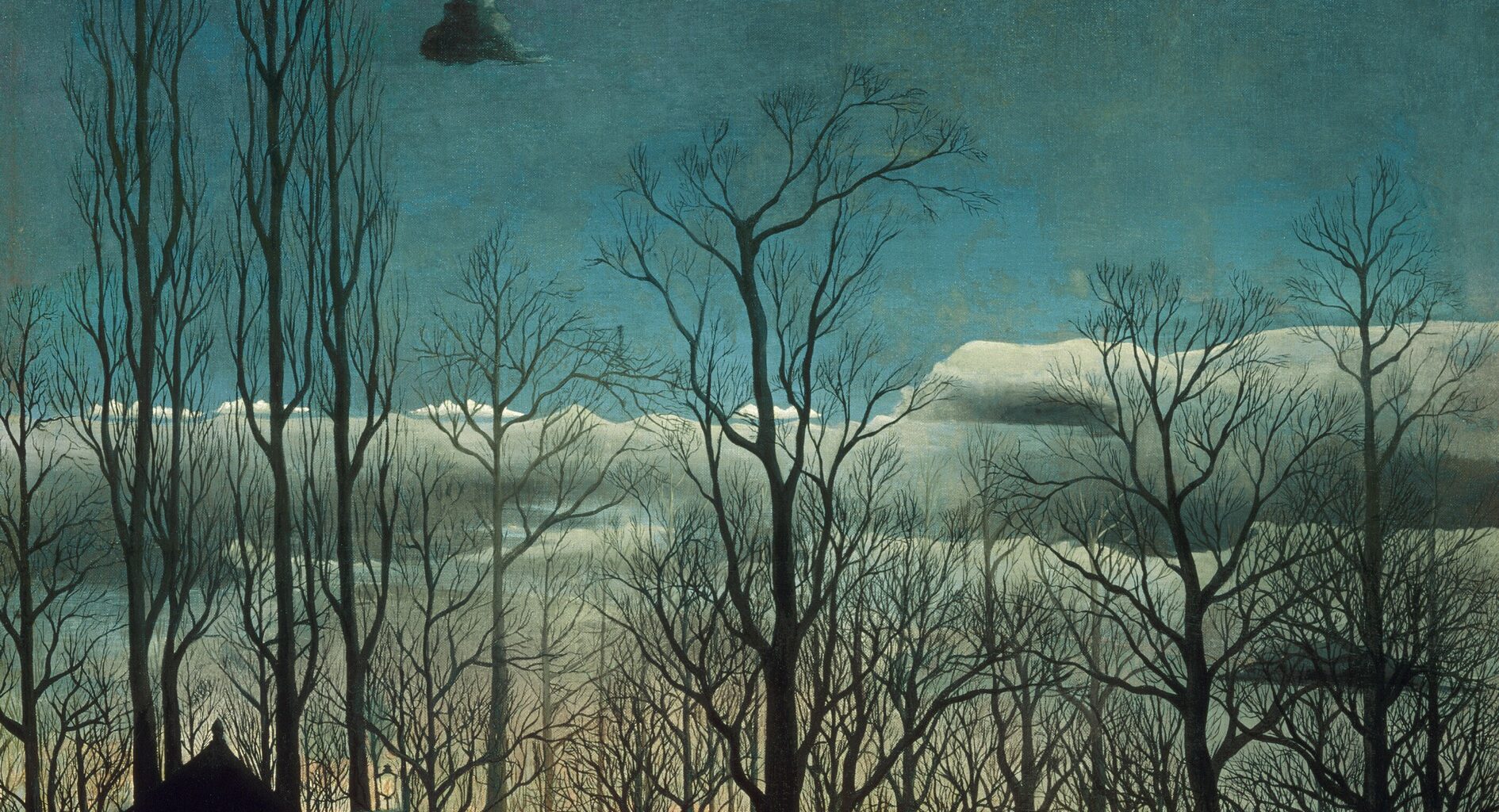
His lack of travel, paired with his self-taught status, accounts for the distinctly flat, awkward style of painting for which Rousseau is known. This is made clear at the start of the exhibition with bizarre scenes of marriage and displaced women who find themself in faraway landscapes. In one early work from 1899, Rousseau commemorates his second marriage to Joséphine Noury by portraying himself and his betrothed in a lush pastoral landscape. Floating in the clouds above, however, are the heads of Rousseau’s first wife and Noury’s late spouse, honoring the new union. At the time, spirit photography—in which photographers attempted to capture images of ghosts—was in vogue. In other works on view in the first gallery, well-dressed women in petticoats and gloves are seemingly plucked from the cafes and streets of Paris and inserted in lush forests or spooky, desolate landscapes. In Carnival Evening (1886), the first painting he exhibited at the Salon des Indépendants, Rousseau depicts a couple dressed up in carnival attire, a Pierrot and a Venetian ball gown, set in an eerie evening in the woods, the trees spindly with wire-thin branches. These scenes of clandestine encounters in the forest reflect the influence of popular romance novels of the time, in which the allure of mystery and unresolved narratives captivated readers and viewers alike.