
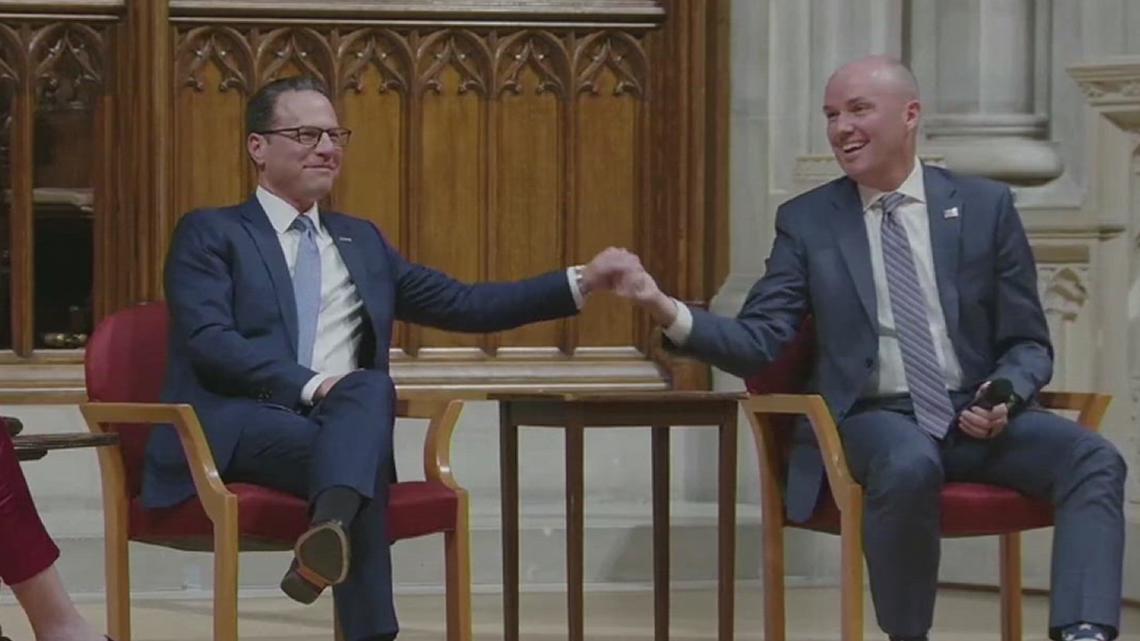
Pennsylvania Gov. Josh Shapiro and Utah Gov. Spencer Cox sat down for a conversation at the National Cathedral in Washington, D.C. on the rise of political violence.
WASHINGTON — Two governors came together on Tuesday for a discussion on political violence — a topic that has hit both of them close to home this year.
Pennsylvania Gov. Josh Shapiro (D) was joined by Utah Gov. Spencer Cox (R) at an event at the Washington National Cathedral in Washington, D.C. aimed at exploring the state of American politics and the rise of political violence.
While the two men belong to different parties, Shapiro and Cox agreed they had plenty in common. Both are fathers of four, belong to Gen X and have worked to cross party lines.
“We both have a lot more in common than that; we both married our high school sweethearts,” Cox said. “And we both married way up,” Shapiro added.
Earlier this year, Shapiro was targeted in an attack on the Governor’s Mansion in Harrisburg that saw an arsonist set fire to the residence. That attack, in the early hours of April 14, prompted Shapiro, his family and guests to evacuate.
For Cox, political violence came to the forefront of his mind with the assassination of conservative activist Charlie Kirk at an event in Utah on Sept. 10. When Cox got the news, it was Shapiro that reached out to offer his support and guidance, he said.
The two events aren’t isolated incidents, either. In June, a gunman killed two Minnesota state legislators at their homes outside Minneapolis. Last year, a man attempted to assassinate presumptive Republican Presidential nominee Donald Trump in Butler, Pa.
While the governors agreed on many issues, they also expressed a willingness to “disagree better” — a phrase that comes from the name of one of the nonprofits that partnered to host the event.
One such issue was the prospect of banning social media use by children. Referencing a recent ban for children under the age of 16 in Australia, Cox suggested such a ban would combat the corrupting effects of social media.
“These are the opioid companies of the early 2000s,” Cox said.
When asked if he would agree to a ban, Shapiro said he would rather see a focus on teaching digital literacy and other ways to limit harmful effects.
“I think it is important that young people learn about these tools, they are empowered to use them responsibly,” Shapiro said. “While at the same time, those of us in positions of authority hold these companies accountable.”
While they disagreed on a ban, that disagreement does not have to turn ugly.
“If I go around, saying that everybody who likes social media is an evil person, I’m probably not going to get the bill passed,” Cox said, explaining that American democracy requires people to work through differences. “I’ve got to work with people who disagree with me, so I’ve got to treat them with respect. I’ve got to listen to what they have to say.”
More that binds Americans than divides
Shapiro emphasized the importance of faith in tying political opposites together. While Shapiro is Jewish and Cox is Mormon, both men share a religious focus.
“We are both called to serve others,” Shapiro said.
Four days after the arson attack at the governor’s mansion, Shapiro’s family served firefighters a lunch at a local firehouse. At that lunch, Shapiro said, John Wardle Sr., the chaplain of the Penn Township Volunteer Fire Department handed him a letter signed by each member of the department.
“He asked me to turn it over,” Shapiro said. “When I turned over this paper, handed to me by a chaplain of 82-years-old, registered from a different political party, from a different era, a different hometown — he had written is favorite prayer on the back.”
That prayer, Shapiro explained, was the Priestly Blessing (Numbers 6:22-27) — a prayer that he and his wife say over their children at night.
“There’s a universality in our humanity and in our faith. There is more that binds us as Americans than divides us. The answers to so much of the darkness that we see in America today is the light that ordinary Americans bring each day, oftentimes grounded in faith and in our shared humanity.”