
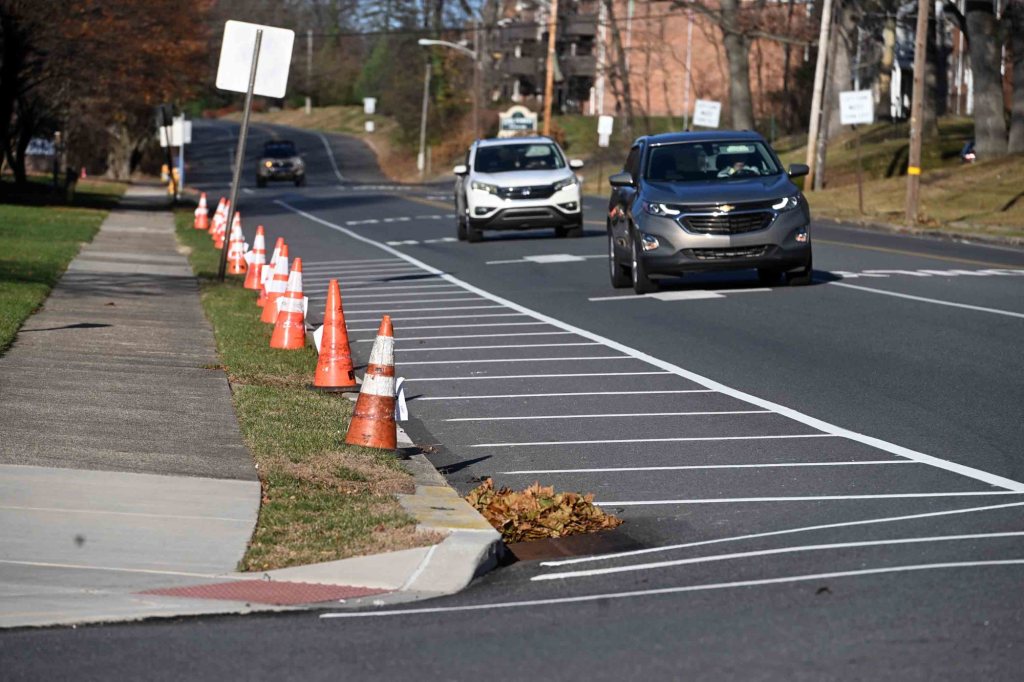
Some residents along Hampden Boulevard are unhappy with the recent elimination of curbside parking at four intersections on the boulevard.
City Council members say they have been flooded with calls and emails since zones were painted to prohibit parking within 20 feet of the boulevard’s crosswalks at College Avenue and Robeson, Perry and Amity streets.
Council delved into the issue during a meeting after hearing complaints from residents who say they can no longer park near their homes.
The new no-parking zones stretch far beyond what several council members said they were led to expect.
The restrictions were approved by council in March under a PennDOT-supported safety initiative intended to improve sight distance and reduce crashes along the corridor.
Hampden Boulevard is a state road under PennDOT’s authority, and the agency’s consulting engineers recommended the removal of curbside parking at four intersections following a study of speeding and crash patterns.
The recommendations were presented at a public meeting at Albright College in April 2024.
“This is definitely one of those, ‘careful what you wish for’ situations,” said Councilman Wesley Butler, who represents neighborhoods along the boulevard.
The problem is not that residents were unaware of potential parking changes, he said, but that the painted markings are far more extensive than residents believed they would be.
The visual materials he reviewed, Butler said, included simple boxes marked with Xs at the corners, not the long diagonal hatching that now spans nearly entire blocks.
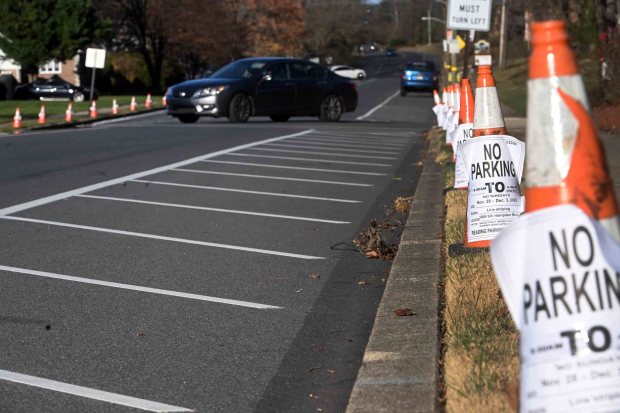 Hampden Boulevard is a state road under PennDOT’s authority, and the agency’s consulting engineers recommended the removal of curbside parking at four intersections following a study of speeding and crash patterns. (BILL UHRICH/READING EAGLE)
Butler said the diagrams shown at last year’s meeting depicted only limited restrictions. He has been unable to locate the earlier diagrams, he noted, requesting a full review of the images and correspondence provided to residents.
City Engineer Timothy Krall said the lengths of the no-parking zones match exactly what was presented at the 2024 meeting, with only one small adjustment made later to accommodate a request from a dental office at 13th and Pike streets.
Residents’ views
Finding a parking space along the boulevard has been an ongoing challenge, said one resident, who wished to remain anonymous. The zones have only made it harder, he said.
Many of the home owners in the first two blocks of the boulevard, he said, are owned by senior citizens, who can no longer park in front of their homes.
While he understands the no-parking zones are intended to improve sight lines and cut down on accidents, the resident does not believe they will help.
“Everyone drives too fast on Hampton Boulevard,” he said, “so you know traffic lights, stop signs or speed traps would have been the way to go, not taking parking spaces from dozens of people when there’s already not enough parking in the city.”
Several residents took to social media to express their frustration over the loss of parking spaces with similar comments.
Visibility is not the problem, they wrote, urging the city to crack down on those who speed or pass unsafely on the boulevard.
One commentor said there was not adequate public outreach and notification before the meeting last year.
“The way this was handled feels like it was done behind closed doors,” he said, “and the residents impacted aren’t going to just accept that quietly.”
But at least one posted in support of the effort, saying that after two fatal motorcycle crashes in the same block near Pike Street in 2023, she welcomed any measure that might potentially save lives.
The extended sight-distance zones are based on PennDOT engineering standards and crash data, Krall said, noting the city has long struggled with speeding and visibility at intersections on Hampden Boulevard.
Improving the line of sight is considered a required first step, he said, even though that step alone is not expected to reduce speeding.
Broader traffic-calming recommendations, including physical measures, will come later as part of a citywide study now underway, Krall noted.
Council questions
Several council members questioned whether visibility improvements alone will make a measurable difference.
Councilwoman Vanessa Campos asked why stop signs were not considered before eliminating so much parking.
Krall explained that PennDOT’s traffic study could not justify stop signs at those intersections based on volume, and that the no-parking zones must be installed before PennDOT will consider stop signs based on safety factors.
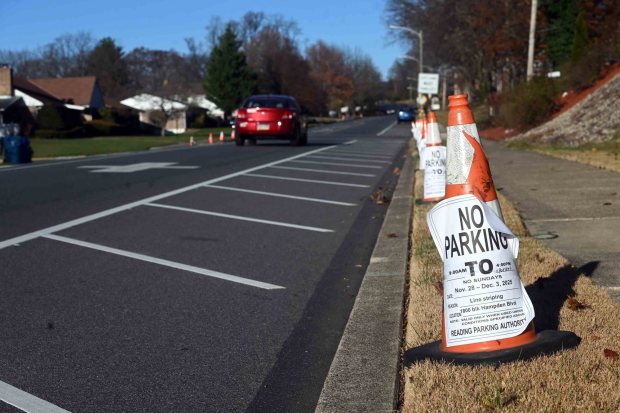 New parking restrictions have been initiated at intersections to increase visibility along Hampden Boulevard. (BILL UHRICH/READING EAGLE)
Council also raised concerns about the burden placed on residents, particularly those living on the east side of Hampden Boulevard, where alley parking is unavailable.
City Solicitor Michael Gombar cautioned council against attempting to restore parking without PennDOT’s approval. He warned that unilaterally shrinking the no-parking zones could increase the city’s liability if accidents occur.
As a possible short-term compromise, he said, council could consider temporarily suspending parking fines in the affected areas while the matter is reviewed. However, Gombar noted, doing so could interfere with PennDOT’s follow-up evaluations, complicating efforts to secure future safety improvements such as stop signs.
Butler said he intends to introduce a temporary moratorium on fines, adding that residents should not be penalized while the city works to clarify what was promised and what options remain.
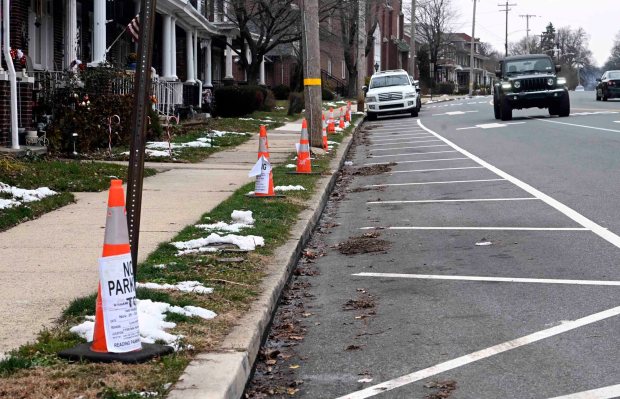 Councilman Wesley Butler, who represents neighborhoods along Hampden Boulevard, intends to introduce a temporary moratorium on fines for parking in restricted areas while the city works to clarify the implementation of no-parking zones on the boulevard. (BILL UHRICH/READING EAGLE)
Council members said they plan to continue discussions, review documentation from last year’s meeting and work with PennDOT to determine whether adjustments are possible without jeopardizing ongoing safety efforts.
A statement issued by council on its Facebook page urges residents to share concerns directly with PennDOT and provides contact information for the agency’s customer call center.
To reach PennDOT, call 717-412-5300, Monday through Friday, 8 a.m. to 5 p.m. Language translation assistance is available. TTY callers, dial 711.