
BCSD postpones vote, parents challenge redistricting elementary schools
DELMAR – The region’s December 2 snowstorm forced postponement of the Bethlehem Central School District’s scheduled vote on a proposition to spend up to $60 million on upgrades to the district’s schools. The district will also continue consideration of re-zoning attendance boundaries for its five elementary schools.
Capital project vote will be next year
At its December 3 board meeting, the district’s board of trustees voted to reset the capital project vote for February 3, 2026. Chief Business and Financial Officer John McPhillips told the board that state law requires a 45 day notice period before a re-scheduled vote can be held. He explained that the public notice process must be completely re-started, including the passing of a board resolution and a new public notice being placed in the newspapers of public record.
McPhilips advised that the February 3 date will comply with the State requirement and provide an additional small cushion of time to hold the vote. He said the date has the added benefit of falling the day before the board meets on February 4, so the board could certify the vote results the very next day.
Board member Katherine Nadeau asked whether the district would again engage in outreach efforts, like it had before the December 2 date, before the next vote. Board president Holly Dellenbaugh confirmed it would.
The capital project is estimated to cost about $60 million, but the district has assured district taxpayers in written statements that the project is “budget neutral, with no additional local tax impact for residents.” Of the $60 million expenditure, New York State building aid is to pay 71.8% of “eligible capital building projects”, with the remainder coming from the district’s $16.6 million capital reserve fund, and also from savings offset from final pay off of debt from prior capital projects as the new comparable debt payments are added.
The district did not respond to questions as to whether any portion of the capital reserve fund will remain for emergency use, or the present status of the capital projects approved in 2021 and 2023 totalling $45 million. As of May 2025, those projects had yet to be completed.
The $60 million capital project plan includes 137 elements across all district buildings, 34% of which will target classroom renovations and 17% for airconditioning, including several identified “hot spots” and gyms, libraries and cafeterias.
Updates are also proposed for the Elsmere elementary library media center, the Slingerlands elementary kitchen, and renovation of the middle school’s “pit” area for physical education. The project also involves infrastructure remediation, like roof repair and replacement, window and door replacement, paving projects, masonry repairs, boiler replacements and site drainage.
In a statement on the district’s website, district Superintendent Jody Monroe said some students (particularly at Elsmere, Glenmont or Hamagrael) may have to be temporarily relocated for a three to six month construction period within their schools or even to other schools. However, if the proposed project is approved, construction would not begin until spring 2027, at the earliest.
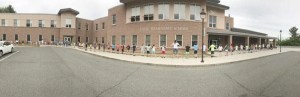 Eagle Elementary School in 2018.
Proposed district elementary school rezoning may also cause disruption as parents raise challenge
At the board’s December 3 meeting, Monroe reported that the rezoning committee would meet again to review community feedback on proposals for rezoning elementary school boundaries provided by Tyler Technologies, an independent consulting company hired by the district. She said the committee would re-evaluate proposed target enrollment numbers and neighborhood planning units.
30 parents, district, faculty, staff and administrators sit on the committee. According to the district’s website, the committee met on December 4 and discussed feedback from a November 20 forum, relating to effectiveness of initial reasoning options, support for walkable neighborhoods and minimizing student disruption. It also provided guidance to the consultant on modeling additional rezoning options for the district to consider.
At the December 3 meeting, Monroe said the board will be presented with final options for consideration at its December 17 meeting. A decision is expected to be made in January 2026.
The district is paying $24,500 for the consulting services.
At the board’s previous November 19 meeting, Tyler Technologies’ representative and Vice President & General Manager Ted Thien presented several options relying on district enrollment projections issued by the Capital Region Planning Commission.
Those options included moving between 128 to 185 students out of the higher attendance schools Glenmont and Eagle into lower attendance schools Hamagrael and Elsmere, but simultaneously moving some students out of Hamagrael.
Several parents spoke out during the meeting’s public comment period against those alternatives.
Parents chided the board for not paying attention to the community’s concerns, particularly those about moving students out of the lower attendance schools to alleviate student populations at Glenmont and Eagle.
A Hamagrael parent said questions have been raised as early as October, but the Superintendent not only failed to address those questions, she never even acknowledged them and said many parent concerns are ignored. He said, “my fear is our message is not being heard and that was sadly confirmed when I looked at the proposals from Tyler Technologies.” He said four of the five proposals moved students out of Hamagrael.
Another parent noted that “community involvement hadn’t moved the needle much” from the original proposals and the board appeared to be “entrenched” in its position.
Other parents raised potential harm to students. One Hamagrael parent cited research that non-promotional elementary school changes cause emotional, behavioral and academic problems. She said under one proposal her child would be moved out of Hamagrael – an underpopulated school – and “arrive at Elsmere knowing no one, with no neighborhood peers, no familiar faces, without built-in friends and his peer group at Hamagrael that functions like siblings.”
“Efficiency should not override humanity,” she said, asserting that legally the re-zoning must be supported by real enrollment stability and demonstrated educational benefit and accused the district of missing that mark. For example, she said treating Hamagrael as both a receiving school and a sending school is “inconsistent, illogical and violates the district goal of minimizing disruption.”
Another Hamagrael parent echoed that concern. She did not understand why a lower enrolled school would be “needlessly vacated” when there is room in those schools for students from overcrowded schools.
A third parent raised concerns about disrupting a rising 5th grader and then one year later disrupting them again to go to middle school.
According to the district’s website, re-zoning is aimed at attendance adjustments at Glenmont and Eagle elementary schools that are at or near capacity, and adding students to the district’s remaining three elementary schools, which school representatives say are “under-utilized.” However, according to the district’s own statement on its website, the district described student enrollment at the 6-12 level as “relatively stable” and states that K-grade 5 enrollment is expected to stay in the 1739-1780 range through the 2030-31 school year.
During the public comment period, parents also questioned, based on enrollment projections, the district’s rationale for re-zoning. One parent asked, “when overall enrollment has been in steady decline and when the long range projects show steady enrollment and when the community is overwhelmingly uncomfortable with these proposals, how can these boundary changes be the only answer?”
A Hamagrael parent also cited the district’s own student enrollment projections to question the entire premise under the re-zoning proposal. She said according to those projections there will be 31 fewer district elementary students through 2031.
The district did not respond to written questions submitted to it concerning the projection numbers or the rationale supporting re-zoning.
“Students at underenrolled schools would be sacrificed to achieve a spread sheet’s vision of optimal capacity utilization,” a parent said.