
Just weeks after federal authorities arrested an Uzbek terror suspect with a Pennsylvania-issued commercial driver’s license, state senators convened a fact-finding panel in Harrisburg to investigate the details — without directly addressing the widely publicized episode. And by the end of a two-hour hearing on the matter Tuesday, there were few revelations in what had seemed like a political headache for Gov. Josh Shapiro just weeks ago.
U.S. Customs and Immigration Enforcement announced last month it had detained 31-year-old Akhror Bozorov, “a criminal illegal alien from Uzbekistan” sought for spreading jihadist propaganda in his home country. He had a non-domicile commercial driver’s license, used by legal immigrants to work in the trucking industry.
The issue quickly became a political cudgel for conservatives to use against Shapiro, who is up for reelection next year and who is considered a possible presidential candidate in 2028.
The Department of Homeland Security pointedly noted that Bozorov “was given a commercial driver’s license by Governor Shapiro’s Pennsylvania.” State Treasurer Stacy Garrity, who will likely be the Republican challenger to Shapiro’s reelection effort, called for an investigation into how the license was issued “on Josh Shapiro’s watch.”
State Sen. Judy Ward sounded a similar note at the outset of a hearing before the state Senate Transportation Committee on Tuesday.
“ We can’t let any more criminal legal migrants slip through the cracks,” the Republican said. “We need to know if federal and state bureaucracies make it easier or tougher for a citizen of a foreign jurisdiction to attain a CDL or REAL ID compared to the restrictions our constituents constantly face.”
But Bozorov’s name didn’t come up during the subsequent testimony. And there was little to contest Shapiro’s previous assertions that state officials weren’t to blame.
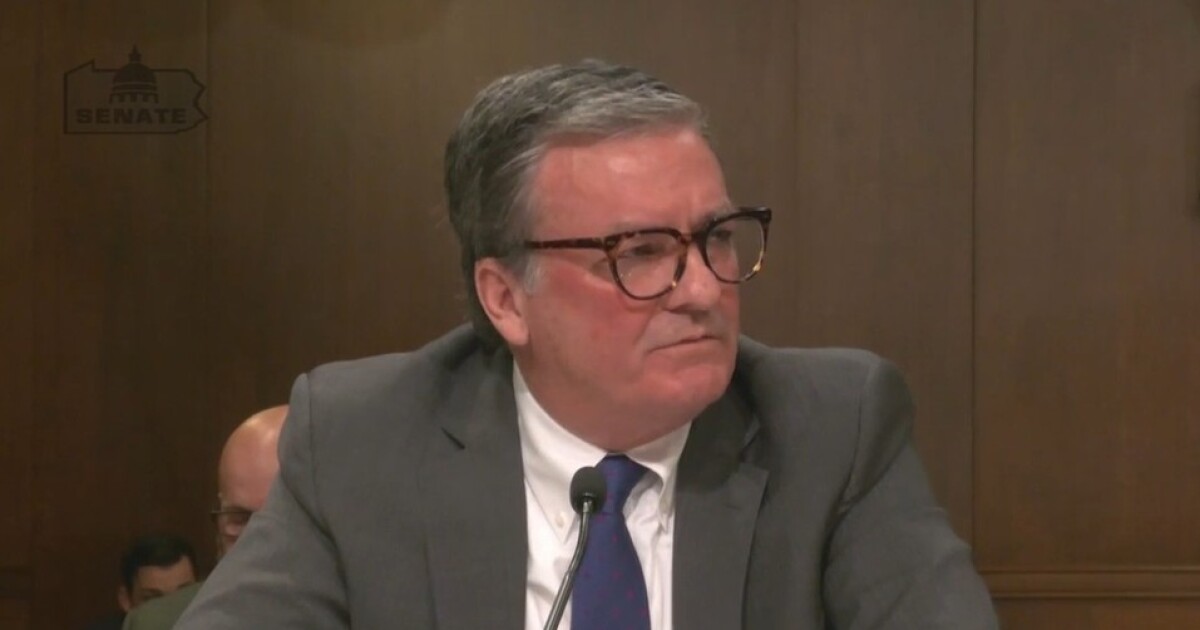
The committee questioned trucking industry experts, state police and members of Shapiro’s administration about the process for becoming a commercial truck driver, and what the state legislature could do to close any loopholes.
The man was in the U.S. legally and the state did issue him a license, said Mike Carroll, secretary of the Pennsylvania Department of Transportation.
But echoing Shapiro’s earlier explanations, Carroll said his agency relies on a federal database, called the SAVE system, to see if would-be truckers present a potential immigration or security concern.
“The Department of Homeland Security gives us the green light or the red light to go forward,” Carroll said, reiterating what Shapiro told reporters days after the arrest. PennDOT checked the database after Bozorov’s arrest, he said, and even at that point he had not been flagged as ineligible for a CDL.
“So that says that these [state and federal] agencies are not talking, they are not communicating,” Ward said.
“There’s really no role there for PennDOT other than to check the driver through the SAVE System,” Carroll said, referring to the federal immigration database.
As for the training needed to obtain a commercial license, officials acknowledged that the process had become laxer. But industry experts said that was a national problem, one that stemmed from the strain that the COVID-19 pandemic placed on supply chains.
As demand for drivers spiked, more drivers began to obtain training from third-party training operators, which offer an alternative to state-backed training centers but which critics say sometimes provide only limited instruction.
While some of those training services are “excellent,” said Rebecca Oyler who leads the Pennsylvania Motor Truck Association, “others focused more on capturing opportunity than meeting long-term safety and compliance standards. Most new interests play by the rules, but not all of them.”
“These pressures were not unique to Pennsylvania,” Oyler added.
“In any market there is a market for a shortcut. There will be both providers and people looking to take those shortcuts,” said Anthony Cloud, the truck association’s safety and education director. “Without a doubt, there are schools that are rubber-stamping and not providing the adequate training.”
And while the Pennsylvania Department of Education plays a role in truck driver licensing and third-party provider approval, compliance standards are set by the U.S. Department of Transportation, and its Federal Motor Carrier Safety Administration.
That office, Oyler said, oversees standards and training requirements for commercial drivers, and manages the federal systems that track driver eligibility. Things work well when those efforts are aligned, she said, “But when even one link weakens — whether verification, training oversight, testing, or data flow — the entire safety chain becomes vulnerable. So that’s the reality we’re facing today.”
Lynette Kuhn, deputy secretary for postsecondary and higher education with the state, agreed. Federal officials add vendors to the registry of training providers, and the state’s ability to police them proactively is “extremely limited.” Flagging a faulty training operator after the fact can mean a delay of between 6 to 18 months before the federal agency acts, she said.
State Sen. Rosemary Brown, a Republican, observed that state Education officials “basically are just rubber stamping” training providers. “Is that sort of based on those standards that are sent to them from the federal level?”
“Without a doubt that’s what’s happening,” Cloud said.
Senators also heard from Jeff Mercadante, chief safety and risk officer at PITT OHIO, a Pittsburgh-based trucking company.
His own company found an issue with a foreign driver who had a Pennsylvania-issued CDL. But he lied about having years of experience.
“Our internal review revealed that his background was questionable. He actually had only five months of experience,” Mercadante said. “If our team would’ve not conducted this deeper investigation, he’d have been placed on a road without the proper experience required to do it safely, based solely just on a CDL from Pennsylvania.”
But Mercadante said that’s a training issue faced in many states.
It’s not clear how directly these concerns applied to Bozorov. Tuesday’s discussion said little about the details of his case, including where the Uzbek national obtained a REAL ID in Pennsylvania, or who hired him.
According to a statement from ICE, Bozorov allegedly entered the country illegally in 2023, was later arrested “and released into American communities by the Biden administration” in 2024. He received his CDL this past July.
State Republicans may still use the issue as Shapiro gears up for reelection. The topic came up during a Beaver County campaign stop for Stacy Garrity, so far the only Republican candidate to challenge the governor next year.
Carroll, of PennDOT, said he had no recommendations for legislation that could set new levels of state enforcement. And Philadelphia Democrat Nikil Saval asked how much state officials could do about the issue at all.
“A lot of these questions… fundamentally regard federal enforcement,” he observed. “PennDOT has limited capacity with regards to the issues we’re talking about?”
“Yeah, I think it’s unfortunate that despite the invitation that this committee made to [U.S. Department of Homeland Security] Secretary [Kristi] Noem, neither she nor a member of her staff chose to come to this hearing,” Carroll said.
The federal agencies did not respond to a request for comment Wendesday morning. But Ward’s office confirmed that Noem and U.S. Department of Transportation secretary Sean Duffy were invited to attend. Officials told the committee that federal policy bars them from engaging in state or local hearings.
Ward, the committee chair, said any key findings from the hearing will be shared with federal agencies. Those communications will be publicly posted online in the coming weeks, her office said.