
Anyone who has tried to construct a genogram knows it’s a bit like working on a jigsaw puzzle. You start with the easy pieces and build around them.
Merriam-Webster defines a genogram as a diagram outlining the history and behavior patterns of a family over several generations. Beyond a simple family tree, it’s a visual map of a family’s history and dynamics, using standardized symbols for gender, relationships and health conditions.
I once had to create a genogram for my own bloodline for a psychology class.
If you want to trace your ancestry back to the Old World, you’d better have plenty of time — it can become an all-consuming project. It helps to have a great-aunt who already traced the family back to when Daniel Boone’s forebears settled in Berks County.
Online genealogy services will now do most of the work for a fee. Sites like Ancestry.com, GEDmatch and 23andMe use DNA analysis to build family trees and identify unknown relatives. These services have inadvertently helped spawn a new branch of forensic science: genetic genealogy.
I recently started watching “Bloodline Detectives,” hosted by Nancy Grace. The series highlights the role privately owned forensic genealogy companies play in identifying perpetrators who escaped justice for decades.
Each episode follows the same pattern: A violent crime leaves a community shaken. The offender leaves DNA at the scene. A profile is developed, but there’s no match in CODIS, the FBI’s national DNA database.
Time passes. Then, beginning in 2018 with the Golden State Killer case, investigators start uploading crime-scene DNA to public genealogy sites. These platforms compare DNA across broader sections of the genome, allowing analysts to build a family tree, identify siblings and cousins, and hand detectives a short list of possibilities.
Police then conduct surveillance and collect a discarded DNA sample — a cigarette butt, a coffee cup — to confirm the match. Often the suspect turns out to be an employed, married father living an otherwise uneventful life.
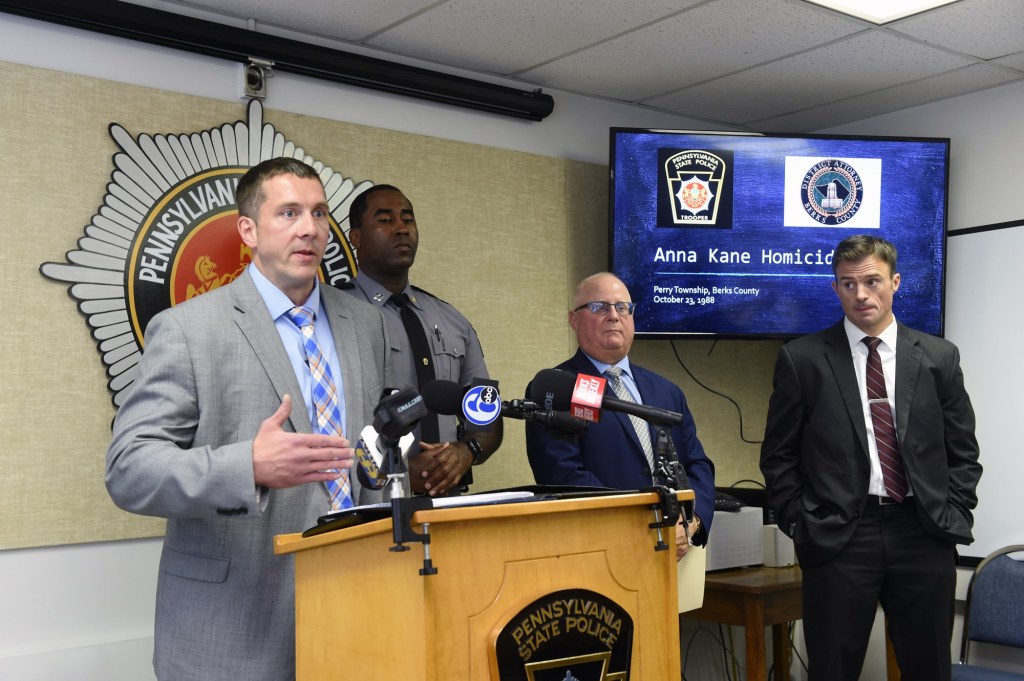
In 2022, Pennsylvania State Police announced just such a breakthrough at Troop L headquarters in Reading. The case followed the “Bloodline” script almost exactly.
Anna Kane’s body was found Oct. 23, 1988, along Ontelaunee Trail near Route 662 in Perry Township. The 26-year-old had been strangled with baling twine.
Investigators believed the killer mailed a letter to this newspaper, revealing details known only to the perpetrator. Saliva on the envelope provided DNA.
Nearly 34 years later, genetic genealogy identified the suspect: a Hamburg-area man Kane’s age at the time of her killing. He died in 2018 of natural causes. One can only hope he spent his last ears looking over his shoulder as DNA science evolved.
The case — like those profiled on “Bloodline” — was a testament to solid early work by detectives.
“All of that stuff was collected, and it was preserved as it should be,” Sgt. Nathan Trate, the Troop L crime section supervisor, said, “because they knew somewhere down the line what they collected could be that little piece of evidence they needed.”