
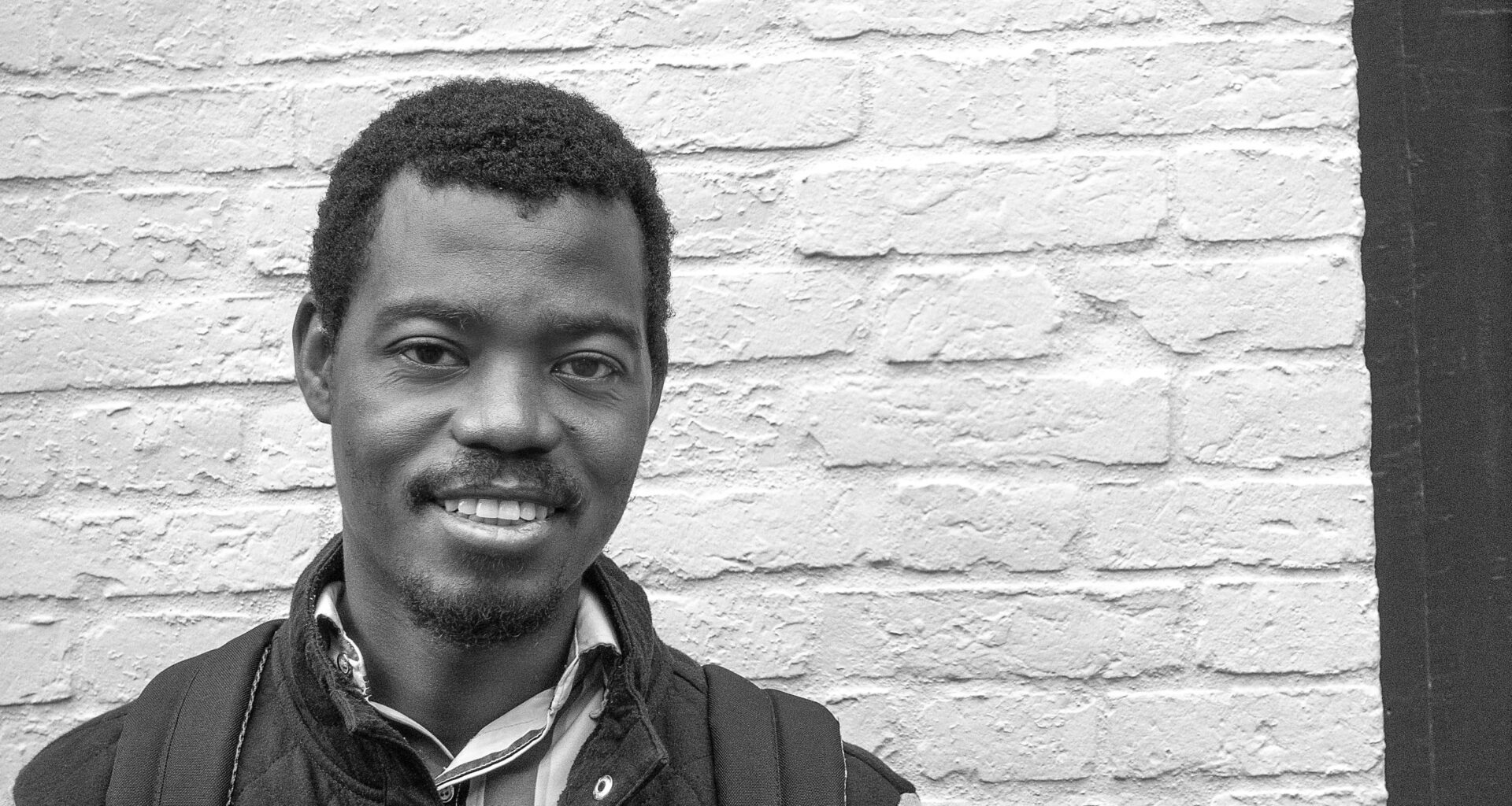
Bertony Louis walks slowly along Sampsonia Way on Pittsburgh’s North Side, his new home for the next two years. The narrow street is lined with houses painted in murals and words — walls that speak, sharing many of the same messages of justice and freedom as many of the poems he has carried across continents. For Louis, a Haitian writer who calls himself a “humanitarian poet,” the walk is both a meditation and a reminder. “Every step I take here, I’m still walking with Haiti,” he says.
Louis, who was born in 1994, spent his Haiti youth on the move. His parents shifted from Marmelade to Croix de Bouquets to other communities not far from Port-au-Prince, Haiti’s capital, seeking security and to avoid gangs in the Caribbean nation.
His parents, neither of whom had more than an elementary education, worked tirelessly so he and his siblings could attend school. His father sold hats at the market, his mother sold rice, and in between, their time was filled with passing along proverbs and stories across the generations. “We didn’t have much, but there was always wisdom around us,” Louis recalls. “Haiti is a place where the culture itself teaches you — through sayings, through music, through struggle.”
From an early age, Louis absorbed that wisdom and turned it into words. He remembers scribbling verses in the margins of his school notebooks, long before he thought of himself as a poet. But the hardships of life in Haiti made poetry feel less like a pastime and more like a necessity. “Poetry was how I could make sense of sadness, of exile, of loss. It became a way to survive.”
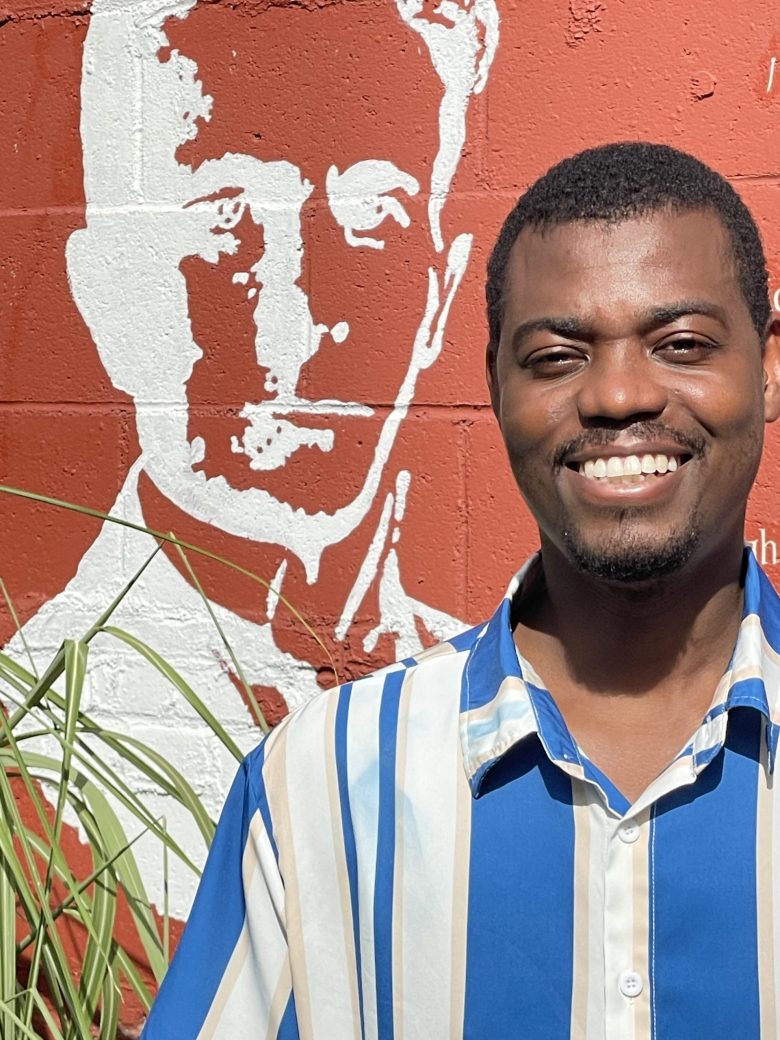 Louis stands outside in front of the murals along Sampsonia Way. Photo by Ervin Dyer.
Louis would later earn a law degree from the State University of Haiti in Gonaïves, a path chosen for practicality. Yet even while studying law, he never stopped writing poems. “I was supposed to be a lawyer,” he laughs.
But as he was introduced to the work of Haitian writers and poets Lyonel Trouillot and James Noël, he began to find his own voice and style and felt strengthened to follow his passion. Poetry became a way to share messages of hope and survival.
“I found myself more and more drawn to writing for people — to use language as a way of seeking justice.”
That shift eventually defined him. Today, Louis has won 13 international poetry prizes, been published in journals such as the Harvard Review and released a full-length collection, “Recovering the Horizons.” His work has been read in theaters, libraries and festivals from Spain to Scotland to Norway. No matter the stage, though, his themes remain rooted in Haiti: the rhythms of its language, the shadows of its struggles and the enduring strength of its people.
In recent years, Louis, 31, has gained notice for “And the Ocean for Ink,” a long-form project that blends poetry and ecology and describes Haiti’s vulnerability to climate change. “There are no more beaches in Haiti,” he laments, saying that abuse of the land has destroyed them.
He describes himself as a “humanitarian poet” because, as he puts it, “I don’t write just for myself. I write for the child who has no voice, for the brother in exile, for the earth that is crying. Poetry must serve humanity — otherwise it is only decoration.”
Louis’ career has taken him into some of the world’s most prestigious literary residencies — from the Artist Protection Fund in Glasgow to Harvard University’s Scholars at Risk fellowship. Those programs provided both refuge and recognition, but they also deepened his commitment to using poetry as a bridge between cultures.
“Everywhere I go, I find people are drawn to my work because they recognize themselves in it. Even if I’m writing about Haiti, someone in Germany or the United States feels the exile, the sadness, the longing. Poetry is where we meet.”
Bertony Louis
That sense of meeting is what brought him to Pittsburgh this fall, where he will spend two years as the 18th writer-in-residence with City of Asylum and as a research fellow in Carnegie Mellon University’s Department of Languages, Cultures & Applied Linguistics. City of Asylum, which provides sanctuary for writers persecuted in their home countries, offered Louis not just a safe home but a community of artists committed to free expression. “When I learned about City of Asylum, I felt like I had found my people,” he says. “They understand what it means to give your life to words, even when words put you at risk.”
At Carnegie Mellon, Louis will continue research on exile and humanitarian literature while sharing his poetry with students and the broader Pittsburgh community. He hopes to lead workshops, mentor young writers and translate more Haitian literature into English. But above all, he wants to listen. “Pittsburgh is a new place for me. I want to learn from this city, its immigrants, its history, its struggles. My poetry will grow because of what I find here.”
Though Louis now walks the mural-covered streets of the North Side, his imagination often returns to his homeland — to the hills, the small schoolrooms where he once taught, the market stalls where his mother bartered. “I carry all of that with me,” he says. “It is why I can never forget the humanitarian part of poetry. Because I know what it means to come from a place where so many are still struggling.”
For Louis, the next two years are about building connections: between Haiti and Pittsburgh, between poetry and justice, between exile and belonging. “Poetry is not just beauty,” he says, pausing to catch his thoughts in the home he’s staying in along Sampsonia Way. “It is resistance. It is testimony. And it is hope.”
As he settles in with his wife and young child, Louis smiles at the thought of being given the chance to develop more of his poetry “as a weapon” against inhumanity. “Here, I can breathe. Here, I can write. And when I write, Haiti is always with me.”