
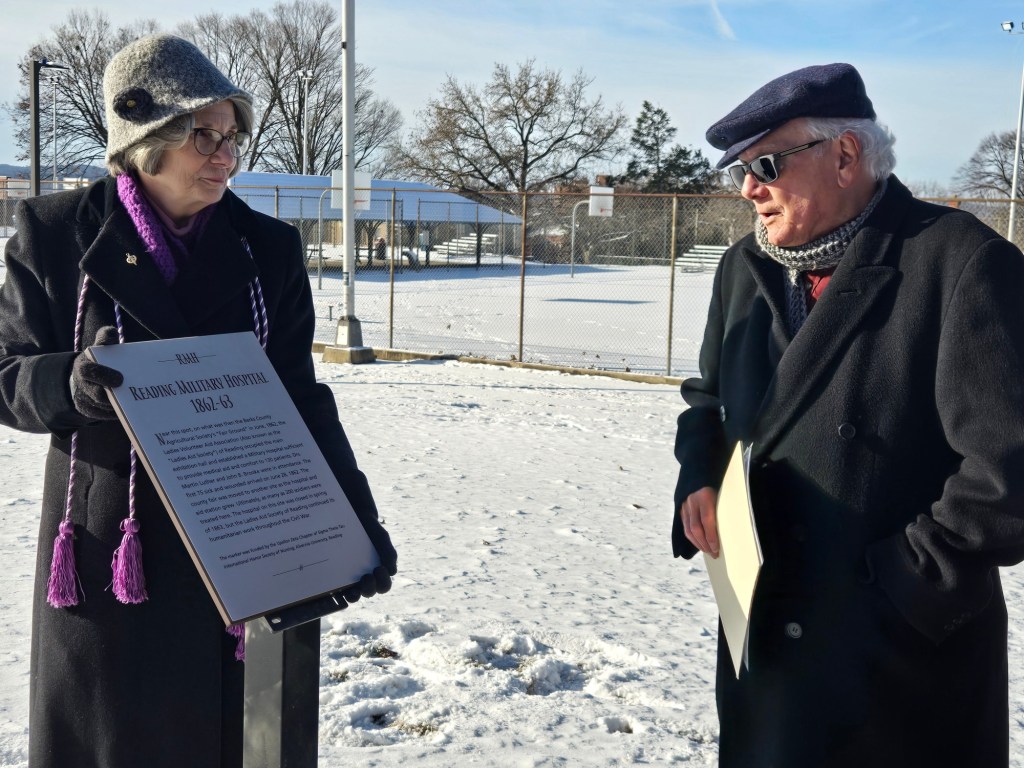
It was decades in the making, but the day finally arrived.
Theresa Adams greeted local dignitaries and colleagues who braved the frigid Monday morning temperatures to celebrate something special at Reading City Park.
About 20 people stood bundled up in hats and gloves by the basketball courts along Columbus Drive to dedicate a historical marker commemorating the creation of a military hospital and the service of volunteer nurses during the Civil War.
The event was the culmination of an effort led by the Upsilon Zeta chapter of Sigma Theta Tau International Honor Society of Nursing at Alvernia University. Adams, who serves as historian for the local chapter, said the event recognizing the Ladies Volunteer Aid Association of Reading was well worth the wait.
“History is taking place today because of the work of many people who felt it was important to highlight the impact of the Ladies Volunteer Aid Association,” she said.
She explained to those gathered that members of the honor society had wanted to highlight how those women took it upon themselves to create and supply a military hospital where they cared for Civil War soldiers for quite some time, but previous attempts fizzled out for various reasons.
The effort received renewed momentum following a discussion last year with her husband, local historian Charles Adams. She said that, with his support, they began to collect the documents necessary about the achievements of the association.
The couple then took that information to City Hall, and with the backing of council members were given the greenlight to fill out the official paperwork for the historical marker.
The local chapter of the Sigma Theta Tau International Honor Society agreed to foot the bill for the marker as well as its installation.
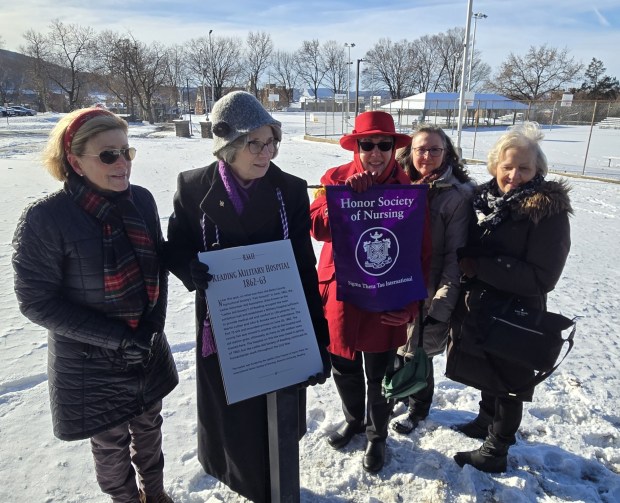 Theresa Adams, historian for Upsilon Zeta chapter of Sigma Theta Tau International Honor Society of Nursing at Alvernia University, second from left, and other members of the society pose with a historical marker in City Park paying tribute to the work of the Ladies Volunteer Aid Association of Reading during the Civil War. (KAREN SHUEY – READING EAGLE)
Charles Adams told the crowd gathered at the event the history behind the marker.
He said that where they stood was once a building that served as the home of the Berks County Agricultural Society, where the organization would host its annual fair. But, as the Civil War intensified and the Confederate troops marched north of the Mason-Dixon Line, reverberations of the bloody battles reached Reading.
So, in June 1862, the Ladies Volunteer Aid Association of Reading transformed the main exhibition hall into a military hospital to provide medical assistance and comfort to the sick and wounded soldiers. Over the next several months, as many as 200 soldiers found care and refuge at what became known as the Fairground Hospital.
While the hospital was closed in spring 1863, the association continued its humanitarian work throughout the Civil War.
“We are gathered to dedicate a simple plaque that marks the brief but significant existence of a Civil War hospital right where we stand,” he said.
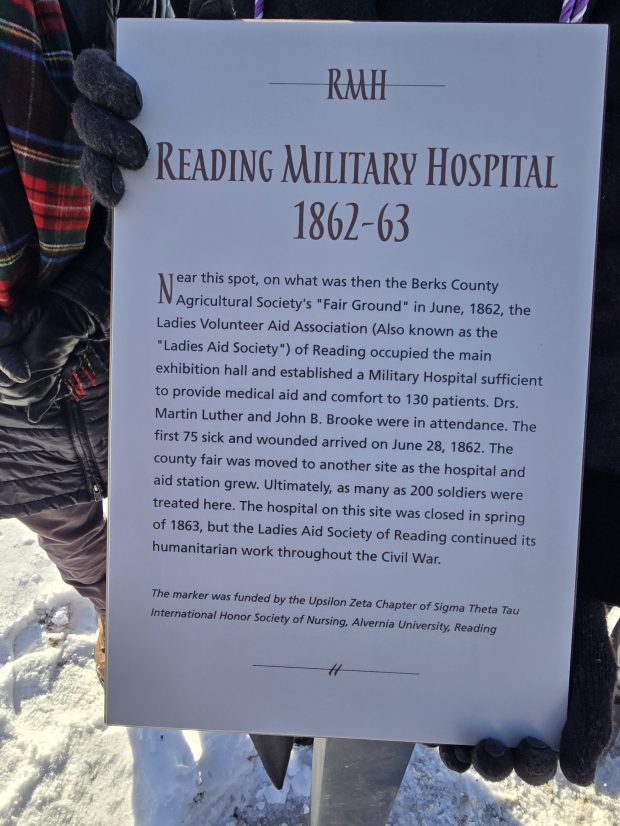 A new historical marker was installed Monday at City Park in Reading highlighting the existence of a military hospital during the Civil War. (KAREN SHUEY – READING EAGLE)
Berks County Commissioner Michael Rivera thanked the association for its efforts to have the marker created, noting it will serve as a lasting reminder of the selfless acts of others during a dark time in our past.
“What a great way to preserve our history,” he said.
Reading Mayor Eddie Moran echoed those sentiments. He said he is especially pleased to see the work of women being highlighted.
“We have a tendency to recognize the generals and soldiers who fought the battles, but here we have a group of ladies who unselfishly cared for those who were physically and mentally wounded,” he said. “That is something we strive to promote in Reading — that we should look out for each other.”