
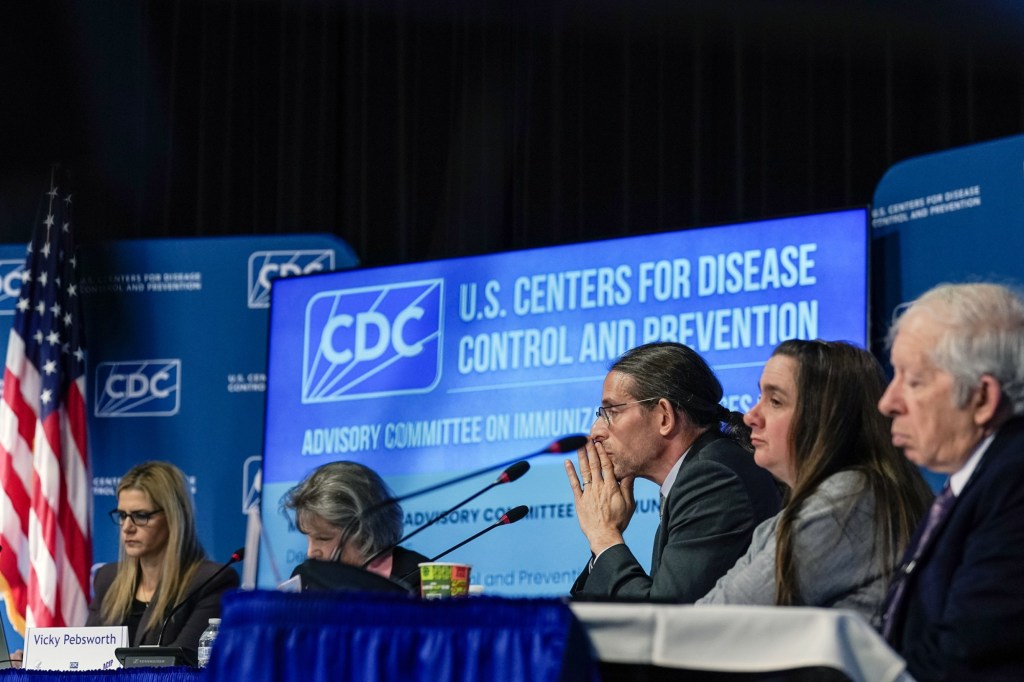
Lehigh Valley’s hospitals will not change their guidance on the hepatitis B vaccine for infants, despite new guidance from the federal Advisory Committee on Immunization Practices.
Lehigh Valley and St. Luke’s University health networks are standing with the Pennsylvania Department of Health, the American Academy of Pediatrics and other hospitals in opposition of the guidance, issued last week, that no longer recommends the vaccine at birth for all infants.
Instead, the ACIP, part of the Centers for Disease Control and Prevention, now recommends the hepatitis B vaccine at birth only if the mother has tested positive for hepatitis B. Mothers who test negative are advised to discuss the need for the vaccine with their doctors.
ACIP added that infants who don’t receive a dose at birth should have the initial dose administered no earlier than 2 months of age.
Critics, including the administration of Gov. Josh Shapiro, said the move will harm children. The Hepatitis B Foundation, a Bucks County nonprofit, said it was “deeply dismayed and concerned about the consequences” of the decision.
“It really is not aligned with the science and the evidence,” said Dr. Jennifer Janco, chair of pediatrics for St. Luke’s.
Hepatitis B is a viral infection that can spread by contact with blood, semen and vaginal fluid, and can be passed from mother to baby during childbirth. Children younger than 5 years of age are most at risk from an infection; complications from the disease can include liver scarring, liver cancer, liver failure, kidney disease, inflammation of the blood vessels and death.
Infants infected at less than 12 months of age have a 90% chance of developing liver scarring or liver cancer, according to the Children’s Hospital of Philadelphia. About 90% of infants will develop chronic hepatitis B if infected and about 25% of those will die young because of the infection, according to the American Academy of Pediatrics.
Starting in 1982, it was recommended that all children born to mothers with hepatitis B be vaccinated. This guidance was updated and expanded at certain points over the next decade, until 1991, when the CDC and the American Academy of Pediatrics first recommended the hepatitis B vaccination for all newborns.
“Before that, we weren’t doing it universally and we weren’t really reducing the number of infected children with hepatitis B disease,” Janco said. “ … There was this ‘maybe get it, maybe don’t get it’ type of approach, which is what the most recent ruling came out with. We’ve been there, we’ve tried that and it didn’t work.”
According to the Pennsylvania Department of Health, since 1991, hepatitis B infections in children decreased by 99%. According to CHOP, before the universal infant recommendation, half of children less than 10 years of age who were infected with hepatitis B were born to mothers who tested negative for the virus. Janco said part of the reason behind this is that many people who have hepatitis B do not know they have it.
According to the state, no children in Pennsylvania have contracted hepatitis B since 2019, thanks to high rates of immunization.
Janco said that the hepatitis B vaccine is one of the safest vaccines; it doesn’t even cause fever, the way COVID-19 and influenza vaccines do. The only notable side effects are temporary swelling and the occasional allergic reaction, which Janco said is so rare she hasn’t seen one case of it in her entire 25-year career. She said this is why doctors feel comfortable giving it to newborn infants, whereas children should wait for other vaccines.
She said this kind of messaging from sources like the CDC creates confusion, but hopefully, parents will continue to listen to their pediatricians.
“What I’m pleading is they continue to do what they’ve always done and trust their pediatrician,” Janco said. “We’re going to be there to help you through not just vaccine choices, but everything else: your child’s first fever, when they get some unusual rash, when they have some cold that won’t go away, when they need help with potty training, all the things that are going to happen during childhood.”