
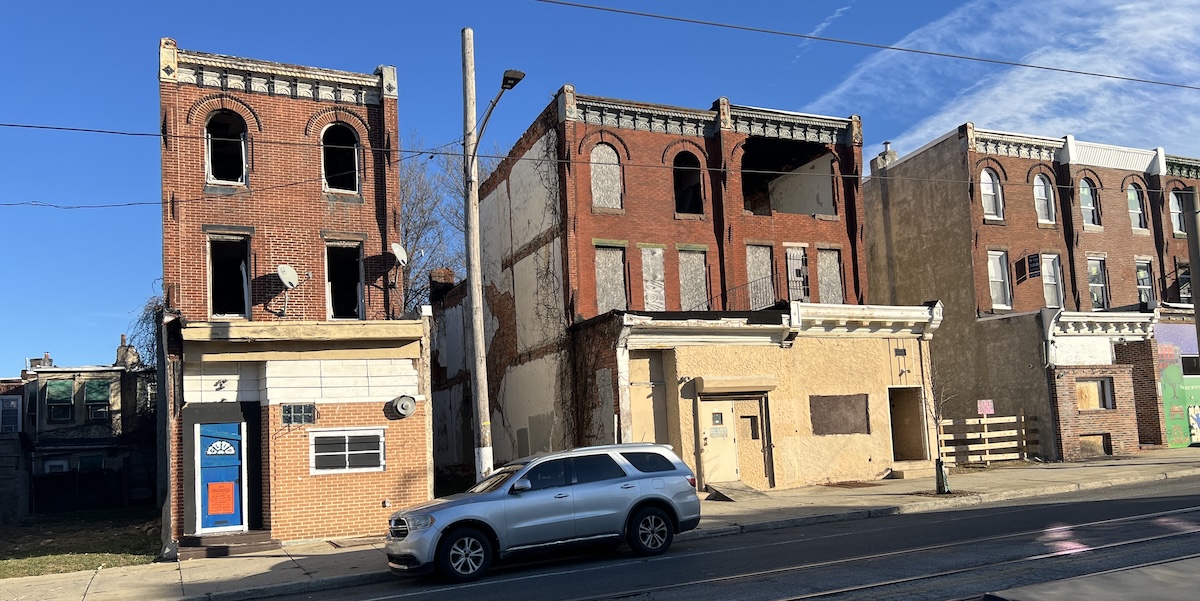
Despite evidence that Philadelphia’s economic status is improving in some important respects — median household income has been growing, while poverty and unemployment rates are declining — the city continues to struggle with chronic problems. One persistent one: the proliferation of vacant houses and lots in many residential neighborhoods. As Jeremy Nowak, then head of The Reinvestment Fund, observed back in 2010, ”It’s not that we have a blight problem. We have a blight machine.”
Have we made any real progress in addressing this problem since 2010? A decade and a half later, the City doesn’t even have an accurate estimate of the number of vacant buildings that can be found in Philadelphia. In place of a citywide inventory, the Department of Licenses and Inspections has employed a reactive approach: identifying vacant properties based on residents’ complaints and vacant property license applications, “which L&I admits is a massive undercount,” according to a December 8 Special Report in The Inquirer.
In a city with a shortage of over 64,500 housing units for low-income households, why can’t we find more efficient ways to acquire a lot of these neglected properties and turn them over to capable housing developers? Some community development corporations and other neighborhood-based developers, including those that have received training and short-term financing through the Jumpstartphilly program, would welcome an opportunity to acquire more properties and rehabilitate more housing.
One related issue: The public sector programs that used to facilitate vacant property acquisition during the 20th century don’t work anymore, and haven’t worked for years. Urban renewal-style eminent domain is too expensive, and the Philadelphia Sheriff’s office, which administers public auctions of tax- and mortgage delinquent real estate, is not a reliable partner; the agency has been scandal ridden for years. Land bank powers, used more effectively elsewhere in Pennsylvania, have been hobbled by Philadelphia’s adherence to councilmanic prerogative, which gives district councilmembers the ability to block any real estate transaction requiring Council approval.
Instead, the best opportunity for Philadelphia to acquire vacant properties and convey them to responsible developers, at scale, is by making the city the biggest and most productive user of conservatorship, a program authorized by the Pennsylvania General Assembly in 2008. Act 135 authorizes a public or private entity to seek court appointment of a responsible party, known as the conservator (usually a contractor or developer), to bring a neglected property into compliance with health and safety code standards. Through the conservatorship action, most public and private liens are extinguished from the property title, making it easier for a developer to obtain construction financing after code compliance issues have been resolved.
In a city with a shortage of over 64,500 housing units for low-income households, why can’t we find more efficient ways to acquire a lot of these neglected properties and turn them over to capable housing developers?
The Philadelphia Redevelopment Authority has the capability to handle property acquisition responsibilities associated with an ambitious and energized conservatorship program. And the City-controlled Philadelphia Housing Development Corporation (PHDC) has the expertise needed to conduct outreach to prospective conservators and to assist well-intentioned but underinformed property owners seeking to resolve problems such as those described in recent media coverage of Act 135 experiences in Philadelphia.
A 2023 report published by the Advocacy for Racial and Social Justice Clinic at the University of Pennsylvania’s Carey Law School found that Act 135 petitions were “disproportionately filed in communities vulnerable to, or actively experiencing, gentrification.” Because these communities also attract real estate speculation, an efficient City-managed conservatorship program could benefit local developers seeking to produce and preserve affordable housing there.
A high-performing City-managed conservatorship program would require an investment in staffing for real estate services, for the operation of a full-time blight court, and for housing counseling and legal aid delivered at the neighborhood level. This investment, which would be eligible for funding through Mayor Parker’s H.O.M.E. Initiative, could start contributing to the City’s ambitious housing production goals during its first year of operation.
Philadelphia has the power to reset, then turn off, the blight machine. All it takes is tough, no-excuses leadership by municipal government, combined with a smart allocation of newly available funding. Would we dare to use this power now?
Former Rendell administration housing director John Kromer is the author of Fixing Broken Cities: New Investment Policies for a Changed World.
The Citizen welcomes guest commentary from community members who represent that it is their own work and their own opinion based on true facts that they know firsthand.
 MORE SOLUTIONS TO OUR HOUSING CRISIS
Photo courtesy of John Kromer.