
Editor’s note: The following text is a transcript of a podcast story. To listen to the story, click on the arrow beneath the headline above.
NICK EICHER, HOST: Today is Tuesday, December 16th.
Thank you for turning to WORLD Radio to help start your day.
Good morning. I’m Nick Eicher.
MARY REICHARD, HOST: And I’m Mary Reichard.
Coming next on The World and Everything in It: The little town of Bethlehem.
It’s best known as the city where Jesus was born, immortalized in songs and living nativities. But the Bethlehem of today is a bit more gritty.
WORLD’s Travis Kircher introduces us to a Palestinian Christian facing a fragile economy and political unrest.
AUDIO: [Celebration in Bethlehem]
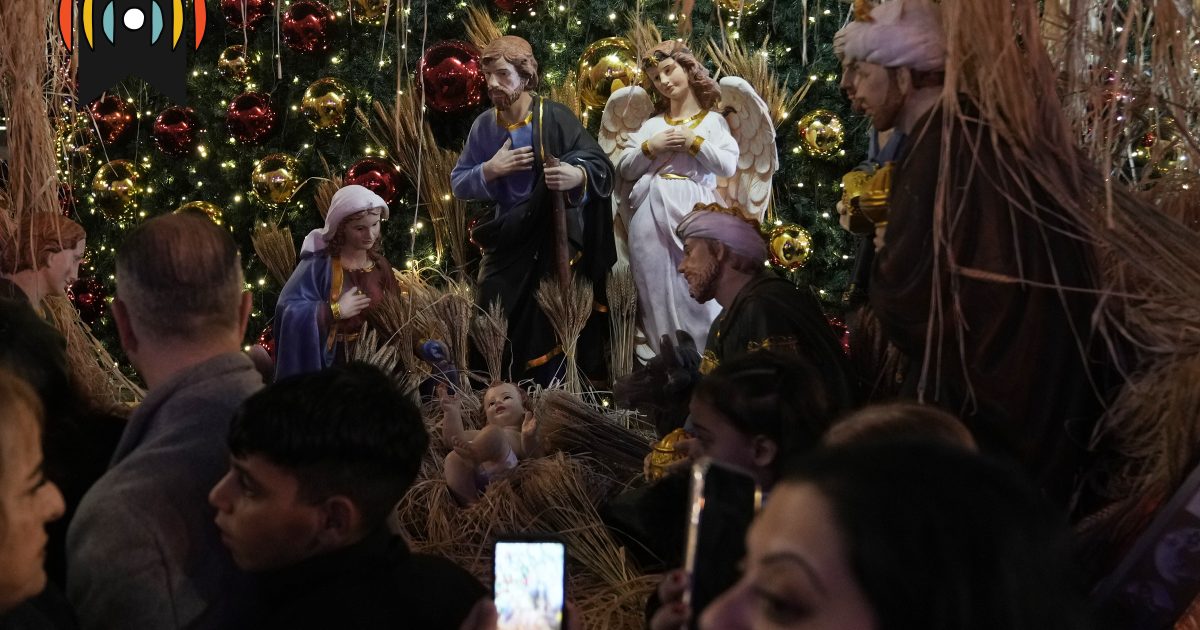
TRAVIS KIRCHER: Hundreds gathered in Manger Square in the West Bank town of Bethlehem earlier this month for the lighting of the square’s Christmas tree. Public Christmas celebrations haven’t taken place here in two years. Local leadership canceled celebrations after the October 7th attacks—citing Israel’s war in Gaza. But with a fragile ceasefire now in place, Bethlehem’s mayor hopes the tree lighting signals a new beginning.
MAYOR: For the past two years, everything was shut down. The unemployment rate jumped from 14% to 65%. Poverty rate touched 65%. The people left Bethlehem.
That was clear when I visited Bethlehem in September.
AUDIO: [Meeting Saleem]
That’s where I met Saleem Anfous. Anfous is a Palestinian and a professing Christian—a faith he says he was born into.
Anfous used to be a tour guide in the West Bank until the October 7th terror attacks.
ANFOUS: You can see because of the war: No tourism. Zero. Tourism is dead. So you can see how that is harmful to the community—specifically to the Bethlehem community and specifically also to the Christian community.
WORLD paid Anfous to show me around Bethlehem. One of the first sites we visited is known as the Shepherds Fields—one of three possible sites where shepherds learned of the Christ child some 2,000 years ago. Anfous points to the heavens…
ANFOUS: The angels could appear anywhere in the sky here, telling those shepherds who are taking care of the flock, giving them this beautiful, beautiful, beautiful message of God Himself started something that is magnificent…
From there, he takes me to the Church of the Nativity where we are greeted by members of the Palestinian tourist police who safeguard the site.
AUDIO: [Greetings from Church of the Nativity tourist police]
Inside, Anfous recounted the Christmas story as the locals understand it. He thinks the Western church may have misunderstood aspects of the story—particularly what he sees as his ancestors’ treatment of Mary.
ANFOUS: Hospitality is something that it very important. So can you explain to me, in the sense of our hospitality, in the sense of human nature, why would people kick a pregnant woman who is about to give birth out into the streets, and not welcome her in their homes?
As a descendant of King David, Anfous says Joseph would have had family in Bethlehem. Luke’s Gospel says there was no room for Mary and Joseph in the inn, but Anfous believes our English translation is misleading…
ANFOUS: The word “inn” is not the actual word of what is described in the Bible. It could mean inn, guest house, or guest room.
He thinks Joseph’s family would have welcomed the couple, but as a pregnant woman, Mary would have been ritually unclean.
ANFOUS: So where does she go? To the cave next to the house, where basically there, she is with the midwives giving birth and being with the family.
As we made our way through the church, we reached what is considered one of the holiest sites of all—the very chamber where tradition says Jesus was born. Before Oct. 7, you might have expected to wait at least an hour in line to touch the precise spot. But at that moment on that day in September, Magaly Varona, a Cuban national from Miami and a professing Christian, was the only tourist in the room.
VARONA: Incredible. It’s amazing. The beginning of everything for me.
Tour guide Michael Cavanati offered a more sobering assessment.
CAVANATI: This is our life here as locals. We depend on this place to live—not just for religion. Now we are very lucky to see it’s empty, but for us, we are not lucky. Because it’s a war and we are praying to finish this war. We pray to Jesus to bring peace to us.
Outside, I asked Anfous what it’s like being a Palestinian Christian living in the West Bank. His answers are blunt.
ANFOUS: I’m literally being persecuted by my faith—persecuted as a Christian and persecuted as a Palestinian…
He considers Israel’s security forces in the West Bank as an occupation, its war against the terror group Hamas in Gaza a genocide, and accuses Israeli settlers of pushing Palestinians out of what he sees as their God-given land. But he also condemns the terror attacks of October 7th and says his quarrel is with the actions of the Israeli government—not the Jewish people.
AUDIO: [Saleem describes the wall in detail]
At one point, he shows me what he sees as one of the most divisive structures in the West Bank—a more than 400-mile long security wall. That wall was built by Israel in response to an onslaught of terror attacks launched as part of the Second Intifada 25 years ago. But Anfous sees it as a land grab. He says the end result is that he and other Palestinians are boxed in.
ANFOUS: You see it, the reality. Where can my girls go? There is no empty piece of land that can turn into a playground. A field. A place where they can go around. There’s no hiking spaces I can take them out.
Despite being my cab driver, Anfous was unable to take me back to my apartment in Jerusalem at the end of the trip. The Israeli government wouldn’t let him and other Palestinians across the border, for security reasons. Not since October 7th.
ANFOUS: Before that, I would take my girls to the zoo, I would take my girls to worship in the resurrection church, visit Jerusalem because that’s the right that I should have like anyone else. But I know I no longer have access to do so…
So I wait at a bus stop for an Arab bus line to take me 4 miles back to Jerusalem.
At a checkpoint, I show my American passport to Israel Defense Forces troops before I’m allowed across the border, left with Anfous’ parting words.
ANFOUS: We’re screaming for the need of the Western church to stand as a church. Listen to us! Listen to what we say!
Now back in the States, I spoke with Anfous again a few days ago. He says even with public Christmas celebrations returning, he hasn’t seen a significant rise in tourism yet, but he’s hoping it will improve by Easter. And some good news: He says he was finally granted a permit to visit Jerusalem—at least until the end of this month.
Reporting for WORLD, I’m Travis Kircher, from Bethlehem in the West Bank.
WORLD Radio transcripts are created on a rush deadline. This text may not be in its final form and may be updated or revised in the future. Accuracy and availability may vary. The authoritative record of WORLD Radio programming is the audio record.