
Pennsylvania American Water has announced plans for a new water treatment plant in Exeter Township to serve 25,000 customers.
The proposed 50,000-square-foot Glen Alsace water treatment plant would be built on a 22-acre plot on the south side of Lorane Road and west of Lincoln Road.
It would serve an area encompassing Exeter and Amity townships, portions of Earl and Ruscombmanor townships and part of St. Lawrence.
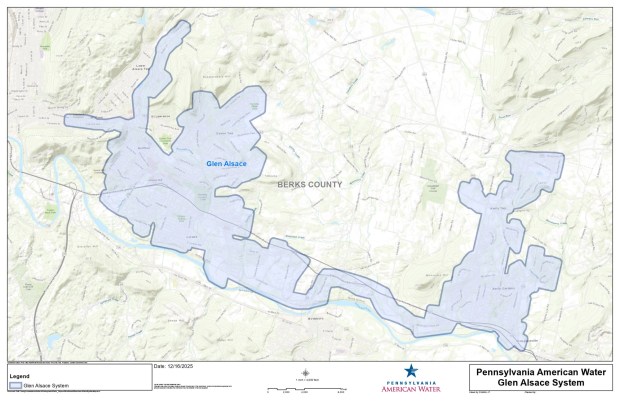 Pennsylvania American Water is proposing a 50,000-square-foot water treatment plant in Exeter Township that would serve customers in Exeter and Amity townships, portions of Earl and Ruscombmanor townships and part of St. Lawrence. (Courtesy of Pennsylvania American Water)
Engineering manager Jerry DeBalko said the company is finalizing an agreement for the land with Metropolitan Development Group, Bucks County.
The company did not provide an exact figure for the cost of the new plant, which would have the ability to treat 6 million gallons per day.
Another plant the company is constructing in East Vincent Township, Chester County, has the capacity to treat 11 million gallons daily and cost $143 million, company officials said.
The Exeter plant initially would treat 3 million gallons daily, but its capacity could be expanded up to 6 million gallons daily to meet future needs.
It is expected to replace most of the 11 wells the company uses for water and instead draw from the Schuylkill River, company engineers noted.
The facility is needed due to new state and federal regulations on the filtration of PFAS, or “forever chemicals,” as well as other regulations that require more stringent filtration, company officials said.
Justin Brame, senior manager of operations for the company’s southeastern Pennsylvania branch, noted the company initially looked at the cost of outfitting the wells to meet the new regulations. He said they found it would be more expensive to rehabilitate the current infrastructure.
“Each one of those wells would need individual treatment,” Brame said. “It would be $8 million to $12 million each. It’s more cost effective to just build a centralized treatment plant.”
Installing the infrastructure that the wells would need would have potentially meant taking measures like seizing properties via eminent domain.
“We don’t want to go down that road,” Brame said.
Relying on river
Using the Schuylkill as a source would create a more resilient water supply even during dry periods, engineers said.
That means not having to rely on buying water from other municipalities when supply needs outstrip demand, such as during droughts.
“This project represents a major investment in the health, reliability, and quality of water for Exeter Township,” Pennsylvania American Water Vice President of Engineering Tony Nokovich said in the company’s announcement of the project. “By leveraging the Schuylkill River and advanced treatment technology, we’re ensuring more dependable water for generations to come.”
The company currently supplements its well water sources via interconnections with the Reading Area Water Authority and Mount Penn Borough Authority.
“In the worst of times when you need it, it’s not always there for you (with wells),” DeBalko said.
Once the plant is operational, most of the wells will be abandoned, officials said.
DeBalko said a few of the wells may already meet the updated regulations and would likely be kept in case of a main break or other circumstances that call for extra supply.
“We’ve spent a lot of money over the years on infrastructure for them (the wells),” Brame said. “So as long as they meet regulations, we would keep those, at minimum as a backup source.”
Promised improvements
In addition to PFAS treatment, the new plant will be equipped with treatment technology for added filtration and improved quality, including:
• UV light disinfection to safeguard against viruses and bacteria.
• Activated carbon filters to remove impurities and improve taste and odor.
• Corrosion control to protect pipes and fixtures in homes and businesses.
DeBalko said he’s heard complaints from residents for years about the palatability of well water, which can have issues with “hardness.”
“It’s going to be a totally new source of supply,” DeBalko said. “All of that goes away as far as that hardness or mineral deposits. For us water geeks, this is such a positive change.”
As to whether the new plant would lead to future cost increases for customers, company officials said the facility’s impact on costs would be hard to predict.
The company is requesting another rate hike that would increase the typical residential water customer’s bill by about $14 per month.
Exeter residents recently expressed frustrations with rising water bills. In 2020, an Exeter residential customer who used 6,500 gallons would have paid $183, according to information provided by Amanda Johnsen, an Exeter Township supervisor and activist.
The rate for the same monthly usage rose to $348 in 2024, after the Pennsylvania Public Utility Commission approved Pennsylvania American’s requests for rate hikes.
The company’s latest request has been paused pending an investigation by the PUC.
Company officials noted that increasingly strict regulations on chemicals in water have forced utility companies everywhere to modify their facilities.
“The EPA standard (for filtering contaminants) used to be parts per million,” said John Kelerman, manager of external affairs at Pennsylvania American. “Then it became parts per billion. Now it’s parts per trillion.”
Brame said the extremely fine magnitude of chemicals allowed into water under the updated standards means the entire industry is facing dramatic expenses.
“Not just here, but across the entire country, the numbers are unimaginable what it is going to cost to treat (water),” Brame said. “Millions and millions of dollars to make the water safe, based off the (new) regulations.”
The plant is in the design phase, which will run through 2027. Construction is scheduled to start in 2028, with completion slated for summer 2030, company officials said.
Pennsylvania American is a subsidiary of American Water, which brands itself as the largest regulated water and wastewater utility company in the U.S. It provides water services to over 14 million people nationwide.