
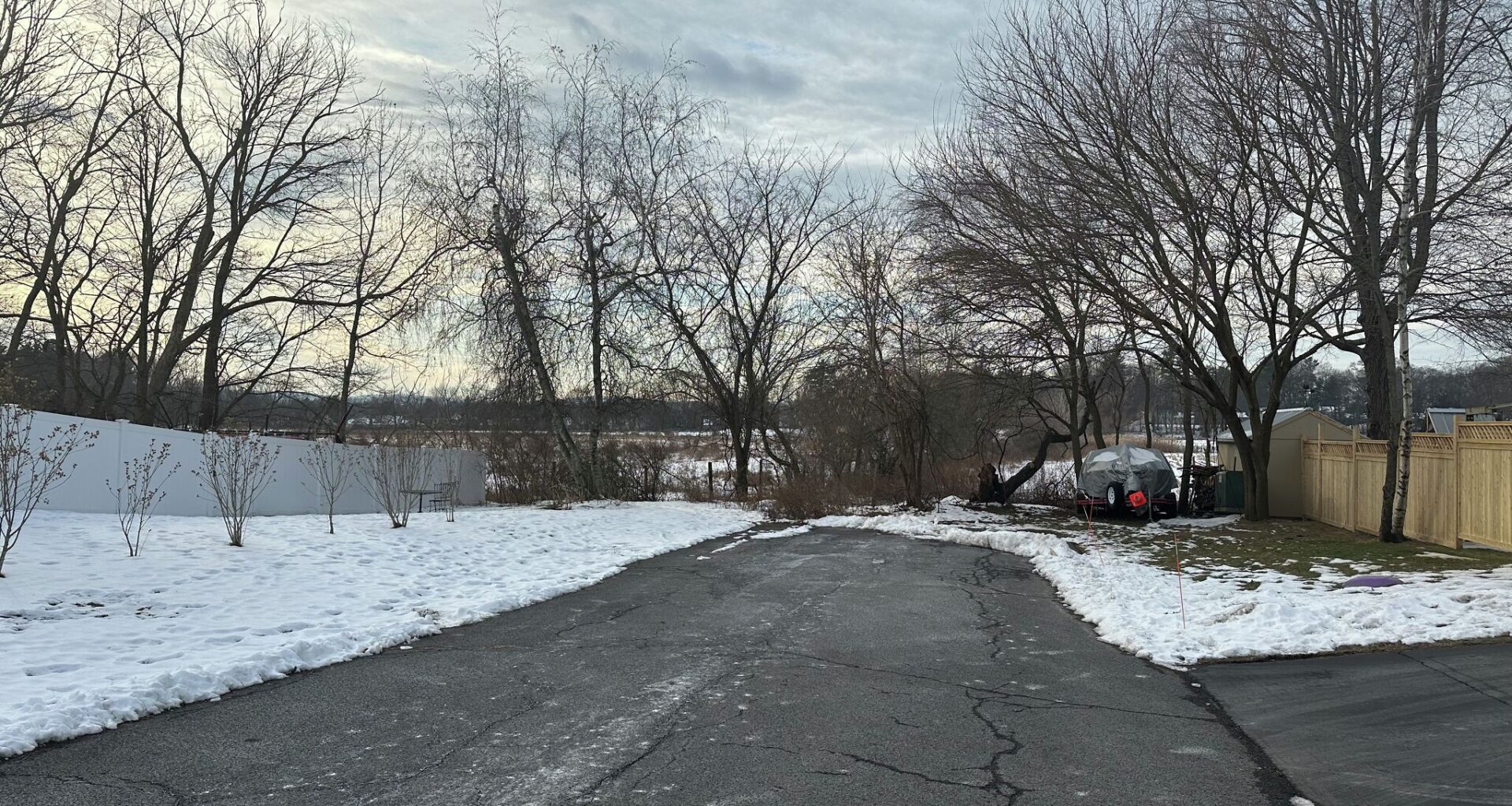
An open field off Jefferson Avenue in Bethlehem’s Glenmont neighborhood could be rezoned for multi-family homes or apartment buildings under new proposed zoning rules.
Patrick Tine
An open field off Jefferson Avenue in Bethlehem’s Glenmont neighborhood could be rezoned for multi-family homes or apartment buildings under new proposed zoning rules.
Patrick Tine
BETHLEHEM — Questions about how land should be used are coming into sharper relief as municipal authorities and the public weigh a proposal that would rezone large portions of the town and make open spaces easier to develop.

Town officials, including Supervisor David VanLuven, say the updates are necessary to shape the growth of the 52-square-mile town. The proposal, which fits into a larger 2022 update of the town’s comprehensive plan, calls for changes to building rules in both rural and commercial areas of the town, but public attention — and growing opposition — has centered on plans to rezone roughly 800 acres of vacant land for mixed-density residential development.
Article continues below this ad
Public opposition has centered on 10 empty tracts of land abutting single-family homes, mainly south of Route 32.
Housing beyond single-family homes, including apartment buildings, would be permitted in the new mixed-density residential development areas.
“Currently, Bethlehem is predominantly zoned for single-family homes only, and that does not address opportunities for a variety of income levels to live in the town,” Planning Director Robert Leslie said in an interview earlier this month. “The new zoning district in town would provide for single-family homes, two-family units, three-family units, and multi-family units, but all within design standards that will help to provide for a transition area to existing single-family neighborhoods so that impacts on existing neighborhoods are avoided or minimized.”
Make the Times Union a Preferred Source on Google to see more of our journalism when you search.
Add Preferred Source
Criticism of the mixed-density development has centered on increased traffic on the town’s arterial roads and worries that an influx of new development will bring families with school-age children into the town, increasing enrollments. Colleen Scott, who owns a home on Jefferson Avenue abutting vacant farmland that would be rezoned for mixed-density development and has emerged as a leading voice in her neighborhood against the proposed changes, voiced those and other concerns in letters to the town’s Planning Board.
Article continues below this ad
“Part of the reason (Bethlehem is) desirable is because of the mix of residential, commercial and agricultural spaces that are present throughout the town,” she wrote to town officials after an open house last month. “Eroding agricultural land/green space in favor of unrestrained residential and commercial growth negates that appeal, both for current residents as well as those who are looking to move here.”
Leslie said his research and communications with the Bethlehem Central School District found that multi-family homes generate fewer students than single-family developments. “I think the tenants of those units are typically, maybe older folks who are downsizing. It could be a condo unit; it could be a rental.”
He pointed to the Kendall Square Apartments, a100-unit multi-family development off Elsmere Avenue, which he said generated only 10 additional students being educated in the district.
Leslie said planners had made adjustments to the proposal during the development of the town’s 2022 comprehensive plan update. “The design standards that are built into the new zoning update will require that the perimeter of the parcel will either have a 100-foot buffer to provide a transition area or require that the perimeter homes along the parcel be single-family or single-family attached,” he said.
Article continues below this ad
“The goal is to match the housing type on the other side of the line.”
The town’s comprehensive plan, a document the state requires every municipality to have to adjust its zoning laws, did not favor keeping the farmland now being eyed for mixed-density development for agricultural purposes, Leslie said. “We have a responsibility to put in place allowable uses that can address the housing needs of the community,” he said.
He also noted that owners of vacant farmland are already free to sell or develop their property under the current zoning rules, though the structures would have to be single-family homes. He also pointed out that under new zoning rules, proposed developments would still be subject to Planning Board approval and public comment.
The proposal remains in the planning stages. Early next year, the Planning Board will make a presentation to the Town Board with its final recommendations, and the town will hold public hearings before voting on the proposal sometime in the spring.
Article continues below this ad
Town Board Member David DeCancio has taken issue with how the public has been kept informed of the proposed changes going back years. He said flyers sent to residents have been insufficient. He noted a Nov. 18 open house was in the run-up to the week of Thanksgiving, and a Dec. 2 Planning Board meeting was held in a snowstorm that took place while much of the region was shut down, which forced the postponement of a local school capital project vote.
“Maybe we wouldn’t have to be on the defensive if we just made sure people felt that their voices were genuinely valued and heard,” he said.
He said he would reserve judgment on the proposal until the Planning Board made its presentation to the town.
“We’ve been getting so much input on this. We didn’t just start getting input a week ago,” VanLuven, the town supervisor, said last week.
Opponents of the draft plans made their voices heard at Tuesday’s Planning Board meeting. Bruce Grossman took issue with what he said were “loopholes” in the voluminous planning documents available on the town’s website. Among his complaints was that a section of Feura Bush Road from Elsmere Avenue to Wemple Road could end up bordered by strip malls based on the town’s designation of that area as a hamlet, he said.
Article continues below this ad
The plan would allow developers “permission by right” to do so, Grossman said.
Changes, officials have said, are coming to the town regardless of adjustments to the zoning laws and the current process allows that change to be managed in a controlled way. Town Board Member Tom Schnurr said the current proposal is a “good start” and praised efforts in the proposal to cut down on sprawl.
“We have got to make sure that if there are increases in density, it goes in places that make the most sense,” he said. “Apartment buildings in behind a vacant lot or on small residential streets aren’t going to do what they need to for the town or the people who live there.”
Article continues below this ad
VanLuven said that keeping Bethlehem’s small-town feel and other desirable aspects of the suburb are the ultimate goal of the proposed zoning changes. He said the changes, if implemented, would not bring about a radical transformation in how the town looks and feels.
“And if absolutely nothing changed, we still would grow and change as a town,” he said. “This notion that I sometimes hear, ‘just leave everything alone and everything will stay the same,’ that’s just not how the world works.”