
Jonathan Pagán voted for Donald Trump in 2024 because of his promise to bring down prices in a country grappling with the high cost of living.
A young Hispanic voter, the 32-year-old was among the winning coalition born in large part from the Republican campaign’s relentless focus on the economy. His ballot helped flip Pennsylvania to red, a key victory that gave Trump the keys to the White House.
A little more than a year later, with the high cost of living still a totemic issue for millions of Americans, Pagán is questioning his decision.
“Everything has changed,” since November 2024, he told The Times from his ice cream parlour in Quakertown. “You go to the grocery [store] and you can spend over £150, easily.”

Jonathan Pagán at his ice cream parlour in Quakertown
Pagán is not alone in his concerns about the state of the US economy. A poll for Public First, published last week, found that almost half of respondents said food, utility bills, health care, housing and transport were difficult to afford. About 55 per cent of Americans blame Trump for high grocery prices, which have climbed by 49 per cent since 2020, according to a CBS price tracker.
• Ryan Bourne: Affordability is Trump’s albatross and he can’t get rid of it
In recent months “affordability” has become the watchword for Democrats, not Republicans, as the opposition has seized the very message Trump deployed to such great effect in 2024 to claim that his administration has done little to improve the cost of living for voters.
On Wednesday, Democrats forced a vote on whether Covid-era Affordable Care Act subsidies should be extended, and four rebel Republicans signed a petition. Although the effort is all but sure to fail when it reaches the House of Representatives, it has revealed cracks in Trump’s party over how to handle the issue.
Later that day, House Republicans passed a healthcare package that did not address the subsidies — which have brought down healthcare costs for 24 million Americans — making it all the more certain that the tax credit will not be renewed.
The affordability message has spurred the Democrats to victory in a slate of key races, from gubernatorial races in Virginia and New Jersey in November, to last week’s mayoral triumph last week in Miami, an office the party had not held for 28 years.
Trump, who has previously referred to affordability as a “hoax”, was dispatched to allay concerns last week at a rally in Monroe County, Pennsylvania. He told the crowd that prices were “coming down tremendously” and “inflation is stopped”, laying blame for present hardships at President Biden’s door.
• David Charter: Trump hits the road to soothe doubts of Maga faithful
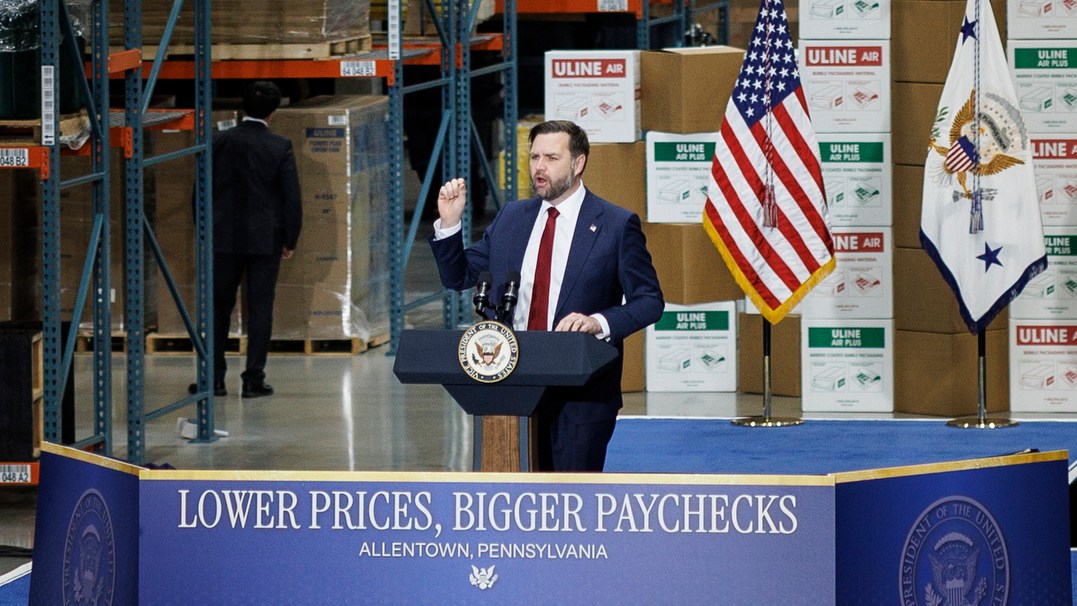
In a visit to Allentown, a city in the Lehigh Valley, JD Vance, the vice-president, also blamed Biden but said the Republican administration was “making progress” on tax cuts, cheaper gasoline prices, pharmaceutical reforms and moves to deport illegal immigrants, whom he blamed for driving up house prices.
“I promise you, there is no person more impatient to solve the affordability crisis than Donald J Trump, the president of the United States,” he said.
After Trump told Politico last week that he would grade the economy under his management an “A-plus-plus-plus-plus-plus”, Vance was asked for his own rating. “A-plus-plus-plus,” he said.
Insisting he was not concerned about the politics of affordability, Vance said the American people “know Rome wasn’t built in a day — they know what Joe Biden broke is not going to get fixed in a week”.

Vance described the economy under Trump as “A-plus-plus-plus”
TOM BRENNER/THE NEW YORK TIMES/AP
Some voters seemed unconvinced. The Times spoke to voters in Northampton County and Bucks County, two of the most polarised seats in the key swing state of Pennsylvania. Though many remained loyal to the president and believed he needed more time to improve the economy, even the most enthusiastic of his backers said they struggled with rising prices.
On the southside of Bethlehem, just a few miles from Allentown, Paola Martinez, 26, sat at the checkout of a corner grocery store where most customers were from the Hispanic community. “A lot of people come in and they always have to put items back because everything is very expensive,” she said.
This happened “a few times a day”. Others asked for credit, “but it’s been really hard to get the customers to come back and pay for them, so we had to shut it down”.
Asked if those visiting expected prices to have stopped rising, she said: “I think so, especially with the new president and everything. He said that he was going to make inflation go away, but it seems like the opposite.”

Raymond Santiago, executive director at a Hispanic community centre
Martinez did not vote in the last presidential election but said “a lot of customers” blamed Trump, especially for the government shutdown and the delay to Snap food benefits.
Raymond Santiago, executive director at the nearby Hispanic community centre, said the past six months had been “unbearable” for some families. “We’ve seen an increase of those families coming and utilising our food pantry for the first time sometimes,” he said, adding that in October and November the centre recorded a 67 per cent increase in the number of people eating there.
“Obviously promises were made,” Santiago, 36, said of Trump’s pledge to bring down prices. “And, you know, we’re about almost a year through. And especially looking at the amount of votes he got from the Latino community, we expected more.”