
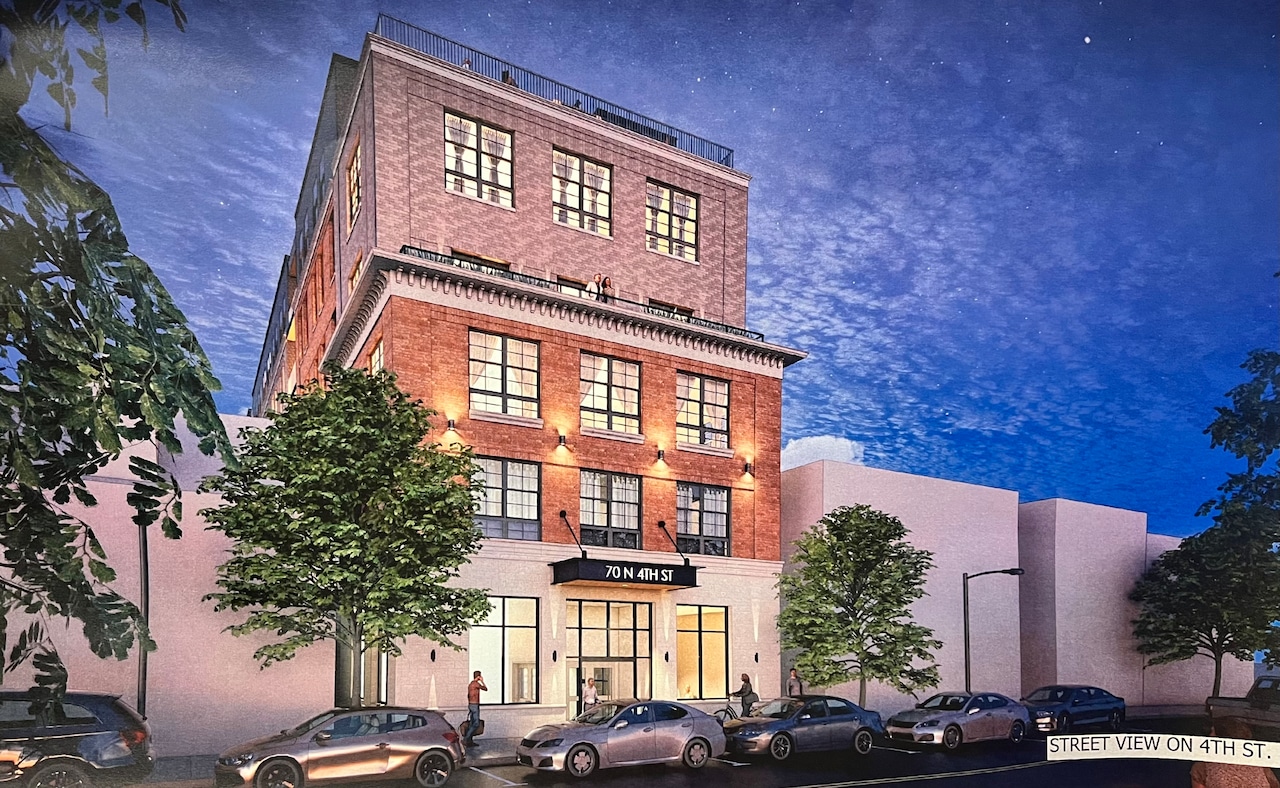
Last December a six-story apartment building was scheduled to go before the Easton Zoning Hearing Board. After opposition from residents, the matter was tabled.
It returned to the agenda a year later, and residents came back to advocate against it again.
The Easton Zoning Hearing Board held a special hearing Thursday evening on a proposed six-story mixed-use building at 70 N. Fourth St. The project includes 34 residential units and approximately 1,190 square feet of ground-floor retail in downtown Easton.
The developer needs a special exception from the board because the building’s proposed footprint far exceeds the city’s ordinance.
The hearing saw repeated objections, sharp exchanges between lawyers, and debate over the relevance of past zoning decisions, ordinance intent, and the scope of expert testimony.
“I want to say this first and foremost, we are not your enemy,” Attorney Chad DiFelice, representing 74 N. Fourth St. LLC, emphasized to the public during the meeting.
DiFelice said the proposed use and height are permitted by right and that the board is being asked to consider four specific variances related to sidewalk width, building footprint, build-to standards and ground-floor window transparency.
He argued the dispute centers largely on how the city interprets and applies its 15% building footprint rule.
The 15% building footprint rule limits how large a new building’s ground-floor footprint can be compared to nearby buildings in Easton’s Downtown District.
Under the city’s ordinance, a new structure must fall within roughly 15% of the footprint of principal buildings on adjoining properties, a requirement intended to keep new development compatible in scale with its surroundings.
DiFelice argued that the wording of the ordinance is unclear and has been applied differently in various situations.
“The reason we’re here tonight is because all we want is to be treated just like every other developer, just like every other person that has come before this board requesting the exact same relief,” he explained. “That’s all we want.”
The proposed footprint is 5,260 square feet, which is 280% greater than the 1,383 sq. ft. base footprint.
The city’s Director of Planning and Codes Dwayne Tillman testified that the proposed first-floor footprint exceeds the 15% threshold when compared to adjoining properties. He said he evaluated three adjoining parcels and selected the middle adjoining building at 74 N. Fourth St. as the comparison base.
He acknowledged under cross-examination that the ordinance does not specify how that base should be chosen and that the selection was clarified only after the initial denial.
DiFelice questioned Tillman about how the footprint rule has been applied on other downtown projects, including instances where only one adjoining building or a non-abutting building was used for comparison.
Assistant City Solicitor Jeremy Clark argued the ordinance is facially valid and that Tillman’s interpretation properly applies the 15% limit to physically adjoining properties.
Clark acknowledged inconsistent past applications but said prior errors do not invalidate the ordinance or require the city to continue applying it differently.
Former zoning officer and current Planning Administrator Carl Manges testified that he applied the footprint rule differently on a Sixth Street project by using a building across the street as the baseline. Under questioning, Manges acknowledged that approach differs from the current interpretation and that zoning decisions can be context-specific.
He said attempts to connect the ordinance to housing demand and population growth were curtailed as irrelevant to the variance criteria.
“South Sixth Street is much different in complexion and development than North Fourth Street, is it not?” opposing attorney Gary Asteak asked Manges. “So considerations in evaluation of variances or other factors with regard to development of South Sixth Street property would be unique to that section of the town, as opposed to North Fourth Street, correct?”
Throughout the hearing, Asteak often objected to hypothetical questions and comparisons to other projects, arguing each zoning application must be evaluated on its own facts.
Stephen Nowroski, a former Easton planning director who helped draft the zoning ordinance, testified that the 15% footprint provision contains ambiguous language and can reasonably be interpreted in multiple ways.
His cross-examination included objections over whether an expert witness could determine on how the board should interpret the ordinance, as well as challenges to his independence and the weight of his testimony.
Designer Anthony Civitella of USA Architects was another expert witness called during the meeting. He testified that design revisions reduced the building by roughly 10,000 square feet, lowered the unit count from 43 to 34, and added parking through a lease for 19 spaces in a city garage.
“We designed a building that we feel is compatible within the neighborhood, and that has taken what I would consider drastic leaps to carve the building and carve the massing and break it down into these various scales that is compatible within the city streetscapes,” Civitella said.
After four hours of testimony, the hearing was continued to Feb. 10.