
The Lehigh Valley is a rare combination of old-world culture and new economy innovation, where historic significance is joined by industrial innovation, and open space preservation unites with smart development. We have a unique location that’s close to world-class cities, but without the overcrowding headaches those cities have to deal with.
Our high quality of life is why so many people and businesses want to be here.
Our new analysis shows that another 100,000 people will be added by 2050 as the region grows by 18.6%, carrying the population to 816,000 people. Our job market will grow even faster, by nearly 25%, adding more than 80,000 jobs and pushing our employment market to more than 404,000.
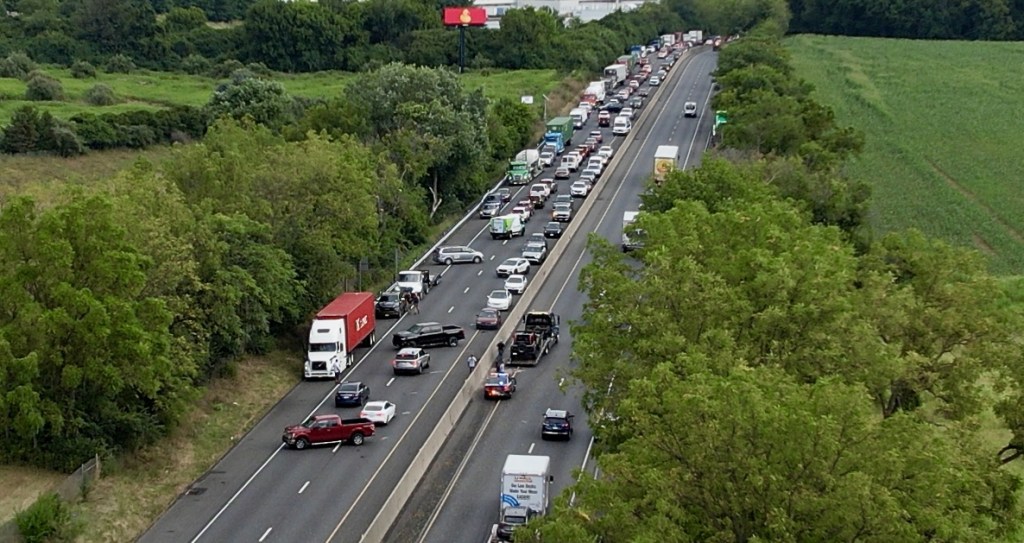
But with more people and workers, those headaches we’ve avoided for so long start to come into play — and the biggest may be our infrastructure. However, the one most people notice is our transportation network. Drivers are already logging almost an additional 1 million vehicle miles per day on Lehigh Valley roads compared to a decade ago, and that number will only continue to rise as more people move into the region.
There’s a $4.4 billion Long-Range Transportation Plan designed to maintain and enhance our network, but with us growing so quickly, it’s not nearly enough. It’s why we’ve requested that 31 of our most traveled roads be given a higher classification, so they can be enhanced to better handle the vehicles that are already pushing them beyond capacity. It’s a big reason we’ve requested that Route 22, and possibly 33, be reclassified as an interstate, which would make it eligible for funding from a different pot of federal money. This will be a process through the American Association of State Highway and Transportation Officials and the Pennsylvania Department of Transportation. As it stands, modernizing the roadway and expanding its capacity to handle our growth just doesn’t fit in that $4.4 billion equation.
We know that maintaining the road network is going to be a constant challenge as we grow, and everyone has been talking lately about how the capacity of our power grid will have to increase rapidly to handle all the electricity we’re going to need, but there’s one infrastructure strain that goes unnoticed to most but might be an even bigger challenge during our future expansion — sewer and water.
I always feel inelegant when I tell people that a big part of planning is about “poop and parking,” but it is so true, and the solid waste part is the one I’m most worried about. There are large areas of this region that have little or no public sewer capacity left and many communities that are growing with only on-lot well and septic systems that are best suited for truly rural places and not subdivisions or industrial parks. This lack of infrastructure has municipalities approving projects that include on-site septic or package plants to handle wastewater.
That’s almost never the best option unless it’s actually rural, not the lingering perception of an agricultural past. That option often leads to failed systems that literally leave, well, poop, bubbling to the surface, drinking water contamination and ultimately real threats to the public health and welfare. Throw on a general sense that paying for anything additional when families are already financially stressed into the mix and you have a looming potential crisis.
We really have to ask where, what and how to address sewer capacity constraints, expansions and yes, even building new public sewer and water systems where a community has become suburbanized or even urbanized.
I’s one of the reasons the Lehigh County Authority’s (LCA) five-year capital plan has $335.5 million in projects to replace and upgrade aging infrastructure. LCA is near capacity in serving roughly 270,000 people and businesses in large areas of the Lehigh Valley, and the area it serves includes some of the region’s fastest-growing communities — Allentown, Upper Macungie, Lower Macungie and a host of other communities that we expect to grow.
That’s why it’s imperative that communities update their Act 537 sewage facilities plans, that new developments be put on public sewer and water systems if they’re in a development zone, and that people and businesses outside of development zones that have on-lot systems regularly maintain them before they fail.
That brings us back to that forecast that raises concerns about infrastructure. LVPC Senior Data and Analytics Planner Dr. Subham Kharel and LVPC and Workforce Board Economist Minsoo Park used more than 70 data sets and developed their own artificial intelligence model to perform what we believe will be our most accurate forecast yet. Not only will we be adding roughly 4,300 new residents a year — even as two-thirds of Pennsylvania flatlines or shrinks — but our analysis showed that our strong job market is driving our growth. In fact, we’re now a net importer of workers. Nearly 5,000 more workers commute into the Lehigh Valley than leave it for work each day. That’s an about-face from just five years ago when the region was a net exporter of nearly 4,000 workers a day.
More jobs and more people equal more needs, more refinement to our systems and the greater need for collaboration, coordination and management. It’s not enough to review a land development, for a local government to sign off on it and for everyone to move on.
Development adds in every context. How developments relate to each other is critical and this happens over time and changes over time.
Yes, I’m worried about how we’ll afford all these infrastructure upgrades, but I’m also confident we’ll tackle this because we have lots of experience. The growth we’re about to see looks a lot like what we’ve been doing for more than a half-century. We’ve added 240,000 people since 1970. That’s like adding another Allentown, Bethlehem, Easton and Emmaus. Yet, we remain one of Pennsylvania’s fastest growing regions — and in my view, one of the nation’s most livable areas.
If we plan with the same resolve that made this region what it is today, the Lehigh Valley’s next chapter can be its most promising.
This is a contributed opinion column. Becky Bradley is executive director of the Lehigh Valley Planning Commission. She can be reached at planning@lvpc.org.