
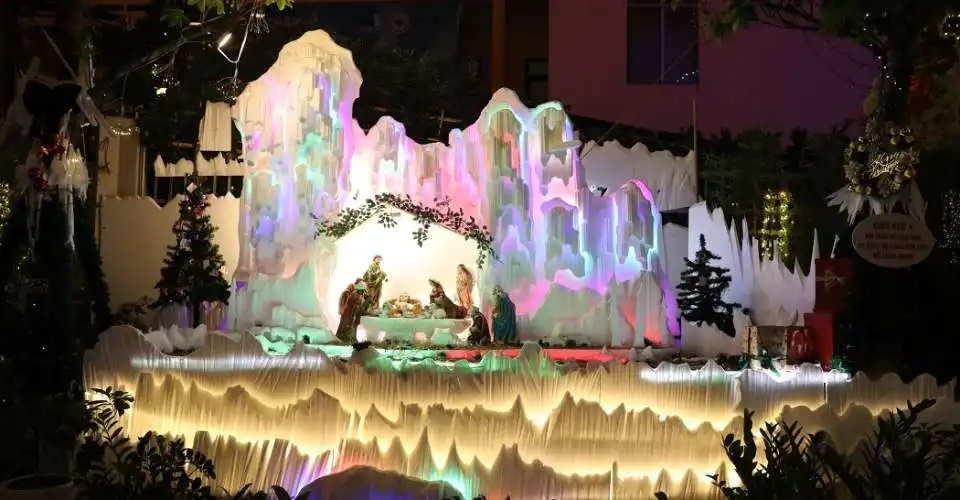
Every Christmas in Vietnam — a country where Catholics are a religious minority — Nativity scenes appear in church courtyards, parish grounds, and even in front of people’s homes. For local Catholics, this is a familiar part of the season.
Dec 23, 2025
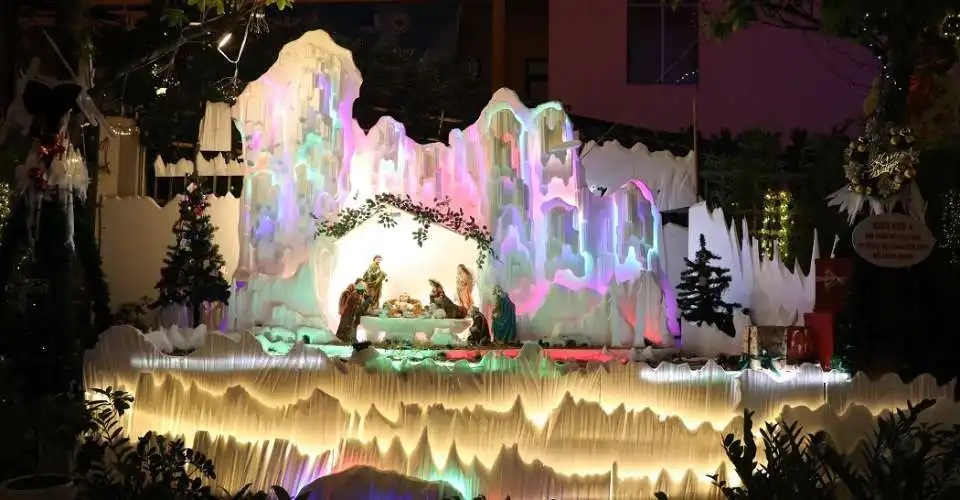
This Nativity scene is one of several on display in the courtyard of Thai Ha parish church in Hanoi. (Photo: Thai Ha parish media)
By Alex Hoang
Every Christmas in Vietnam — a country where Catholics are a religious minority — Nativity scenes appear in church courtyards, parish grounds, and even in front of people’s homes. For local Catholics, this is a familiar part of the season. For visitors from abroad, it can feel unexpected. Bethlehem, it seems, has quietly entered a Vietnamese village.
Inside the grotto, parishioners place statues of baby Jesus, Mary and Joseph, along with a donkey and an ox — a familiar Nativity arrangement for Vietnamese Catholics. To many local believers, this setting feels natural, even obvious.
For visitors from Western countries, however, it can raise a quiet question. Why does the Nativity here look different from what they are used to seeing?
In many Western churches and homes, the birth of Jesus is usually shown in a wooden stable or barn. In Vietnam, the scene is more often placed in a cave-like space, built from simple materials and shaped by hand. The figures remain the same, but the setting feels different.
This difference is not about changing the Christmas story. It is about how the story is imagined and brought closer.
Bringing the story closer
Catholicism came to Vietnam in the 16th century and took root in a society shaped by village life, strong family ties, and a mix of religious traditions. Over time, Catholic communities learned to express their faith in ways that felt natural in their surroundings.
The Nativity scene became one of the clearest expressions of this process. Rather than copying European models, communities chose to tell the Christmas story in spaces people recognized. By placing the birth of Jesus in a setting that feels familiar, the message becomes easier to grasp: God enters ordinary human life.
The characters remain the same. What changes is the sense of distance. Bethlehem is not replaced but brought closer.
What truly sets Vietnamese Nativity scenes apart is how they are made. In many parishes, building one is a community effort that involves people of all ages.
In a parish on the outskirts of Hanoi, Thien Truong, head of a local parish group, said preparations usually begin soon after All Souls’ Month ends in November.
“We start working on the main Nativity scene for the parish right after that,” he said. “Everyone joins in.”
Older parishioners cut old sacks and tarpaulins, heating and shaping them so they look like stone once assembled. Younger adults build bamboo frames, paint surfaces, and plan the overall structure. Children help by making small decorations such as stars and simple ornaments.
“That is when the Christmas atmosphere begins for us,” Thien Truong said. “Not when the lights are switched on, but when people start working together.”
In some parishes, there is not just one Nativity scene. Several are displayed within the same church compound, each made by a different parish group or neighborhood community. Walking through the church grounds becomes a walk through the shared life of the parish itself.
Seen at night, Vietnamese Nativity scenes can look large and impressive. Up close, however, the materials are simple. Bamboo frames, cardboard, sacks, cement bags, foam, tarpaulins, and recycled items are commonly used to form caves, hills, and pathways.
Most communities do not spend much money on these displays. What matters is effort, not expense.
This contrast — between outward scale and modest materials — is part of their meaning. These Nativity scenes reflect a form of faith shaped by everyday life, where beauty comes from care and cooperation rather than luxury. In many ways, the materials themselves echo the Christmas story: something humble made meaningful through shared work.
A gentle presence
Vietnam is home to many religions, and public expressions of faith are often quiet and respectful. Nativity scenes placed in open spaces — church courtyards, village lanes, or house entrances — become a gentle presence in the wider community.
In Thai Ha Parish in Hanoi, one of the city’s best-known Catholic parishes, Nativity scenes attract visitors every Christmas season. A parish priest there said many people come simply to look, take photos, and spend time in the church grounds.
“Most of them are not Catholics,” the priest said. “Some kindergartens even bring young children here as a Christmas outing.”
For him, the Nativity scene offers more than decoration. “It helps people understand what Christmas is really about,” he said. “Not only bright streets, an old man in a red suit, or gifts — but the story behind the celebration.”
Without speeches or explanations, the scene itself invites reflection. It speaks through images rather than words.
In some parts of Vietnam, especially in earlier decades, communities faced periods when religious activities were limited or when priests were scarce. During those years, Christmas Mass was not always possible.
Still, Nativity scenes were built.
For many older Catholics, the hang ?á carries memories of those quieter times. It reminds them that faith continued, even when public celebration was difficult. The scene became a sign that Christmas — and belief — had not disappeared.
Taken as a whole, the tradition of building Nativity scenes in Vietnam shows how Christianity continues to grow through local culture. Christmas here is not simply imported and repeated but shaped by community life.
When Bethlehem meets the village, the Christmas story feels closer and more human. It becomes something people build together each year, using simple materials, shared memories, and collective care.
In that quiet process, Vietnamese Nativity scenes offer a simple message that reaches beyond religion: meaning is often found not in grandeur, but in ordinary places, shaped by community, patience, and hope.–ucanews.com