
To be Philadelphian affords you access to the legacy of living in a city that holds within its limits some many of the firsts in America. We have the first all volunteer fire department, the first university, and the first hospital in these United States. Our city was also the first in all of America to be created with a formulated plan — and one that can still be seen today in Philadelphia’s intersecting streets between the Schuylkill and Delaware Rivers, and five still-surviving original squares (Franklin, Logan, Washington, Centre, and Rittenhouse.) Centre Square is now City Hall.
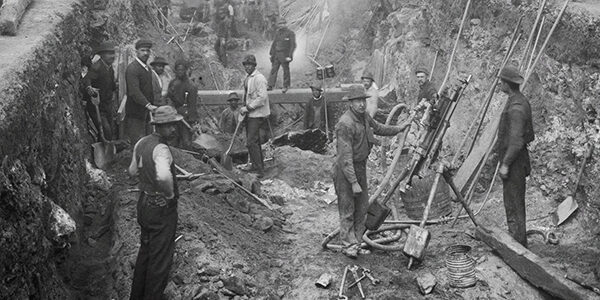
As SEPTA misses the early December federally regulated deadline in regards to its Silverliner IV cars, this month marks a grim milestone in Philadelphia history. In 1893, at the intersection of 16th Street and Pennsylvania Avenue while the construction of the Reading subway in Philadelphia was underway, a support caved in and two men were buried alive. One of them — Michael O’Hearn — became unconscious upon reaching Hahnemann Hospital and then subsequently passed away.
In early December, issues between Mayor Cherelle Parker and Philadelphia’s City Council over her proposed two billion-dollar H.O.M.E. initiative in Philadelphia includes issuing eight hundred million in city housing bonds. This month in 1791, a beginning tenant of Alexander Hamilton’s financial roadmap for America — the First Bank of the US was started at the site of the organized assembly place of the First Continental Congress (right here at Carpenter’s Hall.) The First Bank of the United States was the first one who accepted payments for federal taxes. The Bank would exist in Philadelphia for six years.
But this paramount piece of history this fall isn’t just in Philadelphia history but also for the Independence of the United States. On December 12, 1776, the Second Continental Congress fled the City of Philadelphia. For a time, they would stay in Baltimore in order to escape the fear that the British Army was threatening the city. It would be less than a year before Howe’s army would take Philadelphia.
Pennsylvania’s State House (which would eventually become Independence Hall in Philadelphia and where the Constitution was adopted in July 1776) would be the site of another milestone in the creation of our nation. On December 12, 1787, Pennsylvania became the second state to ratify the Constitution right here in our city.
December holds an additional significance for Philadelphia. December 11, 1800 was the last day that Philadelphia could claim that it was America’s capital. On the very next day, Washington D.C. was registered as the US capital and has been so ever since.
Michael Thomas Leibrandt lives and works in Abington Township, Pa.