
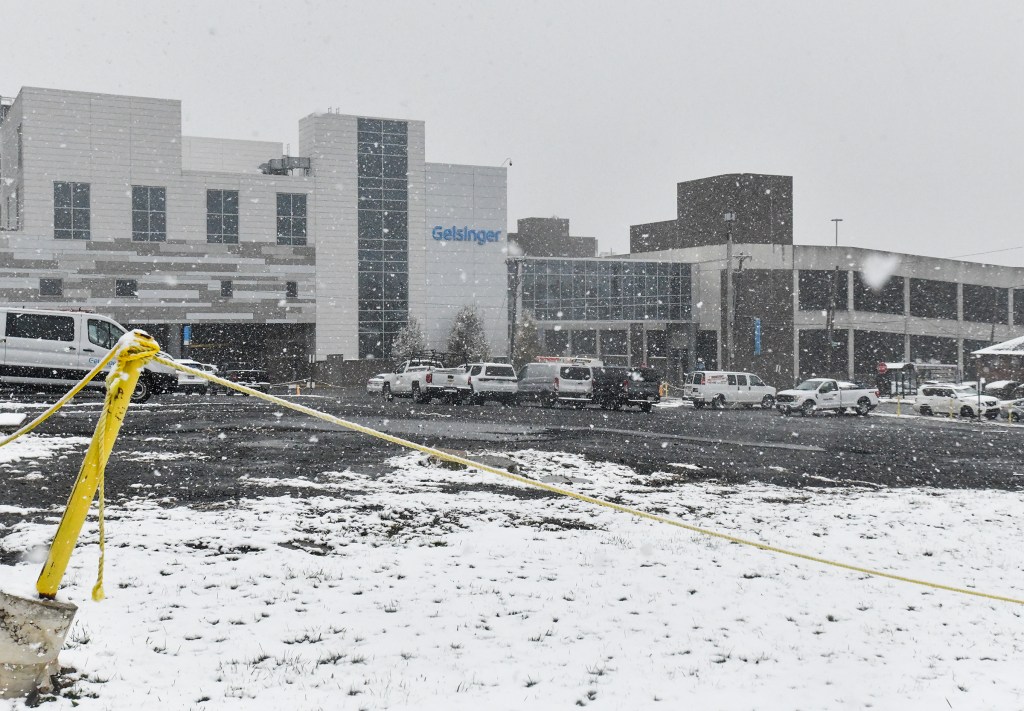
Tough hill to climb
Geisinger Community Medical Center is poised to expand in Scranton’s Hill Section. City council narrowly approved a rezoning ordinance in early December pushed by Mayor Paige Gebhardt Cognetti to allow for the expansion, despite opposition from neighborhood residents.
Council’s decision allows Geisinger to rezone properties in the 200 and 400 blocks of Colfax Avenue from institutional to civic zones. The change raises the building height limit from 45 feet to 100 feet, enabling the hospital’s plan to construct a 75-foot-tall clinical building and a five-story parking garage.
The project includes a bridge over Mulberry Street to connect the new inpatient addition — located on the site of the former John J. Audubon School — to the existing hospital. Geisinger officials and the mayor argued that the investment is vital to meeting the region’s growing health care needs.
The proposal faced opposition from Hill Section residents who argued the rezoning bypasses the zoning board variance process and limits the community’s ability to influence the project’s design. A last-minute legal attempt to delay the vote via a preliminary injunction was denied by a Lackawanna County judge, who ruled that the court lacked jurisdiction to block a legislative act before it occurred.
Residents expressed fears that the hospital’s growth would “swallow” the residential character of the neighborhood and create traffic congestion. Geisinger expects the expansion project to take approximately 18 to 24 months to complete.
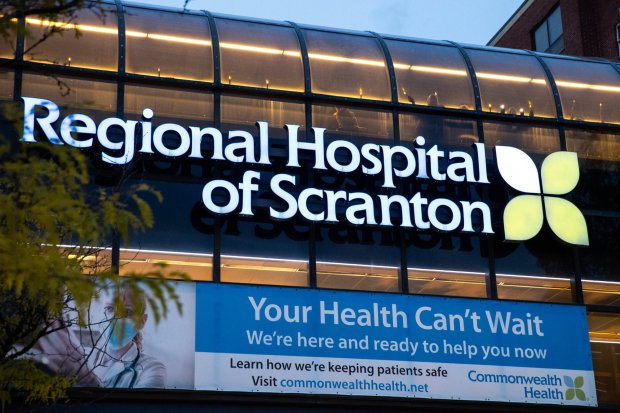 Regional Hospital workers hold candles as they stand on the hospital’s bridge over Jefferson Avenue in Scranton as the hospital’s unionized workers and they supporters attend a candlelight vigil on Thursday, Oct. 19, 2023. (CHRISTOPHER DOLAN / STAFF PHOTOGRAPHER)
Tenor signs letter of intent to acquire Commonwealth hospitals
The nonprofit Tenor Health Foundation signed a letter of intent to acquire three local hospitals from Commonwealth Health: Regional Hospital of Scranton, Moses Taylor Hospital and Wilkes-Barre General Hospital. The deal, confirmed by interim CEO David E. Loving and Tenor founder Radha Savitala, marks a critical point for the facilities. While the acquisition was originally focused on the Scranton assets, Wilkes-Barre General was included to ensure the financial viability of the entire transaction.
The development follows a period of intense uncertainty after a previous sale to WoodBridge Healthcare collapsed late last year. Since then, the Scranton hospitals have relied on millions of dollars in emergency funding from local foundations and nonprofits to maintain operations and pay staff. Community leaders and health care workers had expressed grave concerns that without a buyer, the facilities — which handle thousands of emergency visits and births annually — could be forced to close.
Tenor Health Foundation is a nonprofit specializing in turning around financially challenged medical centers, having recently taken over Sharon Regional Medical Center in Mercer County. While the specific financial terms of the deal remain undisclosed, officials indicated that success will likely depend on appropriate community support. This could involve tapping into the newly created federal Rural Health Transformation Program or continued assistance from the local coalition of foundations that has stabilized the hospitals so far.
Regional leaders, including Scranton Mayor Paige Gebhardt Cognetti and state Rep. Bridget Kosierowski, expressed cautious optimism. They emphasized that while the letter of intent is a legitimate first step toward long-term stability, significant hurdles regarding financial feasibility and service preservation remain. The transition to nonprofit status may also impact local tax revenues, a concern noted by Wilkes-Barre officials as the community awaits further details on the arrangement.
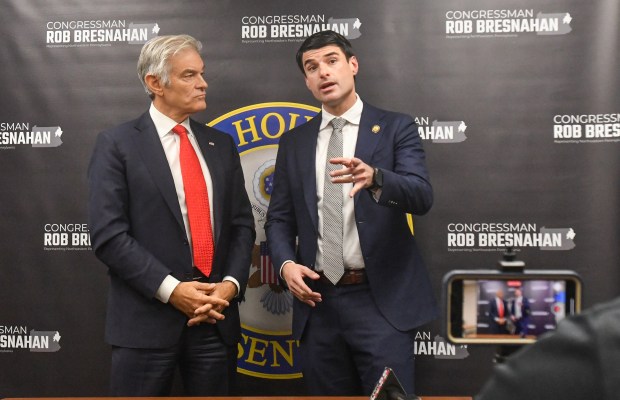 State Rep. Rob Bresnahan speaks with Administrator for the Centers for Medicare & Medicaid Services Dr. Mehmet Oz at the Geisinger Community Medical Center Professional Building in Scranton Friday, December 5, 2025. (SEAN MCKEAG / STAFF PHOTOGRAPHER)
The fight for health care subsidies
Breaking with their party, four House Republicans — including U.S. Rep. Rob Bresnahan, R-8, Dallas Twp. — joined Democrats in December to force a vote on extending Affordable Care Act subsidies. The move came as 24 million Americans, including thousands in Pennsylvania, faced premium increases as high as 50% following a year-end deadline. The defectors argued that the “health care cliff” posed an unacceptable financial burden on their constituents.
Congress adjourned for the holidays without a resolution.
Political analysts view the GOP revolt as a calculated move for political survival in highly competitive districts. Pennsylvania is expected to be a primary battleground for the 2026 midterms, with more competitive Republican-held seats than any other state. Experts point to historical precedents in 1994, 2010 and 2018, where the party in power suffered significant losses after failing to resolve health care affordability issues.
As the 2026 election cycle approaches, both parties are bracing for a campaign dominated by messaging on affordability, with health care costs positioned as a central pillar of the debate.
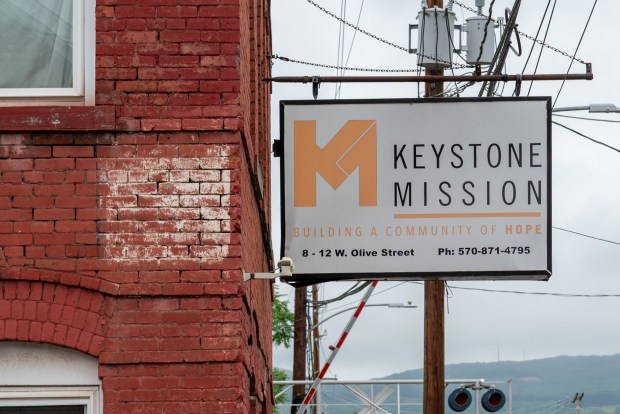 Keystone Mission in Scranton on Tuesday, June 17, 2025. (REBECCA PARTICKA/STAFF PHOTOGRAPHER)
Keystone Mission homeless shelters close in Wilkes-Barre and Scranton
Increased costs and decreased donations and volunteers led the Keystone Mission board of directors to shut down, Justin Behrens, former CEO and executive director of the nonprofit, said.
“I came back … to the mission as the interim executive director (around February), and my goal was to get it back on track and try to keep things afloat. It came about a month ago that I realized that the board needed to start making a decision of what’s the direction of the mission, to keep it sustainable,” Behrens said. “The board, after debating, making decisions among themselves, came to the conclusion that we are going to sell the Scranton building and close down the East Union Street building, and we are going to keep open the Sherman Hills building for operation.”
Behrens said Keystone Mission would reduce staff from 21 employees to six.
Keystone had been operating a day shelter with programming for individuals experiencing homelessness, located at 12 W. Olive St. in Scranton, and the Innovation Center for Homelessness and Poverty, since 2007. The nonprofit opened a facility of the same name in leased space at the former Thomas C. Thomas Building at 90 E. Union St. in Wilkes-Barre in October 2023, and that facility doubled as an overnight shelter for up to about 50 homeless people.
Keystone’s 15-bed Transformation Center for males, located in a building at 290 Parkview Circle within the Sherman Hills apartment complex in Wilkes-Barre, which was donated anonymously to Keystone in 2008, remains operating.
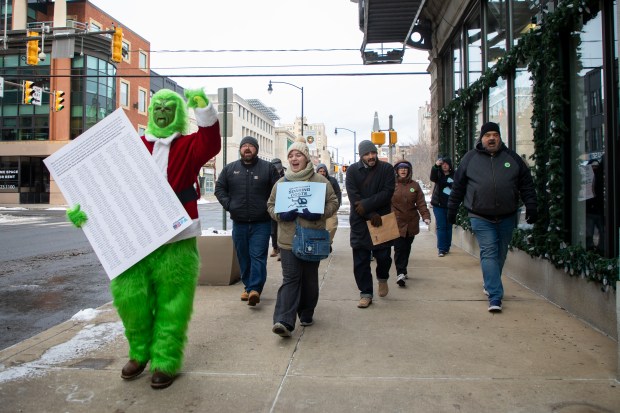 Protesters walk to U.S. Rep. Rob Bresnahan’s office to deliver a petition asking the representative to restore funding to SNAP and Medicaid in downtown Scranton on Monday, Dec. 15, 2025. (REBECCA PARTICKA/STAFF PHOTOGRAPHER)
SNAP benefits delayed
Supplemental Nutritional Assistance Program benefits were paused in November due to the federal government shutdown. The pause caused confusion, panic and frustration among more than 1.93 million eligible Pennsylvanians.
The U.S. Department of Agriculture directed states not to issue November benefits due to the shutdown. States sued the federal government in an effort to restore the funding.
After the shutdown ended, the state Department of Human Services announced the full resumption of the SNAP program in mid-November.
In Lackawanna, Luzerne, Schuylkill and Carbon counties, 146,644 residents were eligible for SNAP as of September.