
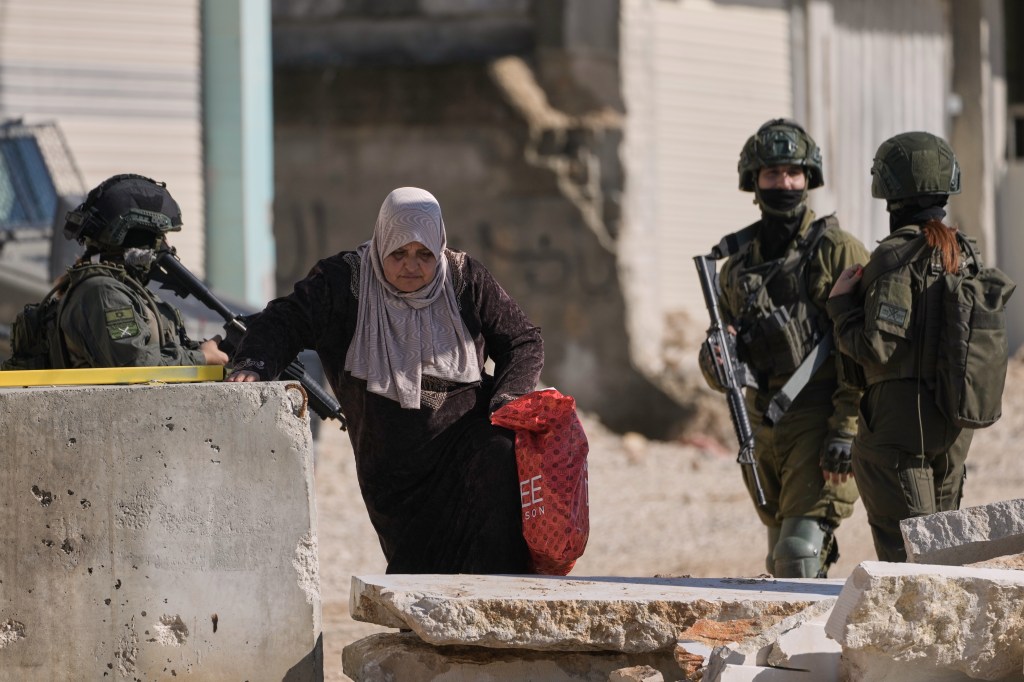
As Christians around the world celebrated the birth of Jesus in Bethlehem, I hope they took some time to think of the children who are there today too. This region that many people only think of in biblical terms is a real place where children and families today live in a constant state of fear and trauma that will continue to perpetuate insecurity in the region if left unresolved.
Bethlehem is a town in the West Bank, the Palestinian region west of the Jordan River, approximately the size of Delaware. The West Bank is home to about 3 million Palestinians, nearly half of them children. It has been under military occupation by Israel since 1967. Although it has not faced the same levels of destruction and suffering as the war in Gaza, the West Bank has seen a dramatic increase in violence, injustice and aggression over the same period.
Since Oct. 7, 2023, the day Hamas killed more than 1,200 Israelis and kidnapped about 250, more than 1,000 Palestinians in the West Bank have been killed by Israeli forces and “settlers,” the term used to describe the Israeli citizens living on property taken forcibly from Palestinian residents.
The Israeli government defends its military operations there as essential to protect against terrorism and rioters. But the excessive and disproportionate use of force suggests collective punishment of the population. More than 200 of these victims are children. This includes a 2-year-old named Laila who was shot in her home during an Israeli security operation that emptied three Palestinian refugee camps, and a 9-year-old named Mohammad who was shot by Israeli Security Forces while playing football.
In at least 244 cases, Israeli authorities then delayed or blocked medical assistance from reaching the injured. Several of these cases were children left to die.
Meanwhile, Israeli settlers “armed with bats and Molotov cocktails” have plundered and destroyed Palestinian homes and property daily in communities across the region, as reported by PBS “NewsHour” earlier this month. They burn olive groves and cut down the trees, some hundreds of years old, in order to destroy Palestinian livelihoods and heritage. And they do so with utter impunity. Tens of thousands of Palestinians have been displaced by settler attacks, strikes on refugee camps, demolitions, and hundreds of checkpoints, roadblocks and other obstacles to obstruct movement.
Since the occupation began, Israel has gradually expanded its settler population by force, even though this explicitly violates international law. About 700,000 settlers live in the West Bank today. This month, the Israeli government approved 19 new Jewish settlements, which means this government has increased these illegal settlements by 50% in just three years. This expansion has been accompanied by a harsh campaign of repression. West Bank Palestinians are denied basic rights and freedoms and have no protection from arbitrary detention, deprivation or violence, which they experience frequently at the hand of Israeli troops and settlers with no recourse.
Consider what life looks like for children there today. They live in the shadow of heavily armed soldiers who see them as the enemy. They must navigate threatening blockades and checkpoints and hope they don’t make a mistake or misstep that could cost them their lives. The threat of violence against their family and friends is constant and arbitrary. At any moment, they could be under attack too. If they feel threatened by settlers who menace their village or take their property, they have no trusted authorities to seek protection from. They look to their parents or other adults for protection, but their elders have little security to offer. It is a bleak existence that does not inspire hope for the future, and it’s only getting worse.
Residents and observers of this region argue over who is to blame for the waves of violence that both Israel and the occupied territories have experienced for generations. But nothing in that history justifies the violence and injustices these children must endure today. Even so, their continued exposure to conflict and trauma will sow the seeds for that violence to continue in the years ahead, if they see little reason for hope and trust in a future.
If the Israeli government continues to deny that hope by blocking a future Palestinian state, ongoing violence and instability there will continue to cause trauma for its own population too.
Some schools and families in the West Bank are trying to help their children cope better with the stress of occupation. One example is House of Hope Vision School, which provides a trauma-informed curriculum and nonviolence education for young children, teachers and moms in the West Bank town of Eizariya just outside of Bethlehem. Using role models such as the Rev. Martin Luther King Jr. and Mahatma Gandhi, these families learn to live and practice nonviolence in their own lives as they learn coping skills to ease the psychological stress of occupation.
It is no substitute for a political solution that could offer a better future to the population as a whole. But during this holiday season, we should all be grateful to those who work to bring hope and resilience to the vulnerable under the hardest circumstances and consider how we can support better outcomes too.
Elizabeth Shackelford is a senior adviser with the Institute for Global Affairs at Eurasia Group and a foreign affairs columnist for the Chicago Tribune. She is also a distinguished lecturer with the Dickey Center at Dartmouth College. She was previously a U.S. diplomat and is the author of “The Dissent Channel: American Diplomacy in a Dishonest Age.”
Submit a letter, of no more than 400 words, to the editor here or email letters@chicagotribune.com.