
Data: Can’t live without it, and we’re about to find out about living next to it.
The Lehigh Valley Planning Commission in December reviewed what it labeled the first hyperscale data center proposed for Lehigh or Northampton counties.
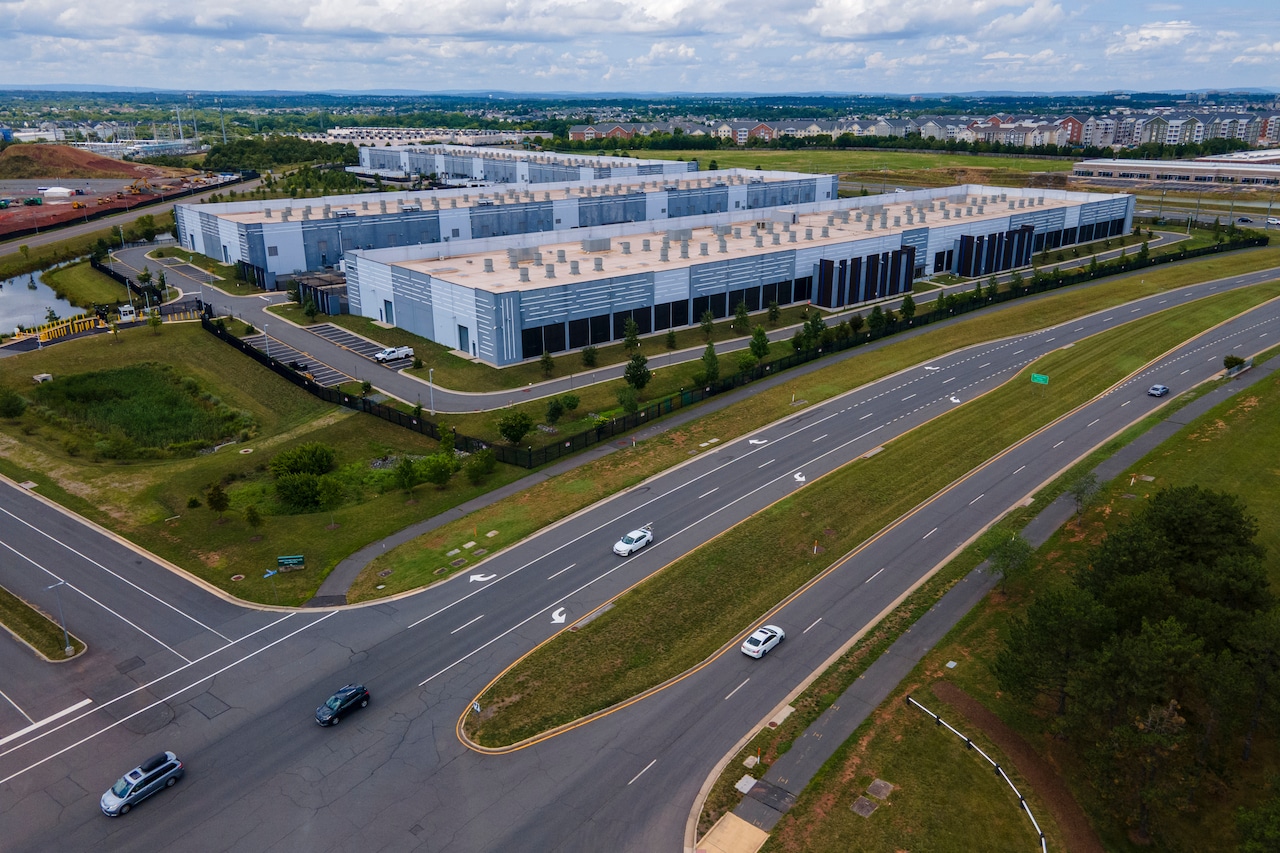
These sprawling, windowless warehouse centers hold rows of high-speed servers that power almost everything the world does on phones and computers.
More are already planned.
The project reviewed by the LVPC on Dec. 16 and 18 consists of three data center buildings totaling 2.6 million square feet on the 194-acre former corporate headquarters of Air Products. The global industrial gas giant owns the land at 7300 Cetronia Road in Upper Macungie Township, according to Lehigh County property records.
Planning commission staff revealed during the earlier meeting that a company called Atlas Industrial proposes another hyperscale data center in South Whitehall Township. WFMZ-TV 69 reports those plans call for six buildings totaling 5.1 million square feet at 2493 N. Cedar Crest Blvd., near Parkland High School.
Data centers aren’t new, with the Lehigh Valley already home to micro, small, medium and large-scale data centers that range in size from an IT closet to area measured in hundreds of thousands of square feet.
The Lehigh Valley Economic Development Corp. on Dec. 16 announced the sale of Tek Park in Upper Macungie that is home to one of these smaller-scale centers. TierPoint, based in St. Louis, purchased the nine-building, 137-acre campus at 9999 Hamilton Blvd. for $175 million and said it has started a 100-megawatt expansion of the existing data center, expected to be complete in late 2026, the LVEDC said.
Hyperscale data centers represent clusters of buildings that can be home to multiple companies colocating on the site, according to the Lehigh Valley Planning Commission.
It’s a type of industrial development that’s grabbed the attention of planners from Lehigh County to the Easton area to the Slate Belt.
Municipal officials in Upper Macungie, Palmer, Forks and Upper Mount Bethel townships all worked on ordinances in 2025 to set ground rules for data centers — like where they can be built.
Pennsylvania law requires every local government to prepare for every type of land use, the Lehigh Valley Planning Commission says. With data centers, new proposals are coming in even as those rules are being established, like with the Air Products plan in Upper Macungie.
“The bottom line is every community in Pennsylvania, under state statute, is required to consider every land use conceivable,” the commission’s executive director, Becky Bradley, said last week. “Unfortunately, sometimes those land uses come in at a time when local governments are working on ordinances to manage those land uses.”
The layout and design of the Air Products proposal are essentially the same as a 2.6-million-square-foot warehouse plan already approved by Upper Macungie for the site, according to the LVPC.
But the proposed shift to data centers was short on details during the planning commission’s Dec. 16 review, officials said.
“The submission does not provide sufficient information to evaluate the project’s full electrical demand or its long-term impacts on the regional power grid,” the commission’s review letter states. It adds later: “The application lacks essential information regarding the project’s water demands and cooling system.”
Air Products says the new development plan aims “to preserve flexibility and optionality for future redevelopment of our former headquarters site,” and that the company believes it’s met the township’s land use requirements. The proposal is scheduled to go up for review by township officials Feb. 25.
“At this early stage, it is normal for certain details to be addressed as the process advances,” a spokesman told lehighvalleylive.com.
Both power and water use for cooling are major issues for data centers.
The Pennsylvania Public Utility Commission is reviewing a model set of regulations for electricity companies to follow for data centers and other high-demand electric users looking to connect to the grid. The goal is to guide how large loads interconnect and share costs.
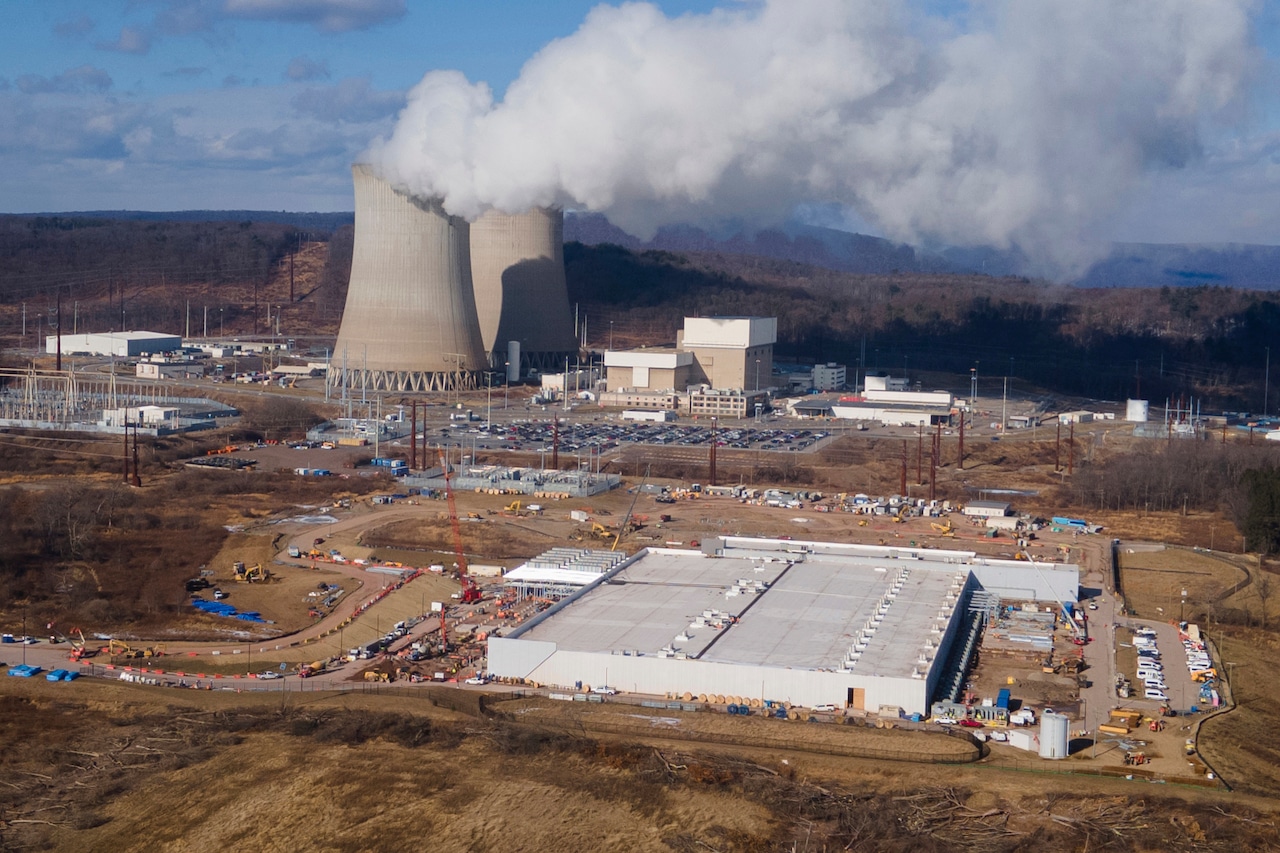 A data center owned by Amazon Web Services, front right, is under construction in January 2025 next to the Susquehanna nuclear power plant outside Berwick, Pennsylvania.AP File Photo/Ted Shaffrey
That comes as federal utility regulators on Dec. 17 voted to effectively allow tech companies to plug massive data centers directly into power plants. It’s part of the Trump administration’s push to help the U.S. lead the world in artificial intelligence and revive domestic manufacturing.
When it comes to water use for cooling, some estimates show a mid-sized data center commands the same water usage every day as 1,000 households. Emerging technology is looking at tapping wastewater — the liquid portion of sewage — instead of potable water for the necessary thermal energy transfer systems.
Worries about how resource-hungry artificial intelligence will affect the environment surpass concerns about other industries that worsen climate change, according to October polling from The Associated Press-NORC Center for Public Affairs Research and the Energy Policy Institute at the University of Chicago.
Developing hyperscale data centers comes with tradeoffs, according to a Lehigh Valley Planning Commission analysis that found:
Benefits like property tax revenue, limited vehicular traffic generation, high-salary job creation and providing critical infrastructure.Challenges including issues with electricity consumption, water management (withdrawal and disposal), environmental (noise, air, heat) and scale/form compatibility to the surroundings.
The Lehigh Valley is surfacing as an attractive area for data centers thanks to strong energy and transmission infrastructure, nearby major population centers and space available for development, according to LVPC Chief Community and Regional Planner Jill Seitz.
“Data centers are essential to meeting modern digital connectivity needs and demands,” she told the commission’s Comprehensive Planning Committee on Dec. 16. “However, hyperscale facilities pose unprecedented levels of impact to communities’ utility infrastructure.”
The Associated Press contributed to this report.