
Wind speeds as strong as 60 mph pushed water away from Lake Erie’s western basin on Monday.
TOLEDO, Ohio — Powerful wind gusts from a low pressure system are producing a seiche in Lake Erie and the Maumee River on Monday, a phenomenon that exposes the usually-covered floors of these bodies of water.
What is a seiche?
According to the National Weather Service, a seiche usually occurs when strong winds and rapid changes in atmospheric pressure push water from one end of a body of water to another. In the case of Monday’s seiche, the water is being pushed from Lake Erie’s western basin to its eastern end, near Buffalo, New York.
Northwest Ohio saw on Monday morning wind gusts as strong as 60 mph near Lake Erie’s shore. These are the winds pushing water away from northwest Ohio, lowering the water levels in the Maumee River and nearby Lake Erie shores by as much as 4 to 6 feet. Waves in Lake Erie on Monday were as tall as 15 feet on account of these strong winds.
Below is an image of the Maumee River near Owens Corning in downtown Toledo, showing the exposed riverbed during Monday’s seiche.


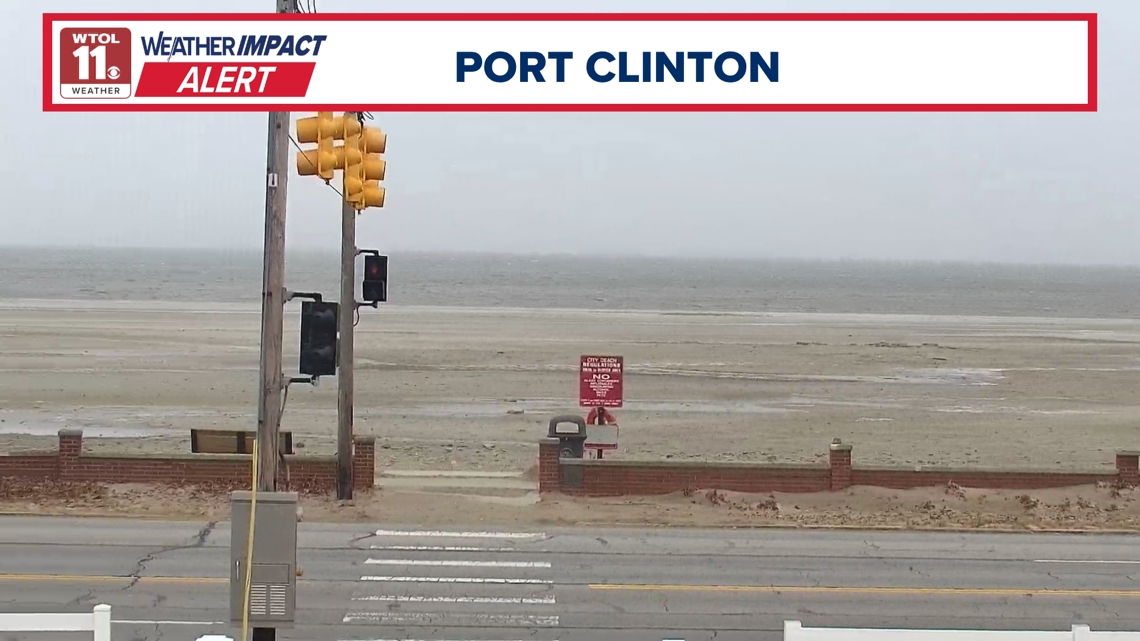
In Port Clinton, the lakebed was also visible where the water had been pushed away from the shoreline.

While seiches cause lower water levels on one end of Lake Erie, it can bring substantial flooding to the other end of the lake, to where the water inevitably moves.
When will water levels return to normal?
When the strong wind gusts cease, the force keeping Lake Erie’s water to the east will no longer be in place. As such, the displaced water will return to Lake Erie’s western basin and the Maumee River, but it won’t be instantaneous. Lake Erie contains 116 cubic miles – or 127.7 trillion gallons – of water, which takes time to return.
If you picture the lake as an enormous bathtub with a fan blowing water to one end, it may be easy to visualize the water rebounding to the other side when the winds are removed. When rebounding, the water will continue to oscillate back and forth for hours or days as it returns to its normal distribution. The National Weather Service said in the Great Lakes, the time period between the “high” and “low” of a seiche can be as much as four to seven hours.