
Data centers dominated local news throughout 2025, ushering in an unprecedented onslaught of new development and packing public meetings with standing-room-only crowds of concerned residents.
Only one year ago, data centers were largely unheard of in Lackawanna County, with neighboring Luzerne County receiving some of the earliest proposals, including Amazon’s plan to build a data center campus tapping into Talen Energy’s nuclear power plant in Salem Twp. and NorthPoint Development’s proposed “Project Hazelnut” in Hazle Twp. Entering 2026, Lackawanna and Luzerne counties have now received proposals to construct over 100 data center buildings across more than a dozen campuses as developers and tech giants look to cash in on the rapidly growing industry driven by a race for artificial intelligence dominance, making Northeast Pennsylvania a data center hot spot not only in the state, but nationally.
Data centers promise significant tax revenue, infrastructure investment, construction jobs and full-time positions operating the high-tech facilities — at the cost of straining local utilities due to the large quantities of electricity needed to fuel them and high volumes of water to cool them; impacting residents with proposals to build near homes, schools and parks; and wiping out local ecosystems by building across hundreds of acres of untouched land while local governments scrambled to update their land-use laws to address the new industry.
Unlike the region’s most recent boom, the warehousing and logistics industry, data center proposals often place the facilities much closer to residential areas, moving from mostly industrial parks to land in the middle of communities.
Rising above local politics, state and federal leaders have championed data centers, from Gov. Josh Shapiro’s June announcement of Amazon’s plans to invest $20 billion into Pennsylvania for artificial intelligence infrastructure — including in Salem Twp. — to President Donald Trump and U.S. Sen. Dave McCormick touting more than $90 billion in planned investments into about 20 artificial intelligence and energy projects across the state — largely in Northeast Pennsylvania, Western Pennsylvania and the Susquehanna Valley — during an Energy and Innovation Summit in July at Carnegie Mellon University in Pittsburgh. Further supporting artificial intelligence and data centers, Trump signed a Dec. 11 executive order aimed at limiting how states can regulate data centers, instead trying to govern the industry with a “minimally burdensome national policy framework for AI.”
Fearing the impacts data centers could have on their homes, residents spent 2025 researching data centers, filling public meetings and pleading with elected officials to protect their communities. While Northeast Pennsylvania residents are familiar with controversial developments that packed public hearings, like the Keystone Sanitary Landfill in Dunmore and Throop or the Lackawanna Energy Center natural gas-fired power plant in Jessup, no industry has generated so much controversy across so many communities, making data centers The Sunday Times’ newsmaker of the year for 2025.
 Archbald resident Tamara Misewicz-Healey, standing at podium, addresses borough council during a data center zoning hearing at St. Thomas Aquinas Church, Archbald, on Monday, Sept. 29, 2025. (FRANK WILKES LESNEFSKY / STAFF PHOTO)
‘Location is key’
John Augustine, the president and CEO of Penn’s Northeast, considers data centers to be the fourth industrial revolution in Northeast Pennsylvania. Penn’s Northeast is a Pittston-based collective that promotes Northeast Pennsylvania for new investments, jobs and business opportunities.
First, it was coal, then manufacturing with work in industries like metal fabrication and plastics, followed by warehousing and distribution as the third, Augustine said.
“(Data centers) just happen to be the fourth,” he said. “Location is key. It was for warehouse and distribution centers, as it is for data centers.”
Just like the region’s proximity to major interstates attracts warehouses, the high-tension power lines slicing through the area attract data centers.
The warehousing and distribution industry thrived over the past decade as major e-commerce firms like Amazon and Chewy opened sprawling warehouses in Lackawanna and Luzerne counties, and an increased reliance on online shopping during and after the COVID-19 pandemic only helped to sustain that industry, though new warehouses tend to be smaller than the 1-million-square-foot facilities often proposed almost a decade ago.
Both Augustine and Greater Scranton Chamber of Commerce President Bob Durkin agree that the warehousing industry is still active locally, though the attention has shifted to data centers.
Companies like Mericle and NorthPoint continue to build warehouses on speculation, meaning constructing them without a specific tenant in mind, Augustine said.
“I don’t really see a lot of slowing down on the warehouses and distribution,” he said.
Both the warehousing and data center industries have focused on this area, despite not really being targeted by economic developers, Augustine said.
“They’ve basically chosen us because of our location,” he said.
Although the Scranton chamber and its development arm, the Scranton Lackawanna Industrial Building Company, or SLIBCO, have moved away from warehousing, private developers continue to work toward larger facilities, Durkin said. Developers also continue to look at manufacturing locally, he said.
“There are markets out there — the markets for manufacturing are not dead, they’re just below the radar,” Durkin said, citing non-disclosure agreements. “One of the reasons you don’t hear about a lot of these things is that you won’t hear about them until they’re a done deal.”
Members of SLIBCO recently traveled to Philadelphia to entertain about a dozen site selection professionals and major commercial Realtors, and while there was a lot of discussion about manufacturing, there wasn’t a word about data centers, he said.
“We want to continue to diversify,” Durkin said. “We want to continue to have quality jobs that come from advanced manufacturing.”
The rise of data center proposals locally is unprecedented, but not unexpected, Durkin said.
“We had been monitoring this for quite some time,” he said.
Augustine first had “high-level talks” with some data center representatives about two years ago, with the earliest talks of Amazon’s Talen Energy project dating back to early-mid 2024.
“That certainly turned a lot of people’s heads and kind of put us on the map where others started to say, ‘Amazon picked this. Why did they pick this area?’” Augustine said. “That’s a major headline. That’s an economic development marketing tactic that we take quite often — not that just we’re a great area for business, but we let company locations do a lot of the talking for us.”
Ongoing projects
Augustine is aware of at least 22 proposed data center campuses along the Interstate 81 corridor in Lackawanna, Luzerne, Schuylkill, Monroe and Carbon counties, with Lackawanna County especially serving as the hotbed for them.
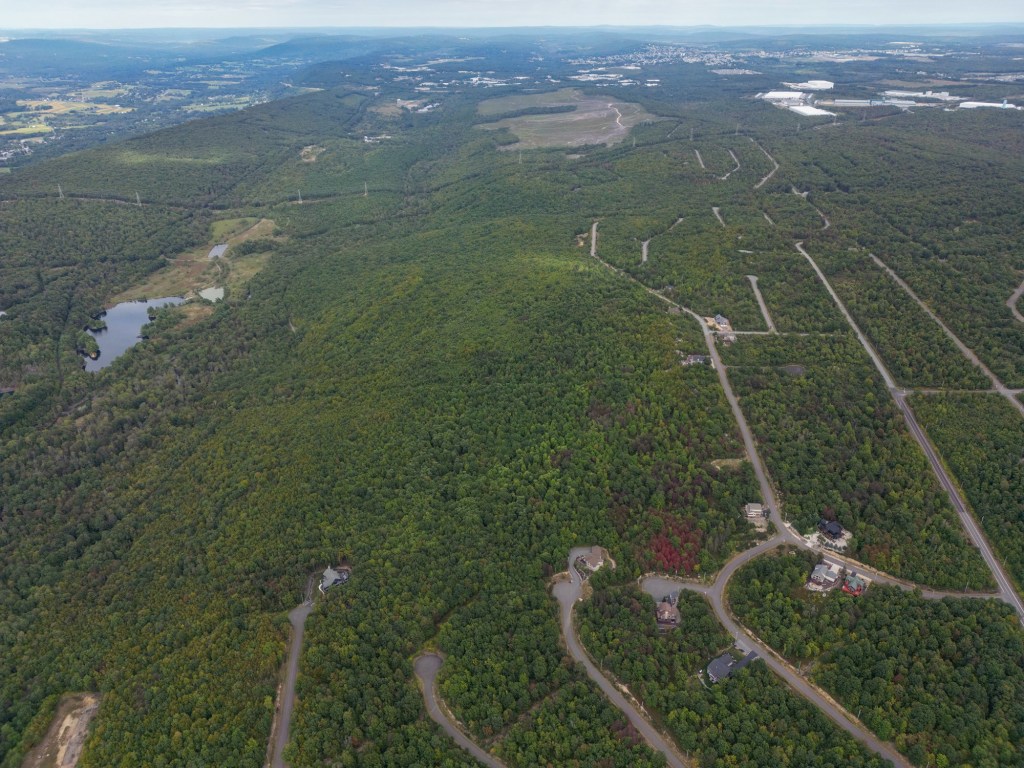
Lackawanna County’s first data center proposal came during an Archbald Borough Council work session in January when a firm approached the town touting an estimated $2.1 billion investment known as the “Wildcat Ridge AI Data Center Campus.” Proposed across nearly 400 mountainside acres along Business Route 6 and Wildcat Road, the data center campus would be 17.2 million square feet with 14 three-story-tall data center buildings, each with a 126,500-square-foot footprint.
The application prompted Archbald officials to explore amending their zoning to address data centers — a challenge faced by municipalities across Northeast Pennsylvania. Municipalities in Pennsylvania are required to allow for every lawful land use somewhere within their borders, including data centers. Zoning ordinances governing those land uses can be 10 to 20-plus years old, requiring amendments to keep pace with new industries. To regulate data centers, communities have most often designated them as conditional uses in special overlay districts. Conditional uses allow towns to establish a slew of criteria that data centers must adhere to in order for borough councils or township supervisors to approve them, with common conditions addressing concerns like noise, water and electricity use, visual aesthetics, preparing first responders and on-site power generation.
Conditional uses also require developers to attend public hearings where residents have the opportunity question them and testify for or against the projects.
However, when developers apply for data centers before a municipality has started the zoning amendment process, they are grandfathered in under their legacy zoning at the time of their application, giving them a much more direct path forward without having to adhere to additional conditions specific to data centers. That pressure leaves local governments scrambling to update their land-use laws as billion-dollar developments bear down on them.
Archbald’s Wildcat Ridge proposal led to a deluge of additional data center applications, with Lackawanna County’s Midvalley region becoming a hotspot as developers look to tap into the power lines strung across the valley.
By May, Archbald had already received applications for two more data centers: Project Gravity, which proposes up to seven data centers along Eynon Jermyn Road and Business Route 6, and Project Boson, which originally proposed three data centers at the site of the former Highway Auto Parts junkyard on Eynon Jermyn Road but later merged those into a nearly 620,000-square-foot data center, akin to four data center buildings in one. In October, a different developer applied to build 22 more data center buildings across two campuses on either side of Project Gravity, bringing Archbald up to 44 proposed data centers.
Neighboring Jessup also received applications for seven data centers across two campuses; developers applied for and withdrew plans to build up to four data centers in Blakely amid intense community opposition that made approval unlikely; and most recently, a developer proposed to build four data center buildings on the mountain above Business Route 6 in Dickson City.
To the south, in Lackawanna County’s largest individual proposed campus, a developer wants to build around 30 data centers along Interstate 380 in Clifton and Covington townships.
And still farther south, in Schuylkill County, Amazon applied in November for two permits for a data center in Kline Twp., and just 3 miles away, Amazon is also interested in building a data center in Banks Twp. near Little Leaf Farms greenhouses in the McAdoo Industrial Park.
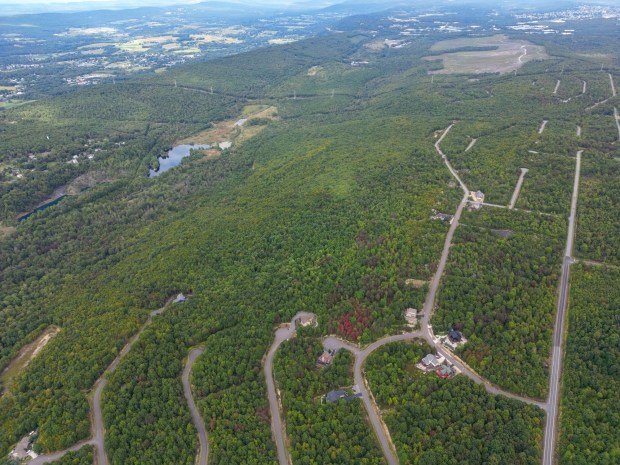 NorthPoint Development plans a 15-building data center for 1,250 acres it has purchased surrounding the planned Tomhicken substation on a proposed PPL power line in Hazle Twp. near the Sugarloaf Twp. border.
Luzerne County is experiencing its own influx of data centers, including the Talen Energy project. NorthPoint wants to create a campus with 19 buildings in Hazle Twp. known as Project Hazelnut, though township supervisors denied approval for that project in November. LBT Investment Group LLC of Chicago also proposed a six-building data center in Sugarloaf Twp., and West Hazleton Borough Council members are drafting a zoning ordinance for data centers, though a proposal to build a data center in the town was withdrawn.
Augustine believes there are three classes of data center proposals locally: tech giants like Amazon and its Amazon Web Services, Google, Meta, Microsoft and OpenAI, although Amazon is the only firm with a local presence so far; third-party operators looking to lease out their data centers to other companies; and prospectors who purchase land around transmission lines and try to market it for data centers without having an actual company behind them.
‘Not enough power’
Neither Durkin nor Augustine anticipate every data center proposal will actually materialize.
“As a chamber of commerce, we’re not opposed to this,” Durkin said. “I just find it difficult to do the math — the unofficial math — and say that there’s going to be 60, 70, 80 of these buildings. I just don’t see it.”
Although PPL Electric Utilities is required under state law to provide power for any customers who meet its technical, financial and procedural requirements, both Durkin and Augustine believe power will be a limiting factor.
“There’s not an unlimited amount of power that’s available to be able to feed these things,” Durkin said. “If you don’t have the power, you don’t have a data center.”
Augustine expects only about one-third of all local proposals will move forward, and power generation will play a key role in 2026.
“Right now, there’s only so much power that’s available on the grid,” Augustine said. “There’s certainly not enough power for every one that’s been proposed.”
As towns continue to navigate zoning for data centers, he expects siting them will also be a debate as local governments increasingly apply stricter zoning to data centers.
“I am absolutely for data centers when done the right away, placed in the right location, paying their fair share and affecting residents as little as possible,” he said.
Data centers will provide both jobs and tax revenue for the region. Beyond the construction jobs to build them, data centers, on average, employ about 25 to 30 people per building across three shifts, Augustine said, explaining they are 24/7 operations. Those jobs are in the $80,000-plus salary range. They will provide opportunities for specialized jobs like engineers and machine operators, as well as more basic skill sets requiring certificates or two-year degrees, he said. Data centers additionally open up ancillary industries, like landscaping, equipment servicing, security and the hospitality industry, Augustine said.
Data centers will also bring significant tax revenue, though not at the level of Loudoun County, Virginia, Durkin said. Loudoun County earned the nickname “Data Center Alley” due to its concentration of data centers, with about 200 existing facilities and 70 to 80 more proposed there.
Property taxes in Pennsylvania are based only on real property — land and buildings — but Virginia includes a personal property tax, which taxes data centers on the expensive computer equipment housed in them, Durkin said. Loudoun County brought in about $1.1 billion from data centers last year, and about 70% of that came from personal property taxes, he said.
“The real money comes from what’s inside the guts of the building,” he said, adding that one very large data center could have $500 million to $1 billion worth of equipment inside.
Durkin floated the possibility of Pennsylvania passing a law allowing counties to enact personal property taxes specifically on data centers, though the legislation would have to be written to avoid unintended consequences, he said.
“Whether it’s taxable or not, a $500 million building is still a $500 million building going up in your community, and that money has a way of finding its way into your community, not just in the form of tax returns, but in terms of local businesses,” Durkin said, pointing to everything from restaurants, gas stations and retail to professional services like HVAC, plumbers and electricians. “All you have to do is talk to someone from the unions, and they’ll tell you they like this idea. They love this idea because it’s going to be full employment for people in the trades for years to come.”
In the shorter term, towns will also see revenue from permit fees and transfer taxes for data centers, Augustine said.
For data centers that have already applied locally, they will continue to navigate the land-use process in their host municipalities, as well as permitting at the state level.
‘Why us?’
While the total number of data centers that will actually come to fruition is unclear, continued community opposition and scrutiny is virtually guaranteed.
The Archbald Neighborhood Association formed more than five years ago, and co-founder Kayleigh Cornell used the association’s Facebook page to share community news and events. While the page still shares community events, data center updates are juxtaposed with posts about local restaurants and visits from Santa. Cornell, who has a young daughter in the borough, initially posted about the Wildcat Ridge AI Data Center in January when the firm approached the borough.
At first, she didn’t think much of the proposal.
“Then, as it got further, we learned more about data centers and just the extent of it,” she said. “That’s when we started being more vocal.”
Residents grew increasingly concerned as they learned about the potential impacts of data centers and close proximity to residential areas, Cornell said.
“It’s been really alarming,” she said. “We’re kind of wondering, ‘Why us?’”
At the same time, Cornell finds inspiration seeing the educated, intelligent residents who have come together to fight data centers in their communities, comparing it to a full-time job.
“They haven’t just been coming to one or two meetings. We’re talking every day,” Cornell said. “I feel like we lost some relationships with the borough, but we gained some more from local residents.”
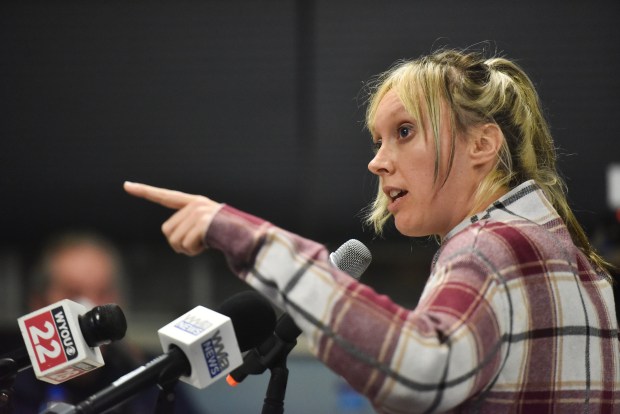 Kayleigh Cornell, co-founder of the Archbald Neighborhood Association, speaks during the community meeting at the Archbald Borough Building Monday, November 24, 2025. (SEAN MCKEAG / STAFF PHOTOGRAPHER)
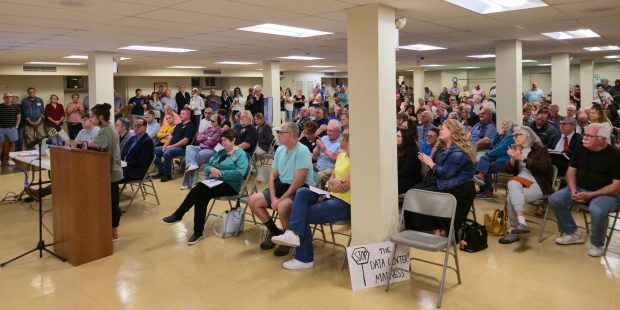
Cornell teared up when she saw 200-plus residents packing St. Thomas Aquinas Church in Archbald on a Monday night in September for a public hearing on Archbald’s then-proposed data center ordinance.
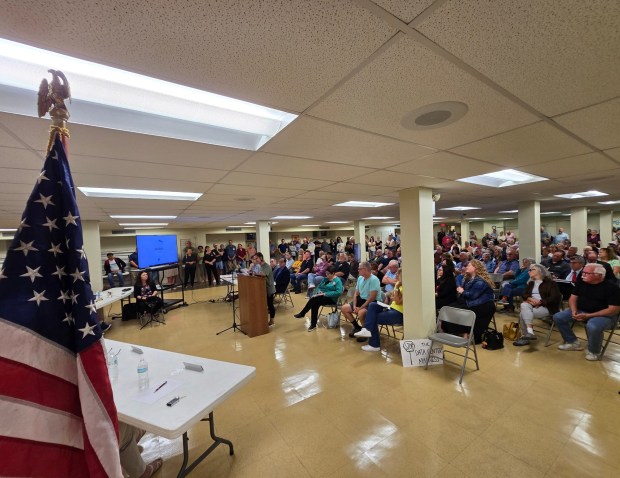 At least 200 concerned residents packed a data center zoning hearing at St. Thomas Aquinas Church, Archbald, on Monday, Sept. 29, 2025. (FRANK WILKES LESNEFSKY / STAFF PHOTO)
Residents don’t want to have to fight, she said.
“At the same time, it’s just been awe-inspiring to see everybody come out,” Cornell said. “It just shows how important of an issue this is, and it just isn’t our area, it’s across the whole country.”
Moving forward, she questioned whether residents’ next recourse will be legal action, though she hopes “we could somehow reach a consensus and keep the Archbald that we all know and love.”
“We’re not going to stop the fight,” Cornell said.
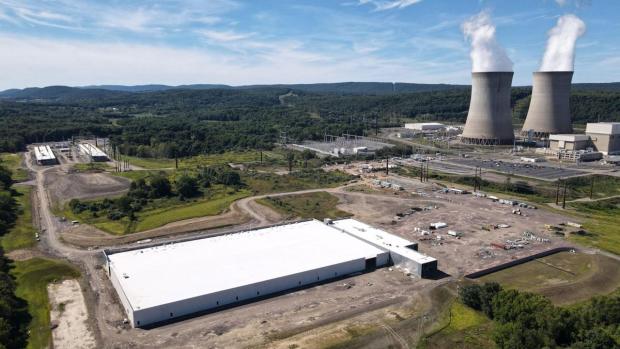 Talen Energy Corporation sold its Cumulus Data Center, located adjacent to the Susquehanna Steam Electric Station, Talen’s nuclear power plant in Salem Twp., to Amazon Web Services for $650 million. (FILE)