

The Greenwood Blue and Gold boys’ basketball tournament that is so steeped in tradition had a new twist this season, and it seemed to play to good reviews. A 35-second shot clock was in use throughout the 80th annual event.
A total of 32 states are using the shot clock in some form in 2025-26. Missouri is one of three, along with Kentucky and Florida, allowing optional use of the shot clock this season, according to the National Federation of High Schools. Wyoming is using it only during the regular season.
Either way, it seems that good basketball is good basketball, no matter the cap on how long a team can take before shooting. The Gold Division championship bore that out on Tuesday night as top seed Nixa, a Class 6 power defeated Hartville, a dominant Class 2 program, 57-50.
Hartville coach Brett Reed, whose team won a Blue and Gold title in 2020 and regularly contends for championships at Great Southern Bank Arena, admittedly is no fan of the shot clock. Experiencing four games with the clock over the last week didn’t change his mind.
“We noticed it probably a little bit, but I don’t think it was a factor in anything,” Reed said. “I guess if there wasn’t a shot clock tonight, we could have maybe played a little bit slower, made them guard a little longer. Maybe we’d got a little better looks, but then again, we might have turned it over, too. So who knows?
“I mean, I thought it was fine. I thought the tournament ran great and went smooth. We just didn’t make enough plays tonight to win.”
Nixa’s side thought the shot clock probably helped them walk away with the first-place trophy. Hartville was able to use its usual disciplined, patient offense within the framework of 35 seconds to build a 10-point first-half lead and was in front 37-36 late in the third quarter.
“To be honest with you, we lose if there’s not a shot clock,” Nixa coach Brock Blansit said. “I knew it would be a struggle, because we couldn’t guard them in man. But it was an even bigger struggle than I thought.
“They were getting every shot they wanted, so without a shot clock, we can’t run a zone (defense) and they could get off a couple of minutes. (The shot clock) made a big difference.”
Nixa guard Randy Flint said he saw enough on video of Hartville to know how dangerous the game could have been otherwise.
“I think (the shot clock) is nice, because in film Hartville usually took two minutes on an offensive play, so I think it was nice speeding them up and see what they can do when they have to make quick shots,” Flint said.
Hartville only shot three times in the second half after the clock went below 10 seconds with one of those a made 3-pointer, along with two missed threes. But Nixa’s pressure forced a flurry of turnovers or contested shots in the fourth quarter.
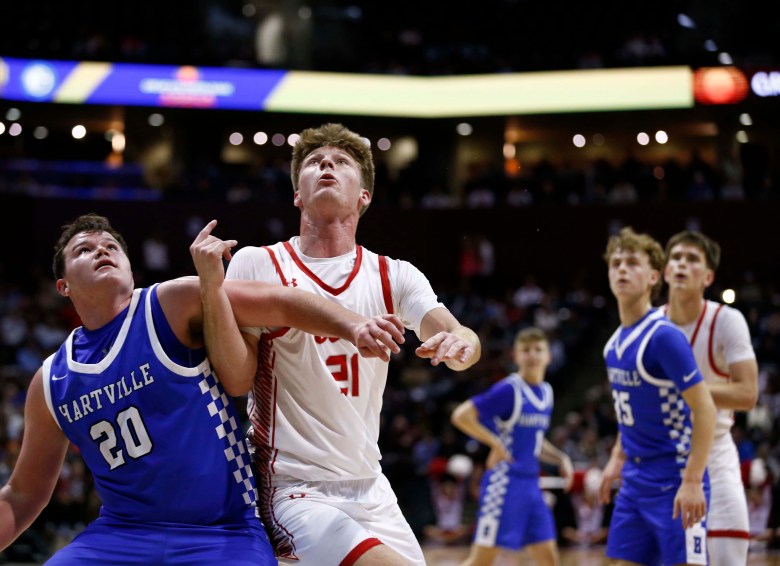 Hartville’s Gus Sinning battles with Nixa’s Adam McKnight during the Blue & Gold Tournament at Great Southern Bank Arena in Springfield on December 30, 2025. (Photo by Bruce Stidham)
Reed said the shot-clock subject was off limits for his players. Hartville guard Mason Cogdill, with a team-leading 17 points, gave credit to Nixa’s defense and said the experience of seeing the bigger school will benefit Hartville as it pursues another Class 2 state title.
“It’s a great game to get prepared for the rest of the season,” Cogdill said. “This is a great tournament. We get up here and we play great competition, so it does help us in the long run of the season.”
Meanwhile, the debate about the merits of a shot clock for high school will likely continue into the offseason and probably beyond.
Parkview coach Jack Simpson, whose team bounced back from an opening-round loss to win three straight and take Blue division consolation honors, said he’s firmly in favor of a clock becoming a mandate in Missouri.
“It’s great. We’ve had it for the majority of our games so far,” Simpson said. “We need it. And our kids like it. It just helps the flow of the game.”
Simpson said it doesn’t change the way he coaches because his style is to play fast on offense and shoot it before 35 seconds either way.
“If not, we’re probably going to turn it over anyway,” Simpson said with a laugh. “I think it helps the flow of the game. It helps the end-of-game scenarios, and I think it even helps the referees, too, because teams aren’t just fouling.”
Simpson isn’t optimistic the clock will be added full-on any time soon.
“You never know, Missouri’s behind in all aspects it feels like, so we’ll see,” Simpson said. “It could be years, but we’re taking a step in the right direction.”

Lyndal Scranton is a Springfield native who has covered sports in the Ozarks for more than 35 years, witnessing nearly every big sports moment in the region during the last 50 years. The Missouri Sports Hall of Famer, Springfield Area Sports Hall of Famer and live-fire cooking enthusiast also serves as PR Director for Lucas Oil Speedway in Wheatland, Missouri and is co-host of the Tailgate Guys BBQ Podcast. Contact him at Lscranton755@gmail.com and follow him on Twitter @LyndalScranton. More by Lyndal Scranton