
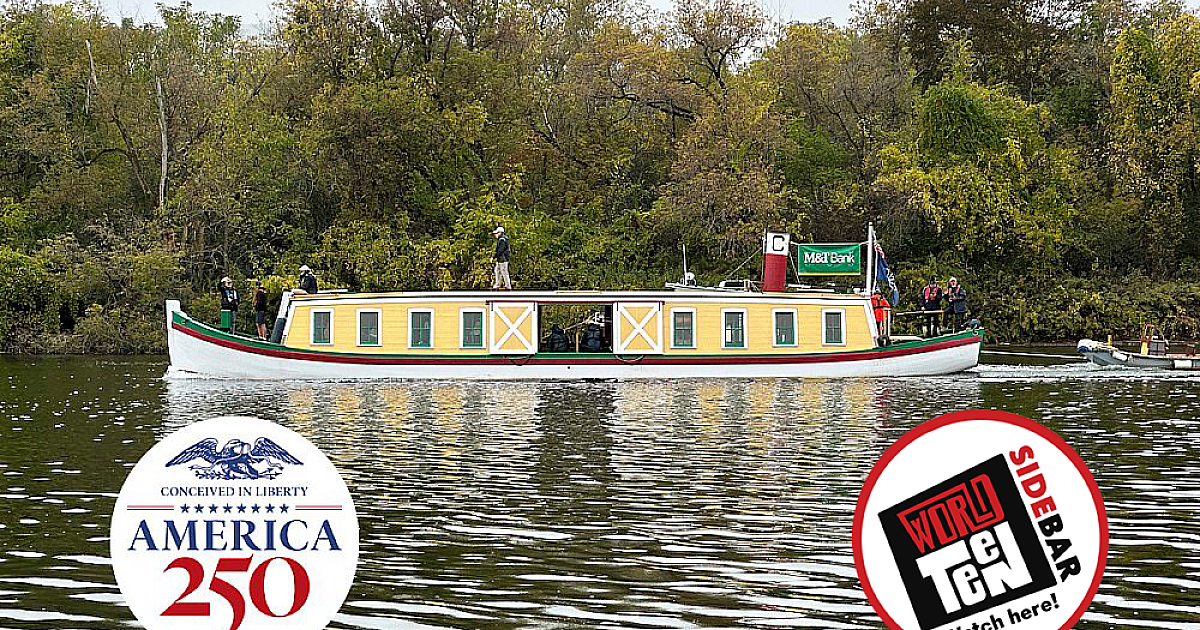
In September and October, a replica of a historic boat toured the Erie Canal. The newer Seneca Chief retraced the first journey taken along the famed waterway. Crew members gathered water from the canal and the Hudson River. They planted pines to honor the Iroquois, the region’s native population. The reason?
Flash back to 1825: The American Tract Society, publisher of evangelical Christian materials, is founded. Italian opera debuts in the United States. The USPS creates a dead-letter office. And the Erie Canal is completed.
The United States was growing. Americans wanted to spread westward, build businesses, and transport goods. Water was the fastest mode of travel then. Shipping companies used oceans, lakes, and rivers to move products. But what if there was no passage?
Canals were the answer. These artificial waterways make connections for boats traveling inland.
But vessels moving from Eastern states to the Midwest needed to cross the Appalachian Mountains. Engineers suggested a route up the Hudson River and across the Mohawk Valley to the Great Lakes.
Workers cleared rocks and stumps. They built a 40-foot-wide canal with 83 stone locks to link the Hudson and the lakes. Locks allow boats to manage elevation change: Imagine a canal with boat-sized swimming pools along the way. At one end of a pool, the canal is higher than at the other. A boat enters the pool (lock) from the low side; doors shut behind it. Canal operators open valves letting gravity pull water from the high side into the lock. The boat rises. The door on the high end opens, and the boat exits. The process can also happen in reverse.
New York Governor DeWitt Clinton championed the 363-mile Erie Canal. Many people opposed the project, calling it “DeWitt’s Ditch.”
The canal took eight years and $7 million (that’s over $200 million today) to complete. It was the first waterway to connect the Great Lakes to the Hudson River and thereby the Atlantic Ocean.
On October 26, 1825, Clinton rode the 73-foot Seneca Chief the length of the canal. Mules pulled it at the “lightning speed” of three to four miles per hour. On November 4, Clinton emptied two drums of Lake Erie water into the ocean: “the wedding of the waters.”
Travel time to the Great Lakes dropped from weeks to days. Shipping costs plummeted. Sleepy settlements along the route grew into thriving cities. Canal tolls helped the state recover the project’s cost.
Two centuries later, much of the original canal has changed. Barges largely give way to pleasure boats and kayaks. But the canal’s effect on the nation remains.
Why? Challenges are opportunities. God gives humans creativity to find solutions and to invent new tools and processes.
Click the “video” button at the top of the story to watch a WORLDteen Sidebar explainer on how canal locks work.