
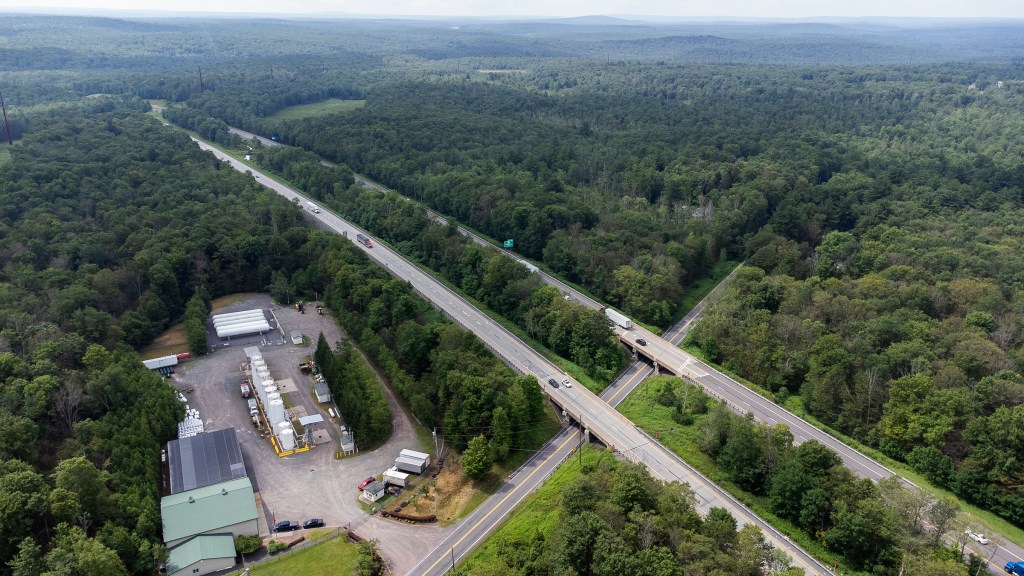
Clifton Twp. will consider a settlement agreement Friday with the developer behind Lackawanna County’s largest proposed data center campus, potentially ending a legal challenge over whether the township’s zoning was exclusionary to data centers.
Township supervisors will hold a special meeting at 7 p.m. at the Gouldsboro Fire Company, 490 Main St., to discuss and potentially enter into a settlement agreement with 1778 Rich Pike LLC and JCO LLC regarding a substantive validity challenge filed by the data center developer in the Lackawanna County Court of Common Pleas, according to a public notice published Wednesday in The Times-Tribune.
The settlement would end multiple legal challenges filed by the developer pertaining to Clifton Twp.’s zoning for data centers, and the township would permit the developer to use the property for data centers and battery storage without the need for conditional use approval, though the settlement includes numerous stipulations and conditions required for the township to approve its land development plan.
Notably, the developer would agree to abandon plans for a small modular nuclear reactor and/or a gas-fired power plant on the site.
The project
The developer, 1778 Rich Pike LLC, 2003 S. Easton Road, Suite 304, Doylestown, initially proposed to build nearly three dozen centers, each up to three stories high and around 125,000 square feet per floor, along Interstate 380 just north of Clifton Beach Road in Clifton and Covington townships as part of a campus known as “Project Gold.” However, plans attached to the settlement indicate Project Gold will have only five data centers in Clifton Twp., but each 65-foot-tall building would have a significantly larger footprint.
The plans do not include Covington Twp.’s portion of the project.
The footprints for each two-story data center in Clifton Twp. are: 160,000 square feet, 279,450 square feet, 459,650 square feet, 460,250 square feet and 684,610 square feet. Other buildings and infrastructure include a fire water storage and pumphouse, an 87,250-square-foot administration building, a 400-megawatt customer substation and a 230-kilovolt utility switchyard.
The site is broken into three campuses called the “Northwest Campus,” “Southwest Campus” and “Southeast Campus.”
Project Gold is currently the largest proposed data center campus in Lackawanna County, which has nearly a dozen proposed campuses spanning Archbald, Clifton Twp., Covington Twp., Dickson City, Jessup and, most recently, Ransom Twp. Developers also applied for and withdrew a proposal to build up to four data centers in Blakely.
1778 Rich Pike LLC filed a land-use appeal on Dec. 1 in county court to contest a Nov. 19 decision from the Clifton Twp. Zoning Hearing Board denying the developer’s substantive validity challenge that argued the township’s zoning was exclusionary to data center uses, according to the filing from attorney Matthew J. McHugh of Philadelphia-based Klehr Harrison Harvey Branzburg LLP. The settlement and public notice reference the docket number for the December appeal.
The appeal is 1778 Rich Pike’s third legal challenge in the township and a direct result of the first challenge in April.
The company initially filed a substantive validity challenge on April 17 alleging Clifton Twp.’s zoning ordinance unlawfully excluded data centers, private power generation facilities and related uses. Municipalities in Pennsylvania are required to allow for every type of lawful land use somewhere within their borders.
Township supervisors amended their zoning the following month by adopting an ordinance on May 22 that defined data centers and designated them as conditional uses in the township’s industrial zoning district. The developer especially took issue with a 35-foot height restriction on data centers, which an attorney for 1778 Rich Pike, Tony Maras, previously told The Times-Tribune was too low to allow for enough cooling and airflow.
Then, on June 20, 1778 Rich Pike and property owner JCO LLC, 207 Drinker Turnpike, Covington Twp., filed a procedural validity challenge against Clifton Twp. in the Lackawanna County Court of Common Pleas. The challenge asked the court to declare the data center ordinance void due to alleged procedural issues, including the township failing to properly post an agenda 24 hours ahead of the May 22 special meeting and failing to have the township planning commission review the ordinance at a public meeting, among other contentions.
The latest land use appeal lists 1778 Rich Pike LLC as the sole plaintiff, describing it as the equitable owner of two parcels owned by JCO LLC on Clifton Road and a parcel owned by Judge Family Estates LLC around the rear of Route 611 and Interstate 380.
The board voted unanimously on Nov. 19 to deny the April validity challenge, determining the township’s zoning ordinance was not exclusionary to data center uses, but 1778 Rich Pike’s attorneys argue it was an abuse of discretion because the decision “was not supported by substantial evidence and, in fact, was contrary to the significant evidence presented by the developer” and asked a judge to reverse it.
The settlement
As part of the settlement, the township would acknowledge that its zoning ordinance that was in effect in April when the developer filed its validity challenge “may have been found by a court of competent jurisdiction to be exclusionary as it relates to the data center uses” but that the subsequent data center ordinance adopted in May addressed that exclusion.
“The township and the developer, in the interest of avoiding protracted litigation and promoting sound land use planning, agree to settle the validity challenge and the procedural challenge,” according to the settlement.
The developer would agree that the settlement constitutes a “full and complete resolution” of its validity challenge, and it agrees to withdraw any and all other challenges to the township’s zoning.
The settlement does not relieve the developer from obtaining all necessary local, state and federal permits and approvals, including having two years to file for a preliminary subdivision and land development approval from the township.
An exhibit attached to the settlement lists conditions for approval, akin to what a municipality would seek in a conditional use approval, tying some conditions to the mandatory land development approval, though it notes “the developer shall be permitted, without the need for conditional use approval” to use the property for data centers, backup generators, power storage systems and related uses.
In addition to halting plans for a nuclear reactor or gas power plant on the site, conditions in the settlement include:
• Data centers cannot have a footprint over 1 million square feet, or a total size of 2 million square feet across two floors, with a maximum height of 65 feet, though buildings could be up to 80 feet with rooftop equipment and screening to hide the equipment. Non-data center buildings are capped at 35 feet high.
• No centralized water system served by wells may be used for data centers’ cooling systems, and the developer must submit an analysis of projected raw water needs from public or private sources conducted by a certified hydrologist who is licensed in the state and approved by the township.
• All water needed to initially fill each building’s cooling system must be provided from an outside source and not from any well in the township, and all nonpublic well water supply sources serving the data centers in the township will have a gauge to monitor use, which the developer would provide to the township in monthly reports. Well water withdrawals in the township cannot exceed 50,000 gallons per day over a 30-day average from any source or combination of sources.
• No data center development will receive final land development approval without sufficient water supply, which may include trucking in water, and no development will receive final land development approval that demonstrates the likelihood of adverse impacts on existing wells — without mitigation — in the vicinity.
• The developer must identify how, and at what temperature, water used inside the data centers would be recycled and released into surrounding water bodies.
• Disposal and treatment of all sewage and wastewater shall occur outside the township.
• The developer must provide an interconnection agreement or feasibility study from an applicable electric service provider indicating that the necessary capacity is available, and that it will serve the data center development.
• Various requirements for woodland buffers, screening and setbacks, including setbacks of at least 100 feet from any property line for data center buildings and at least 400 feet from any existing occupied residential structures.
• The developer must submit an environmental impact study, traffic study and an emergency response plan to document potential impacts and necessary mitigation measures. The developer must also submit a community fiscal benefit/impact study. The impact study must include the estimates of costs incurred by the township related to infrastructure, emergency preparedness, administrative costs and fire protection, as well as estimates of revenues generated by the data centers, including from real estate sales, real estate taxes and income taxes.
• The developer must also incorporate absorptive sound barriers and materials in and around all generators, and the developer must demonstrate through a sound study conducted by a professional that the materials or systems will effectively reduce sounds from the data center. There will be a preliminary sound study to establish a baseline, interim sound samplings during construction for every three buildings completed in the township, and an as-built sound study when construction is complete, which will be conducted six months after the issuance of an occupancy permit. The township can require subsequent sound studies after a documented exceedance. Failing to remediate a sound violation would allow the township to revoke any zoning permits, with an exception during power outages.
• The data centers must provide local fire departments with any required equipment — like foam, equipment or vehicles — at the expense of the data center, and it must furnish on-site water for firefighting.
Attempts to reach Clifton Twp. Solicitor Geoffrey S. Worthington were unsuccessful Wednesday.