
America’s 250th birthday year is finally here.
It’s easy to lose track of all of the events that Philadelphia has planned to celebrate this major milestone in the nation’s history, and the city’s important role in it.
The Philadelphia Historic District wants you to look back, though, with its lineup of “52 Weeks of Firsts,” a variety of marvels, inventions and events that first happened here in Philly.
Many of the events this year will very likely draw crowds, VIPs and excitement. So it only seems fitting that the first week’s “first” would be an event of similar scale that occurred on Jan. 9, 1793 — nearly 233 years ago.
On that day, French aeronaut Jean Piere Blanchard completed the first successful balloon flight in America, starting in the yard of Walnut Street Prison and, after about 45 minutes in the air, landing in Gloucester County, N.J.
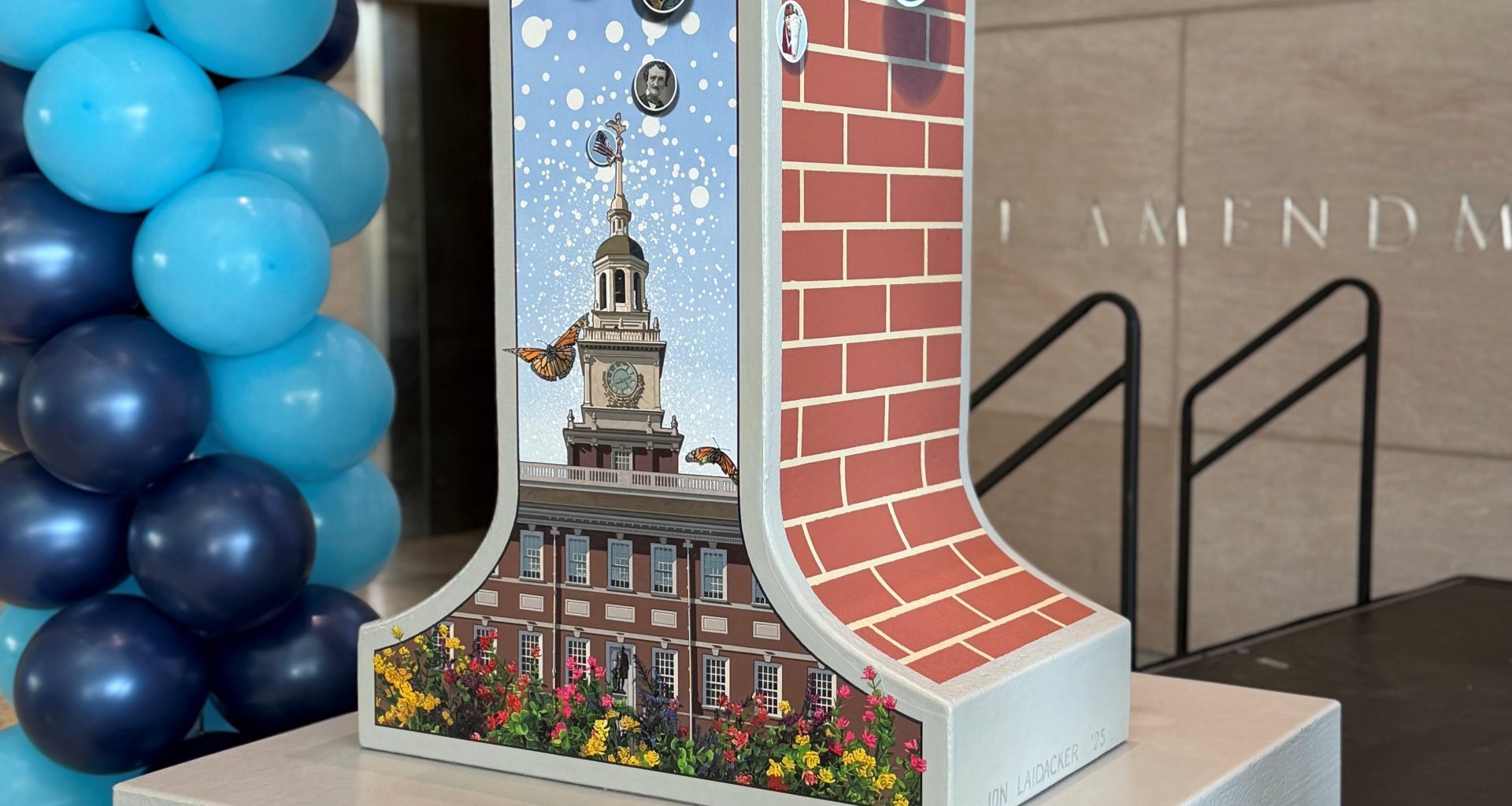
The Historic District have set up a Saturday “Firstival” ceremony to kick off each weekend. The free public events, which will run from 11 a.m. to 1 p.m., will introduce and celebrate the topic through entertainment and activities, a sculpture painted by a local artist, music, giveaways and storytelling by Historic Philly’s Once Upon a Nation historical experts.
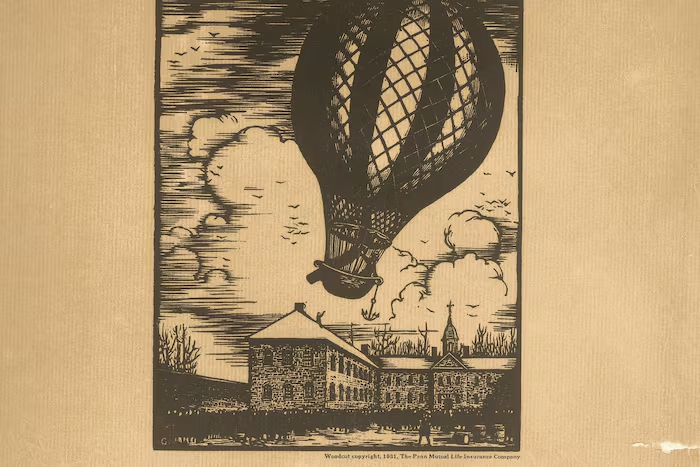 This 1931 woodcut by Charles A. Gardner is titled “The First Air Voyage in America,” and appeared in a book published in 1943 about the balloon flight. (Courtesy of the Anathaeum Philadelphia)
The inaugural “firstival” happens this Saturday at the Athenaeum on 219 S. 6th Street, where aeronautics expert Debbie Harding and the library’s staff will provide details about the historic event.
Billy Penn couldn’t wait until Saturday to learn about the balloon flight, so we hopped on a call with Thomas Paone, who curates the lighter-than-air collection at the National Air and Space Museum in Washington D.C., to get an account of the flight.
Here are the highlights.
Despite only being 39, Blanchard’s was an experienced aeronaut, with 45 balloon flights, including one across the English Channel.
That said, this was still incredibly dangerous. The world’s first successful untethered balloon flight had only happened 10 years earlier and — aside from a successful tethered balloon flight in Baltimore in June 1784 — the several attempts to make that happen in America were unsuccessful. The balloon was filled with hydrogen, which is highly flammable. The 4,200 pounds of acid Blanchard needed to create the hydrogen through a chemical reaction with a metal was very risky, as well. The balloon’s envelope, made of varnished silk, could have ripped. With the balloon technology of the time, once it was airborne the aeronaut was at the whim of the winds and finding a spot for a safe landing.
Philly was the nation’s capital back then, and this event drew so much attention that it might have resembled an Eagles’ Super Bowl parade, but with President George Washington and his cabinet — including future presidents John Adams, Thomas Jefferson, James Madison and James Monroe — in attendance.
“[Blanchard] said when he [took] off, he [looked] down and there’s just people everywhere. Every rooftop, every street, anywhere that you could be, was covered with people who would come to watch this launch,” Paone said.
Blanchard wasn’t alone for the flight. While he rejected all offers for any person to join him, he did agree to carry a small black dog, which sat at his feet during the flight. “As soon as he lands, he mentions the dog hopping out of the basket, going and getting a drink, and coming back,” Paone said.
He also carried a letter from Washington explaining his mission to whoever he met when he landed (Blanchard didn’t speak great English), making this flight the first instance of airmail. The letter, and some French wine, helped him convince two very shocked individuals — one of whom greeted him carrying his rifle — to help him get everything back to Philly.
Blanchard stayed in Philly for a little over a year, opening up a balloon lab to try and recoup his expenses for the flight and try to start a new one. He failed to do either and the balloon was later vandalised, making this a cautionary tale that the creators of Hitchbot probably should have looked at.
In the coming weeks
Here are the first months of other firsts being highlighted this year, along with the Saturday firstival dates and locations.
Jan. 10 at the Mummers Museum, 1100 S. 2nd Street
The first volunteer fire company (1736)
Jan. 17 at the Fireman’s Hall Museum, 147 N. 2nd Street
The first professional basketball league (1898)
Jan. 24 at Xfinity Mobile Arena
The first public Girl Scout cookie sale (1932)
Jan. 31 at the PECO Building, 2301 Market Street
The first African Methodist Episcopal congregation (1794)
Feb. 7 at Mother Bethel AME Church, 419 S. 6th Street
The first abolitionist society in America (1775)
Feb. 14 at the African American Museum in Philadelphia, 701 Arch Street
The first authentic Chinese gate built in America (1984)
Feb. 21 at Chinatown Friendship Gate, N. 10th Street
The first public protest against slavery in America (1688)
Feb. 28 at the Historic Germantown Mennonite Meetinghouse, 6119 Germantown Ave.
The first flower show (1829)
March 7 at the Pennsylvania Convention Center
The first women’s medical college (1850)
March 14 at Drexel University, 60 N. 36th Street
The first match folder (1892)
March 21 at the Science History Institute, 315 Chestnut Street
The first medical school in America (1765)
March 28 at the Perelman School of Medicine, 3400 Civic Center Blvd.