

Change was in the air in 1794. In France the so-called Reign of Terror was ended when the blade of a guillotine sent Maximilien Robespierre, who had executed so many with it, to his death, ending the most radical phase of the French Revolution.
In western Pennsylvania President George Washington had once more assumed the role of general and as Commander-in- Chief and had put down an uprising of anti-tax rebels known as the Whiskey Rebellion. That September a combined Native American and British force, near what is now Toledo, Ohio, was defeated by General “Mad” Anthony Wayne at the Battle of Fallen Timbers.
Undoubtedly, at least some of the residents of Bethlehem were aware of these events. But probably most important to them was one that affected the community directly. It was the opening of the town’s first commercial establishment or store not directly connected with the Moravian Church. Its founders were members of the Rice family, whose roots could be traced to the earliest days of the community.
For at least some traditional Moravians this event was a little unsettling. They valued the past as a way of revering their forefathers, many of whom had sacrificed a great deal to uphold the ideals as advocated by Count von Zinzendorf. It was true that many of those traditions had already fallen away, like the so-called General Economy, a quasi-form of what might be called Christian socialism. Single Brethren and Single Sisters communities by the late 1700s with the upheaval in Europe were unable to be supported.
But there were others in the Moravian communities including Bethlehem, many of them part of a younger generation, who felt, although devoutly Moravian, they were also Americans.

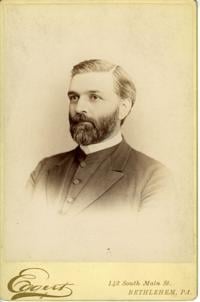
Bishop Thomas Levering
Moravian Archives, Bethlehem
Among those Bishop Joseph Levering, archivist and author of “A History of Bethlehem,” included in this group were Christian Eggert, John Sebastian Goundie, Joseph Oerter, John Frederick Rauch, Owen Rice Jr. and Jacob Rice. Owen Rice was 30, and Jacob Rice, 24.
Goundie was probably the most influential of them. A skilled brewer trained in the old country, he would gradually become the leader in the business community. His stately Federalist style brick mansion, which he had to argue fiercely over to get permission to build, stands today as a symbol to his entrepreneurial spirit. He would later shock his fellow Moravians by hiring a female maid for his wife.
“All of these men,” writes Levering, “were men au fait (had a good knowledge of business) in all the important matters that came under the consideration so far as the various villages were concerned, and each of them were…. a specialist in some department.”
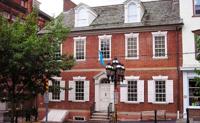
Bethlehem’s historic Goundie House
Visit Historic Bethlehem
They did not see why tradition outmoded and outworn should be followed just for tradition’s sake. These were the type of people who that year would argue with the aging Bishop Ettwein when he defended the continued use of the aging ferry over the Lehigh rather than replacing it with a bridge. A bridge was progress and development and that was good.
The process began early in the 1790s when a store was planned for the community. The first storekeeper, Christian Heckenwelder, although having the right skills for running a store, did not have an easy personality.
“Several times,” writes Levering, “evidence of a ‘hitch’ in the affair appeared- whether because of a coolness between Christian Heckewelder and the village fathers or a lack of entire confidence in his ability of the storekeeper to superintend the building’s operation.” Whether a personality clash or not, eventually Heckewelder was transferred to the facility in Emmas and Joseph Rice was put in his stead.
According to Levering, Rice’s family came over to Bethlehem with the First Sea Congregation between 1784-1790. Owen Rice III had worked as a store clerk for Heckenwelder. Apparently, their relationship was not a good one. The young man was full of ideas and energy. His employer was not. At least that is what the surviving accounts give us.
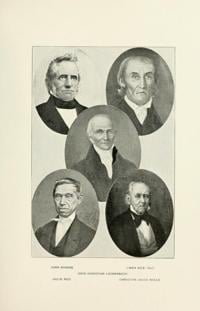
Members of the Rice family are pictured.
From “A History of Bethlehem,” Bishop Joseph Levering
But Joseph Rice was a compromise. He had run the inn at Nazareth. Levering calls him “highly capable but also popular and an esteemed businessman.” And he could deal with a variety of people, even non-Moravians who might be making a visit for the first time. Levering offers this example:
“Even such articles as ribbons of diverse colors and glittering beads as could be purchased by parents who wished to brighten the hearts of their girls after taking the last stroll about the village before leaving them to the boarding school to enter on their first struggle with ‘homelessness.’” As the father of daughters, Levering may have understood the emotions personally.
Joseph Rice was what some economic historians might call a transitional figure. His son Owen III, like many in America, was envisioning a different role for Bethlehem with the opening in 1821 across the street from the Sun Inn, of a much larger new store. He also began to dabble in local politics. The Moravian elders tried to warn him; some sources note that he was going out of bounds. He was named village postmaster, a political patronage post. “To the victor go the spoils,” was the political byword of the Jacksonian era.
Soon Owen Rice was everywhere, and his store was the place to go. But he was one among many in America. Speculation flooded in, bankers and the common men alike were caught up in it. In Allentown one of Owen’s relatives John Rice was president of the Northampton Bank, which collapsed in failure. Panic in 1837 struck the country. Banks and businesses failed. Owen Rice III was a pariah who turned his store over to his nephew James.
James Rice had worked for his relative Jacob in another store. Sources say he early showed a salesman’s temperament and kept Owen’s Main Street Bethlehem store from going under. He remodeled the place and made it more attractive. He also hired a young man John Lerch who had come from Kreidersville seeking his fortune.
It was an inspiring choice as Lerch was also an expert businessman. James entered politics but shortly after he was named postmaster by Whig party President Zachary Taylor he died in a typhoid fever epidemic. His wife Josphine Liebart was named to follow in his job as postmaster and held it till the rest of his term The store, renamed the Bee Hive took on a new partner, Rufus Grider. It quickly became popular once again.
By now the concept of Bethlehem as a solely Moravian city was in its cherished past. Post Civil War Bethlehem was now home to groups of people, including Moravians, who worked in the steel industry. Perhaps most interesting was when J. Fred Wolle, founder of what was to become the Bethlehem Bach Choir, needed to go to Germany to study it was his brother, Bethlehem Iron executive Hartly Cornelius, who provided him with the money to do that.
As for the Bee Hive it later became Bush and Bull and then later Orr’s. It’s now the site of Main Street Commons.

Main Street Commons in Bethlehem, site of the former Rice family store.
Ashley Development
Bethlehem’s Main Street continues to draw shoppers and diners to this day.