
CLEVELAND, Ohio – An organization that represents shipping companies on the Great Lakes has accused the U.S. and Canadian Coast Guards of falling down on the job when it comes to clearing ice on the Great Lakes.
The U.S. Coast Guard announced on Friday the beginning of Operation Coal Shovel, the annual effort to monitor ice coverage on the lower Great Lakes and to keep navigable waterways safe for commercial ships.
But it’s a little late as far as the Lake Carriers’ Association is concerned.
Shipments have been delayed due to ice on the lakes over the past two weeks and a lack of help clearing it by the U.S. and Canadian Coast Guards, said Eric Peace, spokesman for the association.
Don’t be surprised, he said, to see a greater number of ore boats belatedly making their way up the Cuyahoga River over the next ten days to make sure Cleveland-Cliffs has enough taconite to make steel over the winter, he said.
Shipments of taconite, the trade name for pellets of iron ore, originate from the iron range up north, but they will be cut off from cities such as Toledo and Cleveland when the Soo Locks, between Lake Superior and Lake Huron, close for the season on Jan. 15.
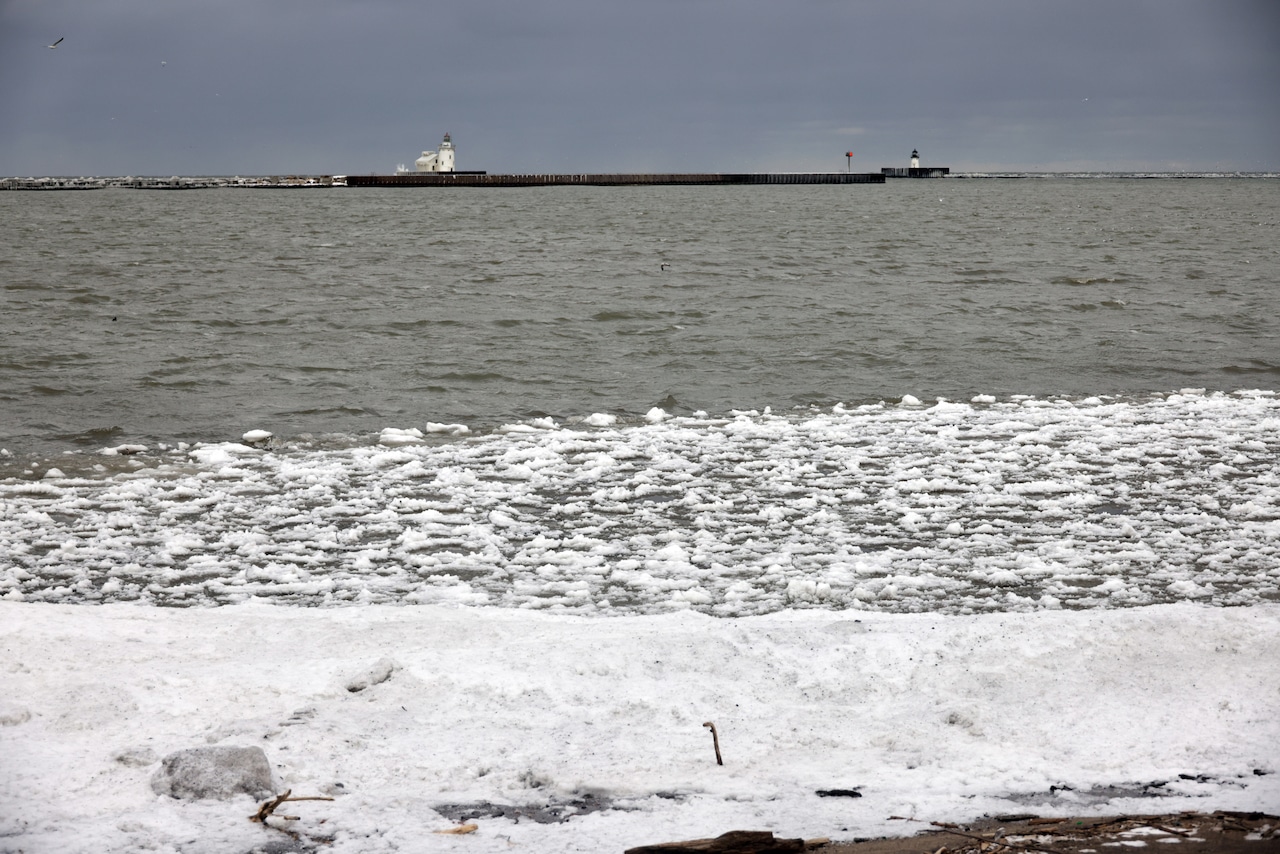
Ice coverage on Lake Erie shot up over the weekend. It was at 24.19% coverage on Friday, then increased to 26.63% on Saturday and 31.13% on Sunday.
Ore boats can make their way through ice if it’s not too thick, Peace said, but in some places, it has been several inches. That includes Pelee Passage, a section of Lake Erie that Cleveland-bound ore boats navigate.
Lake Erie can develop windrows of ice where its blown into mounds on the open lake, he said.
A warmup is expected this week, but that won’t help matters in the Upper Great Lakes, Peace said.
As for Lake Erie, the warmth and rain will start “rotting” the ice but then it will refreeze in the middle of next week when temperatures drop, he said.
Operation Coal Shovel only applies to lakes Huron, Erie and Ontario; the St. Clair River, Lake St. Clair and the Detroit River between lakes Huron and Erie; and the St. Lawrence Seaway that extends east from Lake Ontario.
Lake Michigan and Lake Superior are part of a separate Coast Guard ice-clearing operation that began in mid-December called Operation Taconite.
Peace said the U.S. Coast Guard has nine ships that can break ice, including two whose primary purpose is to tend buoys.
Several of the ships have been unavailable to cut ice, he said, in part because of mechanical problems, but also because the Coast Guard was busy removing navigational buoys from the lake.
Cleveland.com and The Plain Dealer have reached out to the U.S. Coast Guard for comment.
Peace said the Canadian Coast Guard, which operates on the Great Lakes, has also been of no help because they have been preoccupied with ice along the St. Lawrence Seaway east of Lake Ontario.
Peace said ice has been a problem in several areas of the Great Lakes, from the Western Basin of Lake Erie and Sandusky Bay, to the harbor in Duluth, Minnesota, and the St. Marys River that flows from Lake Superior to Lake Huron.
The association said the U.S. Coast Guard is focused on providing more cutters to provide security in the Arctic when at the same time it can’t provide enough resources to keep its “internal domestic waters open,” said James Weakley, president of the Lake Carriers’ Association in a prepared statement on Friday.
“This is a major national security problem if steel mills in the U.S. cannot have a reliable supply chain during winter,” he said.