
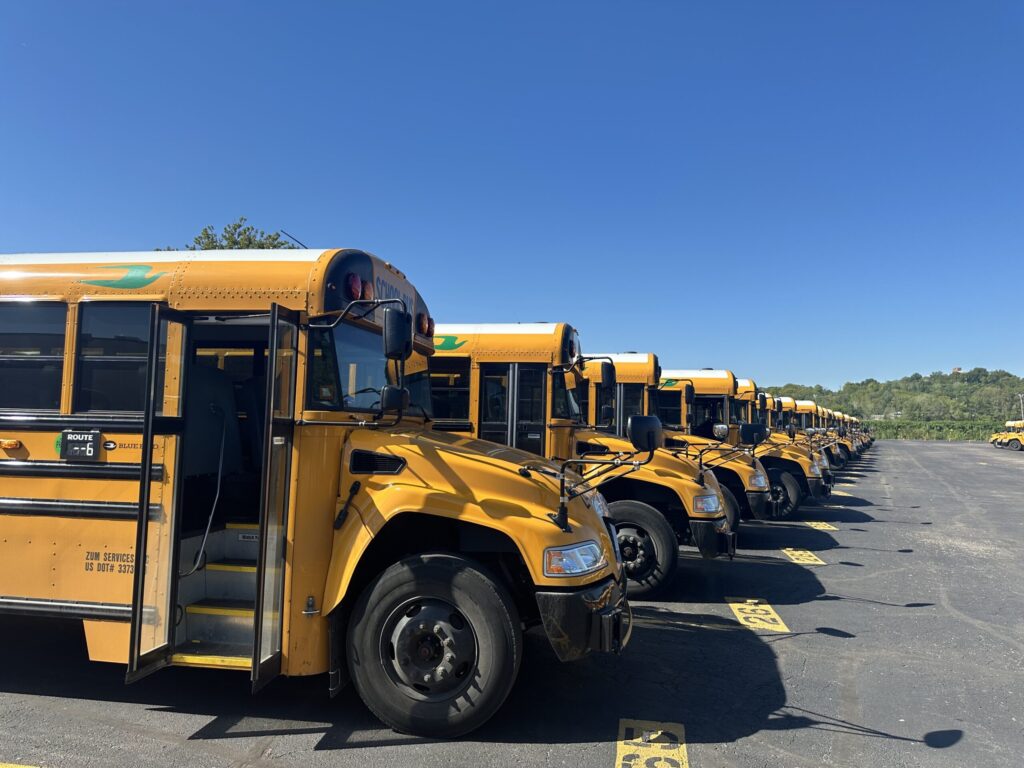
Buses are lined up at the Kansas City Public Schools bus barn in Kansas City, Mo. (Photo by Kevin Hardy/Stateline)
When I heard my former student Mike was suspended after shoving and injuring my 2nd grade student, Eddy, as they got off the bus at the start of a recent school day, I wondered if I could repair what had been done, providing an outcome that would make a positive difference in the lives of these boys.
Could I mediate a conversation between them so that Mike, now in middle school, understood the gravity of what he did? Could I help ensure Eddy felt safe around older students?
Buoyed by the idea of using restorative practices, which separate the deed from the doer and shift the focus away from punishing Mike to address and fix the harm that was done, I asked my school administrators and the boys’ families if Mike could spend time in my classroom as a tutor and mentor to Eddy.
The powerful connection that grew between the boys as a result of this extra effort gives me so much hope.
Across the country, including schools around Pennsylvania, projects are underway to turn traditional student discipline models on their heads. Why? It’s all about encouraging appropriate behavior by bringing students into the collaborative process to resolve the issues.
A recent study by the University of Chicago Education Lab found that schools that implemented restorative practices saw proactive changes in students’ behaviors—including an 18% decrease in suspensions—with many youth experiencing a stronger sense of belonging.
In 2023, Representative Anthony Bellmon introduced bipartisian legislation that reflected this growing body of research and would have embedded conflict resolution instruction into both coursework and educator training. The bill, which didn’t pass, was meant to ensure students develop skills such as mediation, effective communication, emotional regulation, and relationship-building by equipping educators with sustained professional learning to put these practices into action in our schools.
Restorative practices and more robust teacher training are important strategies that go beyond what is included as student supports in Pennsylvania Statute.
Here’s why:
First, they are a more effective and sustaining way to address discipline. Suspension, which pulls students away from their classrooms and learning, doesn’t always help them see the bigger picture of how their behaviors affect others. After the incident, Eddy was hesitant to be anywhere near Mike. However, as I supported them, each boy had a role to play as they worked together. Eddy became more relaxed; feelings of safety and trust replaced his uncertainty as they built a mentor-mentee relationship. Meanwhile, Mike got a “little brother” out of the deal.
Another reason for employing restorative practices is that it teaches students collaborative skills. With Mike’s support, Eddy, who struggled with reading comprehension, became more confident to ask questions of me and his peers when he struggled to understand what he read. For his part, Eddy’s calm nature forced Mike to slow down, which helped him be more patient and understanding while also strengthening his confidence in his abilities as Eddy’s reading tutor. And the time they spent together encouraged conversations outside of academics. Soon Mike and Eddy were singing songs they both liked.
Just as important, restorative practices help students work through conflicts, giving students tools to engage with each other during disagreements and empowering them to use their voice and become part of change.
During the last week of school, as the students walked to their bus, Mike playfully pulled Eddy into a hug and ruffled Eddy’s hair. Eddy was full of smiles and giggles. I was near enough to overhear their conversation: “Eddy, I’m sorry for what I did to you. I don’t know why I did it. If I could take it back, I would.”
The Latin root for discipline is discere which means “to learn.” Restorative practices are a tool that educators can use to teach students how to navigate their social world. Let’s bring it into schools across Pennsylvania so that students like Mike and Eddy can move beyond punishment and into a place where they belong and get along.
NOTE: The students’ names were changed to protect their privacy.

Martine Devine is a K-8 English development teacher in Pittsburgh Public Schools in Pittsburgh and 2025-2026 Teach Plus Pennsylvania Policy Fellow
.