
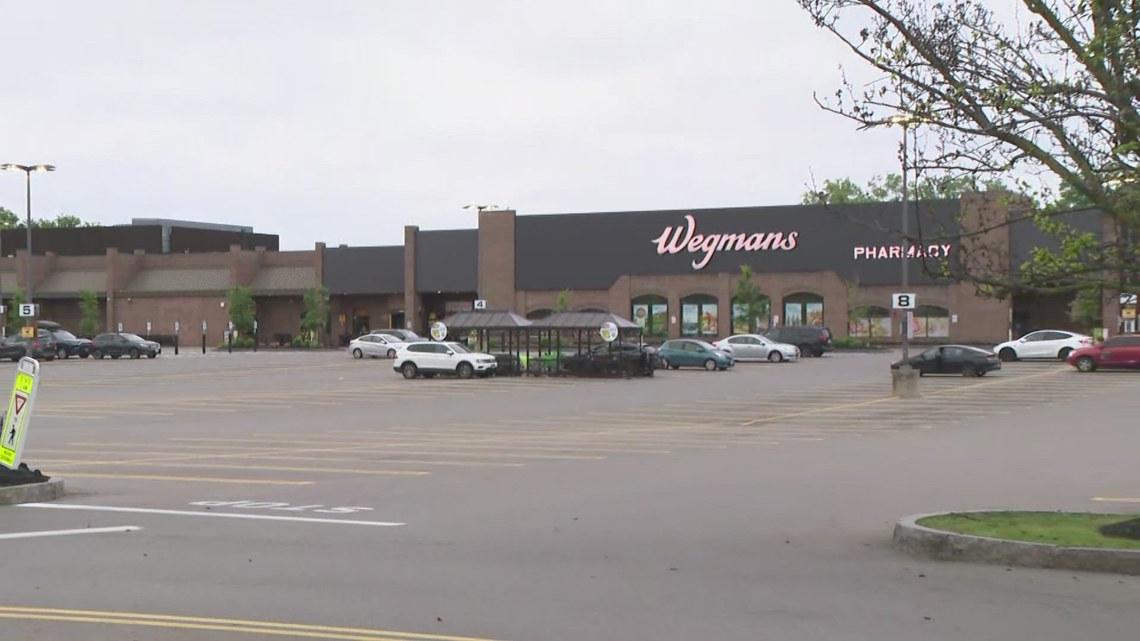
BUFFALO, N.Y. — Erie County lawmakers are weighing possible changes to local law after a Wegmans store in New York City posted signs alerting customers that biometric data may be used, prompting new questions about transparency in Western New York.
Legislators say they have heard mixed reactions from constituents since the notices appeared at the New York City location, where businesses are required by local law to disclose biometric data collection.
RELATED: Cheektowaga Police address privacy concerns over Flock Safety cameras
“Most everybody is saying that it’s creepy. Other people are saying that it’s happening all the time. What’s one more?” said Erie County Legislator Jeanne Vinal, a Democrat representing District 5.
Erie County Legislator Lindsay Lorigo, a Republican representing District 10, said she was surprised by the disclosure and noted that the signage requirement played a key role in informing the public.
“I was certainly surprised. I think, without the law in New York City that requires signage to be posted, we wouldn’t have known about it,” Lorigo said.
Biometric data differs from traditional surveillance video. According to the U.S. Department of Homeland Security, biometric data includes physical characteristics — such as facial features or fingerprints — that can be used to identify an individual.
“We agree to it every time, when we open up something on the internet, we have a right to say yes or no,” Vinal said.
Biometric technology is already used in some everyday situations, including at airports and border crossings, such as when traveling into Canada. Some retailers, including Walmart, have also acknowledged using biometric information.
Still, lawmakers say the issue is not necessarily the technology itself, but whether consumers are properly informed.
“Wegmans is a great store, and it’s a great part of Western New York and but I think that it’s just for people’s own, you know, feeling of security,” Vinal said.
Currently, there is no state or local law requiring stores in Western New York to notify customers when biometric technology is in use.
Lorigo said she is working on a local law that would require businesses or entities using biometric scanning to post signage alerting customers, similar to the requirement in New York City.
“I’m currently working on a local law that would require if a business or an entity is using, you know, biometric scanning and collecting that data that they would at least need to post signage to make customers aware. just like they’re doing in New York City. I think it’s a good measure. And just in terms of transparency,” she said.
Vinal has said she believes legislation addressing biometric data would be more effective at the state level and has expressed concerns about potential legal loopholes in a county law, but has said she would support local action if it reflects the wishes of her constituents.
In response to the concerns, a Wegmans spokesperson told WGRZ in part that the technology is used solely for keeping stores safe and secure and is limited to identifying individuals previously flagged for misconduct, adding that the company does not collect other biometric data such as retinal scans or voice prints.
Here’s the full statement from Wegman’s:
At Wegmans, the safety of our customers and employees is a top priority. Like many retailers, we use cameras to help identify individuals who pose a risk to our people, customers, or operation. In a small fraction of our stores that exhibit an elevated risk, we have deployed cameras equipped with facial recognition technology. In New York City, we comply with local requirements by posting the mandated signage to notify customers about the technology.
This technology is solely used for keeping our stores secure and safe. The system collects facial recognition data and only uses it to identify individuals who have been previously flagged for misconduct. We do not collect other biometric data such as retinal scans or voice prints. Images and video are retained only as long as necessary for security purposes and then disposed of. For security reasons, we do not disclose the exact retention period, but it aligns with industry standards.
Persons of interest are determined by our asset protection team based on incidents occurring on our property and on a case-by-case basis, by information from law enforcement for criminal or missing persons cases. We do not share facial recognition scan data with any third party.
We understand concerns about fairness and bias in facial recognition systems. We employ a multitude of training and safety measures to help keep people safe. Facial recognition technology serves as one investigative lead for us. We never base our decisions on a single lead alone.
Our goal is simple – to keep our stores safe and secure.