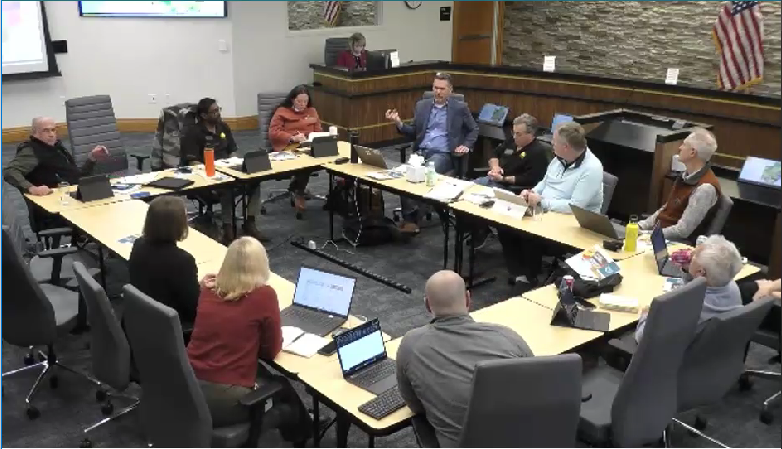
On Tuesday night, the Erie Town Council held a special meeting to confront a question that will shape the town’s next several decades: how dense Erie should become as it grows. The discussion centered on Erie’s Comprehensive Plan, particularly future land use designations and the residential densities tied to them. While no votes were taken, council members were asked to give staff direction on how aggressively the town should plan for growth as Erie prepares to nearly double its population.
Erie’s 2024 Comprehensive Plan updated land use densities for the first time since 2005. The changes were designed to accommodate town-approved growth from roughly 40,000 residents today to 85,000 or more in the coming years. Mayor and Chief Innovation Officer Andrew Moore framed the meeting as a chance to step back and assess whether those density assumptions still align with market realities, infrastructure capacity, and community priorities. Town staff explained that one of the immediate challenges is that the Comprehensive Plan and the Unified Development Code do not currently match. While the plan outlines where growth should happen and at what intensity, the UDC governs what can actually be built. The two have not been fully synchronized since the 2005 plan.
To address that gap, the town has set aside $250,000 in its 2026 budget to hire a consultant to update the UDC, a process council members hope to complete by 2027. Until then, staff is using the Comprehensive Plan as a guiding document while flagging areas where inconsistencies could complicate future development decisions.
Much of the conversation focused on how specific properties could influence Erie’s growth pattern. Council members discussed the southwest corner of 111th Street and Arapahoe Road, the Golden Run project between 119th Street and County Line Road, and the I-25 gateway at Erie Parkway as key sites where density decisions will carry outsized consequences.
Affordable housing also surfaced as a point of tension. Moore said the town needs to better understand how affordable and attainable housing fits within Erie’s budget and infrastructure constraints, adding that a separate session devoted entirely to the issue is likely in the future.
That approach has drawn criticism. Councilmember Anil Pesaramelli argued that the town’s acquisition of Redtail Ranch delayed meaningful conversations about affordable housing rather than advancing them. Moore pushed back, saying developers often recoup the cost of affordable units either through reduced profits or by offsetting costs elsewhere in a project, and that the town must be realistic about financial tradeoffs.
Transportation emerged as another factor closely tied to density decisions. Erie’s Transportation and Mobility Division announced it is negotiating with RTD to extend the Dash bus route from Willoughby Corner in Lafayette to the Erie Community Center. The proposed route would travel along Highway 7 and Coal Creek Boulevard, improving transit access through central Erie. Transit access matters because proximity to transportation is a major criterion for higher-density zoning. Moore noted that a potential shift of the Jump bus route from 119th Street to County Line Road could affect whether nearby properties qualify for higher-density designations. In one case, land owned by developer Aaron Harber could become ineligible for higher density if the route moves farther away.
Taken together, the meeting underscored that Erie’s growth decisions are becoming more interconnected and more consequential. Choices about zoning, transit, and housing are no longer abstract planning exercises. They will determine where people can live, how they move around town, and whether Erie grows up, grows out, or attempts to do both at once.
Like journalism like this? Consider becoming a sustaining supporter — and get our print edition delivered to your home each month.
Democracy needs journalism more than ever. For 25 years, we’ve told the truth — your support helps us keep doing it for the next four and beyond. Administrations come and go. Our team stays, ready to lead no matter who’s in charge.