
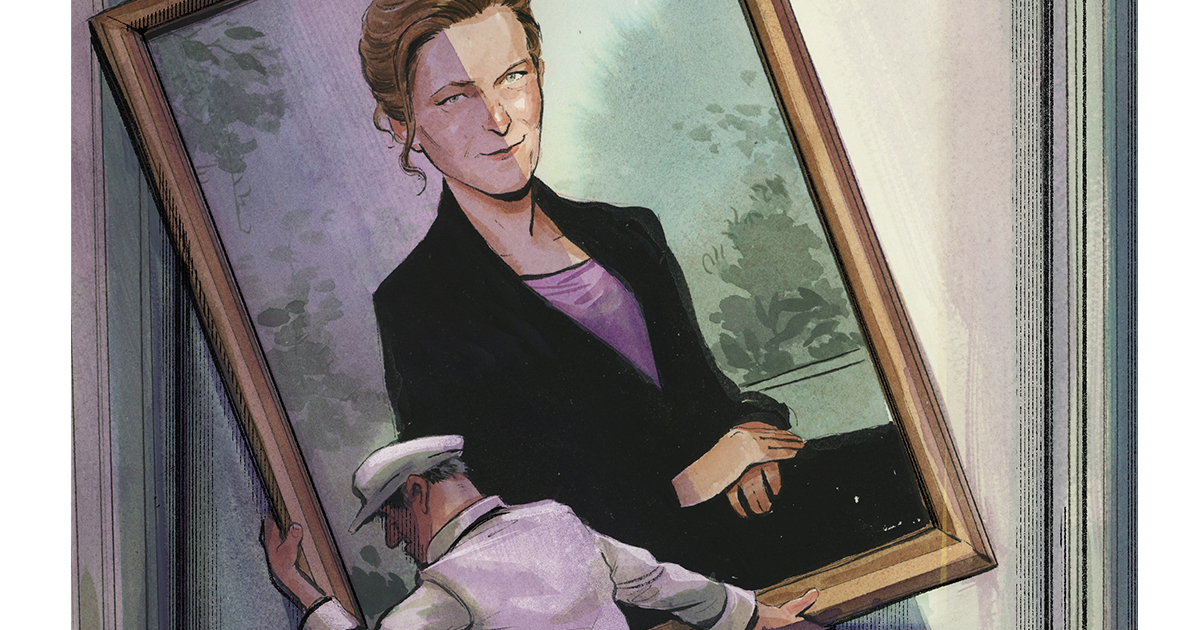
The exclusive story behind the brutal ouster of Sasha Suda and the new civil war at Philadelphia’s premier cultural institution
Get a compelling long read and must-have lifestyle tips in your inbox every Sunday morning — great with coffee!
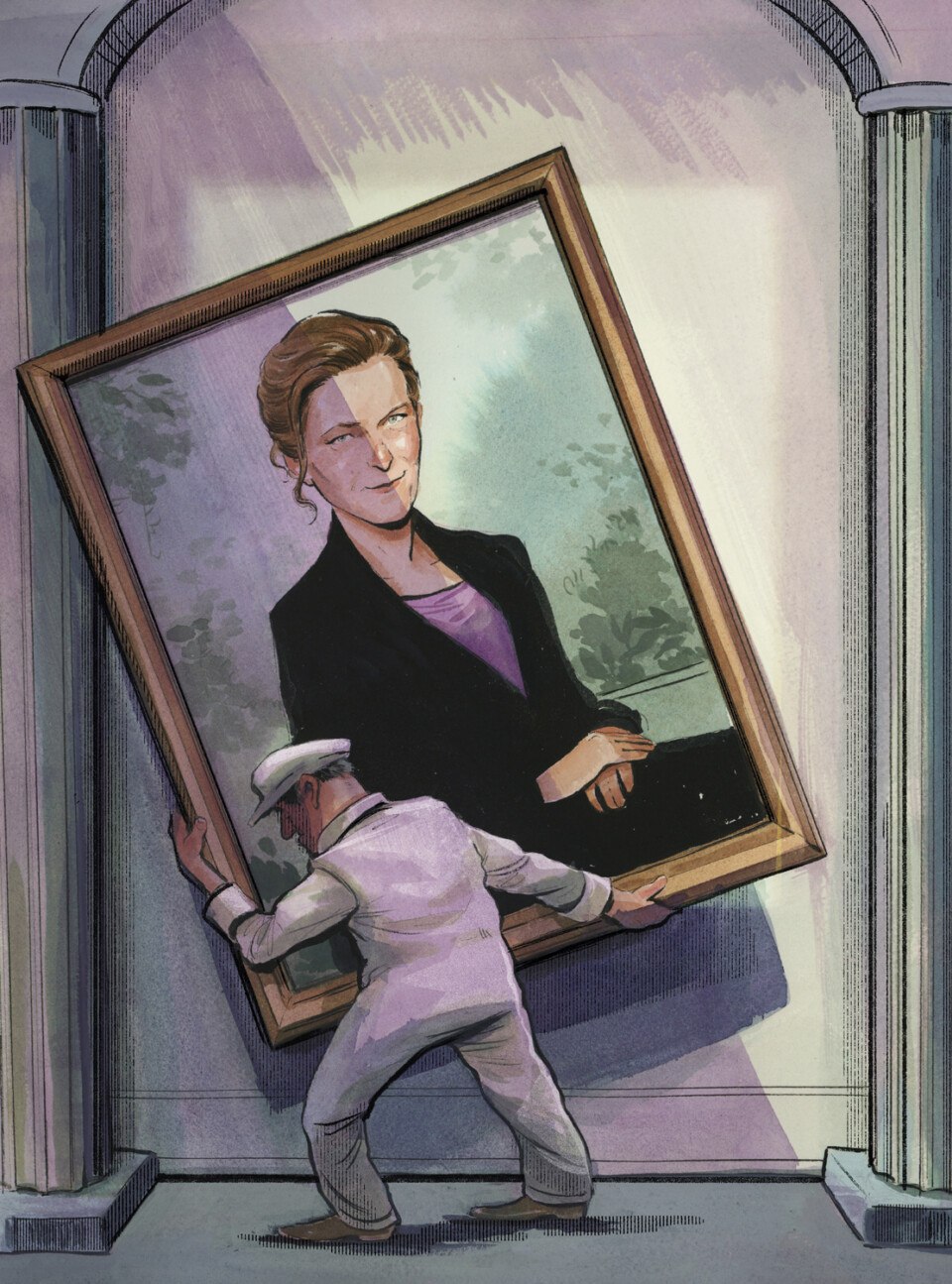
The Art of the Takedown: Sasha Suda’s brutal ouster at the Philadelphia Art Museum / Illustration by Britt Spencer
On the morning of Tuesday, October 28th, Sasha Suda, the director and CEO of the Philadelphia Art Museum, was called into a meeting at the office of museum board vice chairman Osagie Imasogie, in Center City.
There had been escalating tensions between Suda and the board for going on a year by this point, but that day she wasn’t worried. She’d just returned from a triumphant week in Prague and Vienna with two dozen donors. While there, she’d solidified a gift from Comcast co-founder and museum trustee emeritus Julian Brodsky for $20 million to create a children’s learning center at the museum, with Comcast’s Brian Roberts throwing in an additional $5 million. “I called [board chair] Ellen Caplan and some other board members from Europe,” Suda says, “and everybody was thrilled.”
Suda had been summoned to Imasogie’s office because the board had initiated an outside investigation into museum finances, which they wanted to discuss with her. She wasn’t particularly concerned about that. “I’d never hidden anything from them,” Suda says. Besides, a few board members told her the investigation was a broad look at how the whole system was working.
Four board members were in the room: Caplan, Orlando Esposito, Tac Justi, and Imasogie, who quickly got to the point. The investigation, he said, revealed that Suda had been dishonest, twice.
Suda was stunned. She asked Imasogie what he was talking about, but, she says, he wouldn’t elaborate. And suddenly it hit her: She was being canned. “I said to them, very calmly, ‘This is something that you all have been trying to achieve for quite some time. But this doesn’t feel like the right way to do it.’”
Suda says she was given a choice: resign amicably, or be fired. They hoped she’d do it amicably. She had until the end of the day to make her decision.
Suda was incredulous. That very night, she was to host directors of prominent museums from around the world at the home of general board member Jennifer Rice. (Rice declined to comment for this piece.) It was an important step toward getting Philadelphia, which had fallen out of global programming partnerships, back on the international map.
“I have to do that” — make a life-altering professional decision — “and I have to host these people? How am I going to do that?” she asked.
“You just have to do it,” she says Imasogie responded.
Suda gathered her things, said she had a lot to think about, and left.
The following Tuesday, Election Day, Suda received an email from the museum, which told her she was being “terminated with cause.” And that was that: Her brief, momentous career at the museum was over. The news, summarily leaked to Philly Mag and the Inquirer, sent shock waves through both the city and the international arts community.
But the bitter fallout was just getting started.
On November 10th, Suda sued the museum, after — she says — the museum refused to pay her an acceptable severance and consent to a mutual non-disparagement agreement. Her suit alleges that “a small, corrupt, and unethical faction of the board” fired her for just doing her job. The museum countered in its own legal filing that Suda had been fired for giving herself unauthorized raises. Suda is pushing for a jury trial. But the employment contract she signed stipulates that work disputes be settled privately, in arbitration. The museum has asked the court to hold Suda to it.
As of press time, the court’s decision was still pending. But, of course, the bigger, more compelling question is this: How the hell did the museum — and Suda — get to this place?
This is one of the most spectacular examples of the failure of board leadership ever in a prominent Philadelphia institution.” — David L. Cohen
To learn how it all went sideways, I talked to some 30 insiders, including board members, though none would allow me to quote them by name in this piece. Yes, it’s that messy, and the museum is that insular and self-protective. In full disclosure, some of the museum’s board members are connected to Philadelphia magazine’s nonprofit parent company, Citizen Media Group. Leslie Anne Miller, for example, is a founding donor of CMG; Jennifer Rice is a board member; and Osagie Imasogie has previously supported The Philadelphia Citizen, another CMG publication. These individuals hold differing views on Suda’s firing; their inclusion here reflects the magazine’s commitment to reporting this story independently.
Neither the museum’s board nor anyone representing the museum would comment at all; not even their public relations consultant, Brian Tierney, would weigh in. Others spoke off the record or for background only. But I met with Suda herself, who has not spoken publicly about any of this until now.
Another person who agreed to speak on the record about the whole thing is David L. Cohen, longtime Philly civic and business leader (and chairman of Citizen Media Group’s board), now back in town after serving four years as ambassador to Canada. Cohen befriended Suda in Ottawa, where the American Embassy sits practically next door to the National Gallery; she was director and CEO there before coming to Philly. He sees how Suda was treated here as an affront, a disaster. Cohen doesn’t mince words: “This is one of the most spectacular examples of the failure of board leadership ever in a prominent Philadelphia institution.”
It’s more than that. The failure at the museum is ultimately not just about what this institution is, what it wants to be, and who gets to call the shots. It’s a referendum on how young change agents get treated in this city — a symptom of Philadelphia’s age-old insular struggle between Old and New. In the end, it’s a fight over who defines and represents this place to the broader world.
•
I meet Suda, 45, in a Rittenhouse Square office where her lawyer, Luke Nikas, an art-world litigator from New York, has arranged our first interview. She is tall — nearly six feet — and dressed casually, her brown hair swept back. She is friendly and almost eager, it seems, to answer questions, staying even-keeled, even when recounting the gnarly details of how she feels she was treated. Later, she’ll tell a friend that talking through her story felt like a first step forward, but she isn’t kidding herself. “This is still really hard some days,” she says. Her position at the museum had been a dream job, a life’s goal come to fruition.
Suda inherited her passion for art from her father, a Czech immigrant who’d studied medicine in the homeland. In 1968, he fled to New York during the Soviet invasion; his brother was a journalist with Radio Free Europe, which made the entire family vulnerable to persecution. He then joined family in Canada, where he met and married Sasha’s mother, a fellow Czech refugee, and started his own family in Toronto. He never returned to medicine, becoming a teacher of ski resort management instead. Suda describes what sounds like a happy childhood: There was a great deal of skiing, and, she says, “We would go to New York a lot as a family. My dad had this connection to museums — the Guggenheim and the Met. Those trips are seminal memories for me.” They sparked Suda’s own passion for how great exhibits can feed our imaginative lives.
She went on to study art history at Princeton, discovered the Philadelphia Art Museum, and was immediately smitten.
“It was like a bite-size version of the Met, where it had an extremely high- quality collection, but it was navigable and had a soul,” Suda says. “It was started by industrialists at the turn of the century. But at one point, it became a place where artists are invited to install their own work in rooms dedicated to their legacy. It’s extraordinary — not just because you can go and see a lot of Jasper Johns in one experience, but because the institution really believes in the artist and really believes in the power of art to have an impact over time. The confidence for a museum to say, ‘This modern artist is going to be somebody who people will be interested in for the next 150, 250 years,’ it takes a remarkable amount of courage. That’s why most museums don’t do it. Yet this one did.”
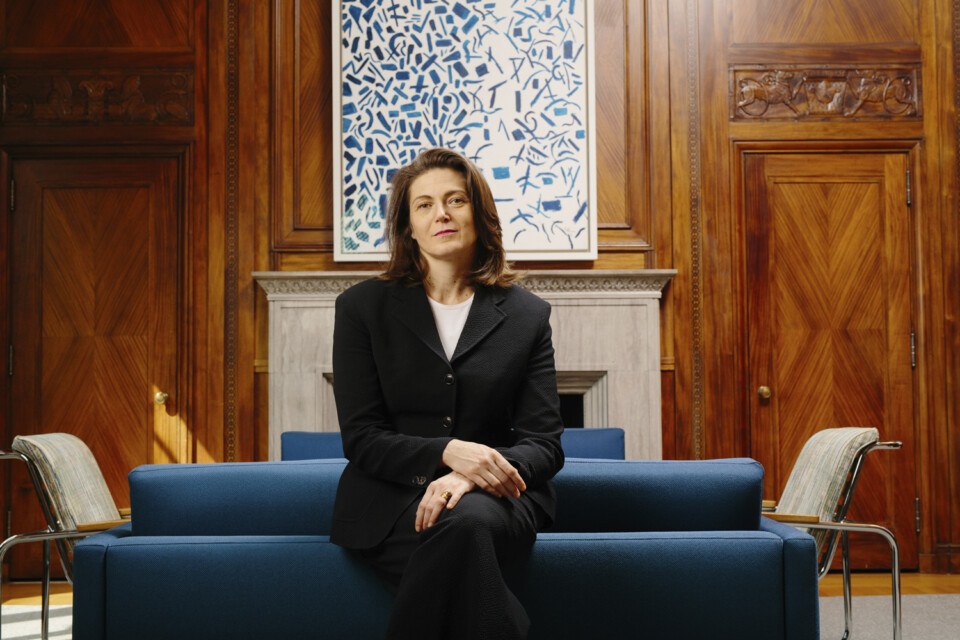
Sasha Suda / Photograph by Jauhien Sasnou
For Suda, museums are actual worlds that open right before us. “Here in Philly are these period rooms that are meant to give the public the opportunity to travel without traveling, to be in ancient China, say. And this idea of transporting people and engaging in a little bit of imagination play, which then carries through into the artist rooms — that doesn’t exist anymore at other places.”
Suda went to Williams College for a master’s in art history, then to NYU for a doctorate in medieval manuscripts (her dissertation was The Making of Girona Martyrology and the Cult of Saints in Late Medieval Bohemia — yes, she’s a big-time art nerd). She worked at the Met as a medievalist from 2003 to 2011, then became a curator at the Art Gallery of Ontario. In 2019, at the age of 39, she was recruited by the National Gallery in Ottawa to be its director and CEO, their youngest in more than a century. She received some criticism for being too “woke” there, for focusing too much on exhibits that celebrated decolonization. But Suda herself proudly cites a high point of her tenure: Each year when the Canadian government allocated $8 million to the National Gallery, she’d use it to bring art to other parts of the country — Saskatchewan, Manitoba, Newfoundland, and so forth.
“Whatever we commissioned for and with those communities was part of the National Gallery collection, but it was cared for by them,” she says. “I was drawn to the notion that one institution could serve an entire country, even though it seems like kind of an absurd ambition.” (So: an art nerd with a strong inclusivity streak.)
In Ottawa, when then-Ambassador David L. Cohen attended a tour Suda was leading, he was dazzled.
“Sasha is absolutely brilliant,” he says. “There are just some people who blow you away by what they know, how they can talk about it, how they can translate their knowledge and excitement into excitement and passion that you feel.”
By 2021, Suda was gaining a reputation as one of the best young museum directors in the world. And the Philadelphia Art Museum took notice.
•
The museum was looking for a new director and CEO to replace retiring Timothy Rub, whose long tenure — he’d led the museum through a 15-year, $233 million renovation and expansion designed by architect Frank Gehry — was ending on a sour note. Long-simmering tensions around pay equity and diversity (related to both personnel and museum presentations) had come to an ugly head, further inflamed by complaints that allegations of sexual misconduct by a former museum manager had been met with a shrug in the executive office. By 2021, as union negotiations picked up steam among the museum’s rank and file, Rub was preparing for his own departure. The museum began a search for a leader to both deal with the problems and modernize the institution, which needed a bolt of young energy to ramp up funding. Suda was seen as an intriguing candidate, one who’d bring a fast-moving millennial’s sensibility to the staid arts behemoth on the hill: open, fresh, artist-focused, committed to bringing new audiences to the institution. Someone, perhaps, whose “wokeness” might be exactly what the museum needed in a post-Rub leader.
In the fall of 2021, Suda was invited to interview for the role of museum director and CEO. The interview was led by Leslie Anne Miller, then head of the board. A major arts patron, Miller is known as a no-nonsense player both on the museum’s board and throughout the city. She had a long career as a litigation and mediation lawyer, and was Governor Ed Rendell’s general counsel for two years, overseeing 450 attorneys and 32 agencies, the first woman ever in that position. She is, in a word, formidable, and also — by multiple accounts — someone who is used to wielding power and getting things done.
The 70-member museum board is also impressive and well-connected. Current board chair Ellen Caplan, for instance, brings deep philanthropy to the position (the Wistar Institute cancer center is named for her and her real-estate-developer husband, Ron Caplan). Vice chair Osagie Imasogie, a serial entrepreneur and investor, is head of the board of advisers at Penn’s law school. John Alchin is a former Comcast and banking executive. Martha McGeary Snider, who served as Governor Rendell’s arts and culture adviser for eight years, was once married to late Flyers owner Ed Snider. Connie Williams, a founding donor of CMG, is a former state senator, VP of the Hess Foundation, and former board president who’s given generously to the Art Museum. The list goes on, a who’s who of Philadelphia money, power, and pomp. But when it comes to running things, it’s the dozen or so members of the executive board who really call the shots.
Shortly after Suda’s interview at the museum, Miller offered her the job. But it was no longer the job Suda had interviewed for, which was director and CEO — running both the art and business sides of the museum. Miller now told Suda that the job was to be split in two: Suda would be the director only; someone else would be the CEO.
Suda was taken aback. (Miller didn’t respond to requests for an interview.)
Suda put her off and did her own digging, eventually learning that some board members wanted an art person to run the museum and a smaller group wanted a business leader. It’s actually a current debate in the arts field: What sort of skills better serve the institution? But Suda wanted to put her stamp on the museum by running the whole shebang, the way she had at the National Gallery.
Soon, she heard from Imasogie. He said the board was courting John Fry, then the president of Drexel University, to be the museum’s new CEO (sources confirm that this was a serious pursuit). Fry would need a year to wind things down at Drexel, Imasogie said, after which he’d deal with the board and the business side of things at the museum. In the interim, Suda could be both the director and the CEO, and then she’d revert to director only.
“Miller and Imasogie wanted someone else as CEO; others wanted me, or somebody like me,” Suda says. She thinks that “because I’m young and female, they thought they could make both work.” In the meantime, of course, she’d be thrown into a messy situation, dealing with newly unionized workers who were threatening a strike and managing the ongoing fallout of those sexual misconduct complaints. Only to be rewarded, when it was all done, with the stripped-down position of director only.
Annoyed, she turned down the offer. Then, in late spring, Miller called to offer her the full job.
“You mean the one I applied for?” Suda, confused by the bait and switch, remembers saying.
It was a watershed moment for her. Suda wasn’t desperate to come here. She could simply stay put at the National Gallery in Ottawa, with her sculptor husband, Albert Zuger, and their (now) 10-year-old twins. But this was an extraordinary opportunity to guide and impact a museum she had loved since her first visit, one whose sensibility was powerful to her.
So she met once again with Miller and the hiring committee. She says she told them that the way the job had been offered, then altered, then changed back to its original form was “not a promising way” to begin her tenure at the museum. She also said she expected to be paid the same $720,000 salary given Timothy Rub (whose departing package had included a John Deere tractor).
It wouldn’t look good, Suda felt, for them to bring in a younger female director and CEO, and pay her less than her older male predecessor. (These things are often discussed in the museum world.) She stuck to her guns.
They gave her the money.
•
In the eight-month transition between Rub’s leaving and Suda’s coming on board, Miller acted as CEO, even hanging some of the art she owned in her office at the museum. “She really set up shop,” Suda says. September 26, 2022, Suda’s first day on the job, coincided with the beginning of the new union’s 19-day strike. Suda says Miller wanted her to stay away from the museum during the strike. Suda went to work anyway. “The issues that prompted the strike predated my tenure,” she says, “so I felt okay crossing the picket line until the offer they were picketing was one I had helped to pen.” (For her actions, she wound up getting doxxed online, she says. And at the hotel where she was temporarily staying, the receptionist told her that people had shown up looking for her.) Suda says Miller didn’t want her to be involved in union negotiations, either. Suda alleges that the board president characterized her tenure at the National Gallery as “at best, a finishing school” — that is, hardly the big time, nothing like the down and dirty of Philadelphia.
Miller, Suda says, would often voice her unvarnished opinions, which was startling to her — she found Miller to be a force with a hair-trigger edge. But as she settled into the job, something bothered Suda more: a growing belief that Miller was keeping her away from the larger board. When Suda was hired, she dealt only with the small faction who hired her — Miller and Imasogie, in particular. She says Miller provided no opportunity for her to meet the full 70-person board. During the strike, of course, board business was handled online, a remnant of COVID, but the distance from the rest of the board felt intentional to Suda — an indication that Miller was in charge and would keep a tight rein on her. And given that much of the board was over 70, with decades-long tenures and, for many, only sporadic interest in museum business, keeping the new hire outside the fold wasn’t tough.
At this point, did it occur to Suda to run for the hills — or back to Canada?
“I would say I was in a bit of denial,” she says, “because everything was in motion. There were movers at my house in Ottawa — we’d bought a house in Gladwyne in a day. There wasn’t a kill switch for me.”
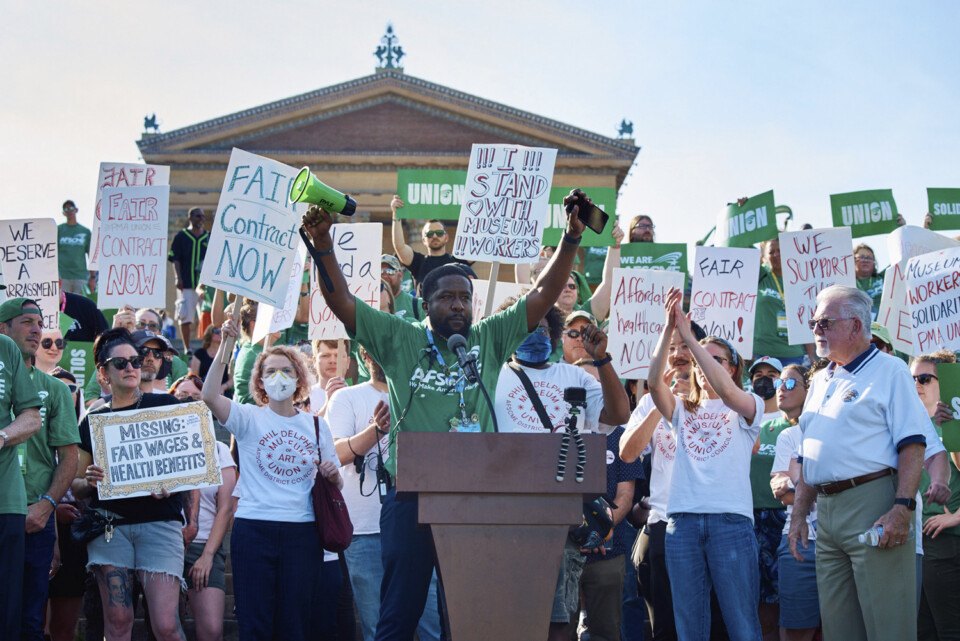
A union rally at the Philadelphia Art Museum in July of 2022 / Photograph by Tim Tiebout
But things got … hairier. In December 2022, just three months into the job, Miller told Suda that she’d been negotiating with Phillies owner John Middleton about displaying his art — considered perhaps the finest private collection of American art in the country — at the museum, a deal that Miller would control. Suda saw this as an obvious intrusion into her own territory as director. Moreover, displaying private collections can be tricky: Would the art be donated to the museum, or was the museum serving as a kind of gallery where the value of the art would rise before it was spirited away?
Suda, circumventing Miller entirely, says she invited Middleton to her house for a discussion. His intent, she understood, was only to share his art with a wide audience, and a partnership developed, with Miller excluded. The resulting “A Nation of Artists” — some 120 of Middleton’s paintings — will be a central exhibit of the city’s Semiquincentennial celebration this year, to be shown in extended shows at both the museum and the Academy of the Fine Arts. (Before she got fired, Suda had been working on a next step: She’d visited Crystal Bridges — the Arkansas museum created by Walmart heir Alice Walton — to brainstorm with leadership there about taking Middleton’s collection on a national tour.)
None of this pleased Miller, says Suda, who soon learned from support staff that Miller had characterized her as “incompetent” and “a snake,” among other shortcomings.
Then there were the many smaller intrusions. Miller was privy to Suda’s calendar, Suda says, and would interrupt her day with marching orders: “I know you’re in a committee meeting, but I need you to make some calls” — for example, to board members to alert them that they were pushing out the head of development, a decision Miller had been on Suda to make. Another example, per Suda, was Miller wanting to control how Suda would terminate the employment of Suda’s own assistant, someone Miller had known for 20 years.
Some of this sounds absurd, and perhaps Suda would have been better off if she had ignored the intrusions and carried on. But the accretion of incidents made her feel isolated; she suspected that Miller had “seen me as a threat from day one.”
She found an unexpectedly sympathetic sounding board and ally in Bill Peterson, the museum’s new chief operating officer. Miller had installed the former Verizon executive as COO right as Suda started, which had irked Suda at the time. She felt the hiring should have been her call, not Miller’s. (When challenged on it, Suda says, Miller responded, “Don’t be ridiculous.”) Regardless, Suda immediately felt that Peterson was somebody she could trust. She told him she was disturbed by this rocky beginning with Miller. “I was afraid this was going to happen,” she says he responded. “But I thought it would happen later.” (Peterson did not respond to a request for comment.)
There was one out, Suda saw: Miller told her that she was stepping down as board chair the following year. (She’d served two three-year terms, with an additional year.) Suda decided to wait her out — if she herself could endure until then.
•
Meanwhile, Suda pressed on. She and her curators came up with exhibitions of cutting-edge art from surprising artists — some of it culled from the museum’s own archives (95 percent of the museum’s collection is in storage) — to entice new visitors. She arranged for the U.S. debut of “The Time Is Always Now” (November 2024 through February 2025), which featured contemporary paintings by Black artists of Black figures, after its glorious run at London’s National Portrait Gallery. In a review, Observer.com called the exhibition “a striking exploration of humanity that transcends race, illustrating how racial identity is a construct shaped by social and political forces while foregrounding our shared human experience.”
Another exhibit, “Boom: Art and Design in the 1940s” (April through September 2025), featured 250 works of sculpture, painting, fashion, photography, furniture, and more, including work from Black artists. The Times Literary Supplement gushed: “It is difficult to imagine a more comprehensive exhibition of the art and design of the 1940s.” There was also a surrealist show (through February 16th) that brought in paintings from Europe and showed off the museum’s own stored collection, and an exhibit of paintings by Noah Davis, a Black cult figure who started the Underground Museum in L.A. Suda might have a doctorate in medieval manuscripts, but her taste in art certainly doesn’t trend wonky.
Suda also opened up space to make more room for schoolchildren, increasing visits from 8,000 in 2021 to 38,000 in 2024 — a move that was, as The Philadelphia Citizen reported last August, part of her “people-forward” vision. “These students,” the story noted, “might be future artists or art collectors, donors or curators or, most importantly, lifelong visitors to their city’s premier arts institution — but only if they feel like it is theirs to enjoy.”
Many board members seemed pleased with her work. “Sasha regularly puts the PMA in the global conversation,” board member Jennifer Rice told The Citizen in the same story. “But she’s also not afraid to bring change; she’s not afraid to break things that need to be broken.” Another longtime board member, Kathy Sachs, founder of ArtPhilly, said: “The PMA is on this hill. I feel like Sasha is walking off that hill, going into the city, meeting lots of people. We … have a responsibility to our city and our citizens, and that matters to Sasha.”
Still, as that story noted, the artistic direction some board members seemed to love was a point of contention among other longtime members, who felt that Suda’s focus on inclusion was too narrow “when it comes to exhibitions.”
As for fulfilling her role as CEO, Suda’s lawsuit states that over three years she reduced the museum’s $6 million budget deficit by two-thirds and last year pushed past fundraising goals. Her negotiations last year for a new labor contract within the board-approved budget were also successful. Local 397 president Halcyone Schiller told The Citizen, “We’ve been met with more consideration than I previously experienced from management in terms of problems and how to solve them. We are closer to a place of labor peace than we have been the whole time we’ve had this union.”
And as for board demands that she find new donors to bring sizable money into the museum, well, there was that $20 million gift she scored from former board member Julian Brodsky (with another $5 mil from Comcast’s Brian Roberts). Brodsky’s commitment landed, it turns out, just a week before Suda was fired.
One place Suda appeared to struggle was in finding her footing as a workplace leader. One mid-level museum worker remembers open-ended staff meetings where Suda would say, “I’m not afraid of conflict — you can ask me whatever questions you want,” but then talk around challenging questions. A tech staffer says the gatherings were derided as “word-salad meetings,” where Suda talked fancy and didn’t really say much. Once, adds the staffer, Suda was asked whether the museum was going to take a stance on the growing conflict in Gaza, given that Philadelphia is a sister city to Tel Aviv-Yafo, Israel.
Suda had no response to that, the staffer told me. She was silent for a moment, then called on the next person with a question, which came off to the staffer who told me about it as arrogant and dismissive. Suda, for her part, says she thanked the staffer for the comment, and organized an advisory committee to address the Israel-Gaza conflict, in which the staffer then participated.
Perhaps the worst complaint was that the openness staffers were hoping for — for Suda to come in with collaborative leadership, to solicit their feedback on what the coming rebrand should entail, for example — didn’t happen. In fact, in December, the Inquirer ran an even more pointed critique in a story about low staff morale. Staffers worried, the story alleged, that the programming team “became less autonomous and more risk-averse under Suda.” And that the reputation and mission of the museum, post-Suda, was at stake.
Suda says that whatever managerial challenges she faced, “the accomplishments, exhibitions, financial improvements, school district engagements, and robust plans for the future were all the product of the great work that the team produced, which could not have happened without the input of numerous people inside the museum.”
In any case, the more pressing problem for Suda seemed to be the issue of managing up. And that raises a question: If you’re making three-quarters of a million dollars to run a major institution, is dealing with a difficult board just, well, part of the gig?
•
In the spring of 2023, Miller stepped down as board chair; she was replaced by board member Ellen Caplan after a few other candidates backed away. Caplan was an odd choice, according to some board members I spoke with. Her bio on the museum website introduces her thusly: “I grew up coming to the Philadelphia Museum of Art with my parents and two older sisters. In fact, in my first memory of the PMA — at about five years old — I was trying to reach the top of the desk to give money for a Pay What You Wish Sunday. … I have countless memories over the years of PMA visits.” That may be sweet, but it also plays into how Suda and some board members saw Caplan: as an enthused volunteer, an envelope-stuffer woefully unprepared to lead the big board of a complex institution.
Not that Caplan didn’t try, as chair. Early on, she touched base directly, one on one, with all 70 board members, Suda says. But she didn’t know how to prioritize board demands.
“It was like playing whack-a-mole with issues small and large,” Suda says. Maybe somebody sent a donation for 10 grand and the check didn’t get processed on time — Caplan wanted Suda to call that person and massage his ego for 15 minutes. But Caplan might give only two minutes to the Trump administration’s new rules on DEI or federal funding. “Her head was spinning with all these board complaints,” Suda says. “And thinking strategically was a big pivot for her” — an opinion echoed by board members and a prominent museum partner I spoke with. (Caplan declined a request for comment.)
Leslie [Anne Miller]’s incredibly intelligent — she can read a person’s insecurities and exploit them. She operated like a politician.” — Sasha Suda
Meanwhile, Miller hadn’t really gone away. Suda says that Miller framed photographs taken of herself and Caplan at museum events, and sent them to Caplan. To Suda, it looked like Miller was wooing Caplan — though Caplan, like Suda, also had to deal with a harsher side of Miller. Caplan shared with Suda that Miller once gave her comprehensive notes on how bad her remarks had been at the last board meeting, including a line-by-line feedback on her tone of voice, and criticized what she’d worn. An exhibitor later told Suda that Miller had complained to him that Caplan needed all the help she could get, given that “she doesn’t know her ass from her elbow.”
“Leslie’s incredibly intelligent — she can read a person’s insecurities and exploit them,” Suda says. “She operated like a politician.”
By the fall of 2024, Suda’s standing with Caplan was feeling precarious to her. Suda’s biggest ally, David L. Cohen, knew the situation was dire and tried to step in. He had learned that Caplan might not be seeking a second term as board chair. Given his vast experience heading boards in Philly, if he could be brought in to help run the museum board, Cohen was confident he could make things better and perhaps become board chair when Caplan’s term ended in 2026.
It didn’t happen. “Do you really think the full board would have taken umbrage to David L. Cohen going straight on to the executive committee?” a board member wonders. Of course not. To that member’s mind, “there’s only one insecure, paranoid person responsible for keeping him off”: the current head of the board.
Moreover, Caplan decided to stay on as chair after all. Cohen never joined the board.
•
The real beginning of the end for Suda came in October of 2024. She decided to put staff curator Carlos Basualdo on administrative leave over issues Suda declined to address, after having spoken to Caplan extensively, she says, about the decision.
But when Suda attended the board meeting in which the Basualdo leave was brought up, several members were furious at the news. Suda realized they had not heard about the decision; he was an important curator they respected. They felt blindsided. “They understandably need to feel that decisions like this are made in consultation with them,” she says. “It was Ellen’s job to keep the significant players apprised. I didn’t know I couldn’t count on her to work the back channels.” (Basualdo now serves as director of the Nasher Sculpture Center in Dallas.)
Board member and philanthropist Sheldon Bonovitz, chairman emeritus at law firm Duane Morris, was so incensed that he demanded a vote then and there, Suda says, on whether she should stay or go. It didn’t happen — it certainly wasn’t protocol, anyway. But it was clear that neither Caplan nor Suda had anticipated the depth of the board’s anger.
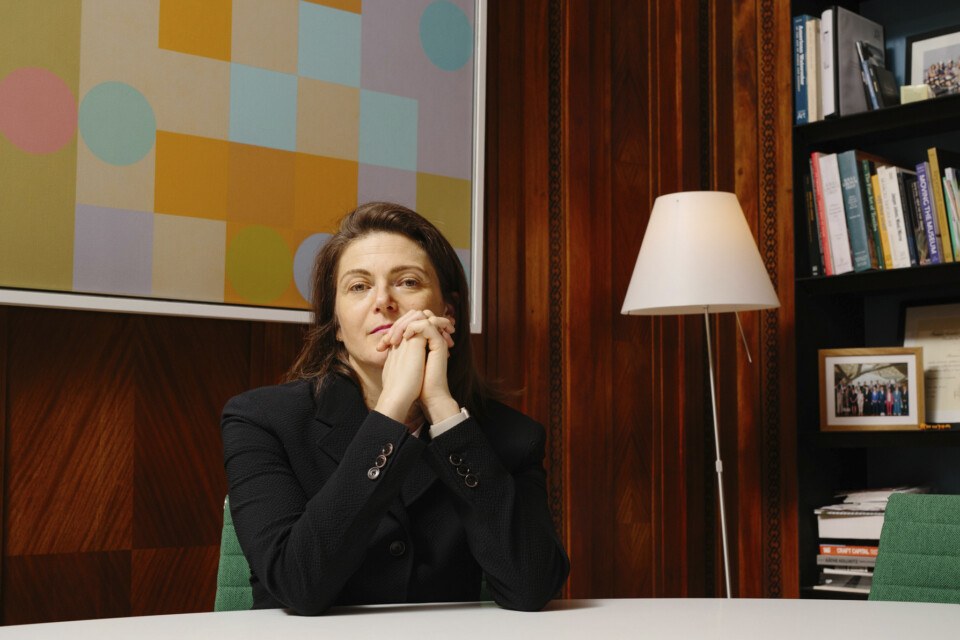
Sasha Suda at the Art Museum in 2024 / Photograph by Jauhien Sasnou
In subsequent days, Suda says, Caplan repeatedly told her how she had defended Suda to the board in a separate executive session. But she seemed “on edge,” says Suda, on a trip Suda took that included Caplan and Caplan’s husband (among other board members) that same month to visit museums in Korea. Caplan said defending Suda was difficult, the meeting was a disaster, and Suda had failed her — denying, Suda says, that they had discussed the problems with Basualdo well before the meeting. Suda had failed everyone, Caplan told her.
Plus, she and her husband hated the Korea trip, Suda recalls Caplan saying. They told Suda it was “boring.”
Then came last fall’s rebranding of the museum, something Suda says began “in conversations with Leslie Miller when I started, to reset the institution, to present it as a new chapter in the organization’s long history.”
The institution’s name was changed from the Philadelphia Museum of Art to the Philadelphia Art Museum. There was a new logo, too: A huge griffin inside the columns at the front entrance, with one word — PHILADELPHIA — encircling the top of it, which aimed to connect the majesty of the museum with the notion that the museum is ours; it belongs to the public. When the $250,000-plus rebrand rolled out in October, the response was mostly negative: Why spend so much money on that, and why had the museum used a New York design firm, and why didn’t anybody see how the name would be shortened, Philly style, into a loud … PhArt? Ouch.
Some on the museum board told me they loved the rebrand, though board member Jerry Wind told the Inquirer, in what seems to be a rolling complaint about being kept in the dark, that when it was launched, “we were as surprised as everyone else.” Which, Suda says, is ridiculous, given myriad board briefings and that Suda herself traveled to Caplan’s vacation home in Nantucket last summer to present a full rollout. While some media accounts of Suda’s firing point to the rebranding as a contributing factor, not one of the 30 people I spoke to sees anything in that. It was just noise.
•
By the middle of last year, relations between Suda and the board had so devolved that Caplan would take a vote of the executive committee on whether to fire Suda. The vote went eight to two in favor of Suda staying. Then Caplan hired an outside firm to do an investigation into museum finances, especially whether Suda had given herself pay raises that the board hadn’t approved. Suda had received, over two years, about $39,000 in additional pay, in what she says were three percent cost-of-living raises that she was due. Not so, says the museum’s response to Suda’s complaint, and that’s the heart of the museum’s legal argument: that Suda gave herself raises — and then lied about it to the board.
Suda’s lawyer, Luke Nikas, shares documents that appear to support Suda’s version of events: A report by a firm the board commissioned to analyze museum finances in 2024 lists Suda’s salary as $734,400, which reflects part of the cost-of-living raises. Suda’s complaint also notes that in her first year at the museum, Suda declined the pay increase because of the museum’s deficit. The following year, the CFO applied the three percent cost-of-living adjustment. The adjustment — that $39K, over two years — was “processed through payroll, approved by finance, and included in the budget. It was also published in the institution’s 990 tax form, which was seen by the organization’s compensation committee and was fully transparent in its application.”
So the board (if it was paying attention) had knowledge of her income. Suda’s point is that she wasn’t hiding anything.
Then there’s this email exchange, between museum CFO Katherine Harper and HR head Meredith Clayton on March 17, 2023:
I was just trying to figure out what increase Sasha might be entitled to in FY24. I will budget her with a 3% increase in September 2024 — [2 years] from her arrival. Prior to finalizing I will check with [head of the finance committee] John Alchin or Leslie [Miller] to make sure they are comfortable. Ok for you? Thanks, Kathy
That same afternoon, Clayton answered:
Hi Kathy, Sounds good to me! Thank you! Meredith
Did Harper make that call to John Alchin or Leslie Miller? I don’t know. (Neither responded to request for comment.) But this exchange seems to undermine the notion that Suda was “self-dealing,” as the museum’s complaint alleges, and operating in the dark to steal money.
On the Saturday after she was given the option to resign or be fired for cause, Suda says, board member Ira Brind (who didn’t respond to a request for comment) called Suda. He said he was upset both by how her tenure was ending and that the museum had called the law firm handling her green card status, notifying them that she no longer worked at the museum. Suda’s lawsuit alleges that this would potentially force her to leave the country within 60 days.
In the aftermath of Suda’s firing, Cohen is angry, as are many other people. One board member, Connie Williams, resigned in protest — and withdrew the substantial financial donation she had pledged to the museum. Others are taking a wait-and-see approach. One member says the full board has yet to see the report that details Suda’s alleged offenses. Cohen, for his part, concedes that Suda’s strength is art, not management, not the business side. But it’s a board’s responsibility to give help, to mentor, he says.
“The Philadelphia Museum of Art,” he says, “had the potential to smooth out any administrative or managerial rough edges that their young leader, a world-class professional, brought to the table, which would have made her the whole package. And they didn’t do that.” Nor, says Cohen, did board leadership understand or respect the relative roles of a board versus management.
Brian Allen, a former museum director who skewered Suda’s firing in a piece for The National Review (which characterized it as “a catfight in a snake pit”), said in a text that the process comes at a cost: “What’s happened is very embarrassing, will give donors pause, and, of course, with the fiasco-making trustees in place, who knows what they’ll do next?” (Though Allen also skewered Suda in his piece for being young, woke, and Canadian.)
Which is presumably why the museum just hired calm-the-waters Daniel Weiss as director and CEO, through 2028. Weiss, 68, the former president of Haverford College, went on to lead the Metropolitan Museum of Art in New York for eight years. Strangely, it was Suda herself who brought him to Philly’s museum in the fall of 2023, to give her guidance on governance. But by last June, she sensed him “pulling away” from her. (Weiss did not respond to requests for comment on this story.)
“I saw him at a retirement for a director in Boston,” she says, “and he was distant. He said, ‘How are things going?’ I said, ‘Look, it’s really complex,’ and he said, ‘You have the most complex board in the field. People think that they have tough boards. Your board is really tough.’”
Weiss, it seems, is exactly what some board members truly wanted: a well-credentialed, safe choice — someone more of the (older white male) establishment — to run the place. As a longtime board member who had stopped coming to meetings but has become reengaged by the current crisis tells me, “I just want to move on, and I think we’ve got the right guy.” Meaning the one who will get everything back, this board member hopes, to business as usual, never mind a potential retreat from opening up the museum to new kinds of exhibits and visitors, with a new presence in the city.
It used to be a common complaint, going back a few decades now, that all the so-called power players in Philly could do was fight over the scraps left in a once-great city in decline. The scandal at the Art Museum turns that complaint a different way, as the city looks to lead the 250th anniversary of the signing of the Declaration of Independence this year: We do have a great museum, with a world-class collection of art, as Suda so readily recognized the first time she laid eyes on it. So why do we run it as if we’re fighting over the scraps?
And therein lies the ultimate failure of the board. In the end, and all along the way, they had every right to fire Suda, if they saw fit. But in how they operated — undisciplined, threatening, fomenting combativeness rather than collaboration between the board and the new head, seemingly set on retaining control — they failed her. And worse, they failed the city their institution is meant to serve. It has played out as a blood sport.
For her part, Sasha Suda will survive. At the end of my second interview with her, she suddenly stops talking because a pop-up on her laptop has announced the death, at 96, of Frank Gehry, the iconoclastic architect and visionary behind the museum’s massive, gorgeous 2021 renovation. Suda seems to tear up. In the five hours we have spoken, this is the first time she appears upset.
Early on, in the first days and weeks after her firing, people who had worked with her, who had gotten close to her, would go to Suda’s home to offer comfort — she took the firing hard. She seems to be coming out of that now. But the tawdry scandal of her exit, and what it might do to the city’s standing, in the arts world and beyond — that’s what will remain, what we are all now left to grapple with.
Published as “The Art of the Takedown” in the February 2026 issue of Philadelphia magazine.