
It had warmed up a bit the morning I wrote this column, but cold weather is forecast to return. That, I’m sure, will make ice fishermen happy. And I’m sure that many of them are also grateful that the Pennsylvania Fish and Boat Commission in fall stocked rainbow trout in many lakes.
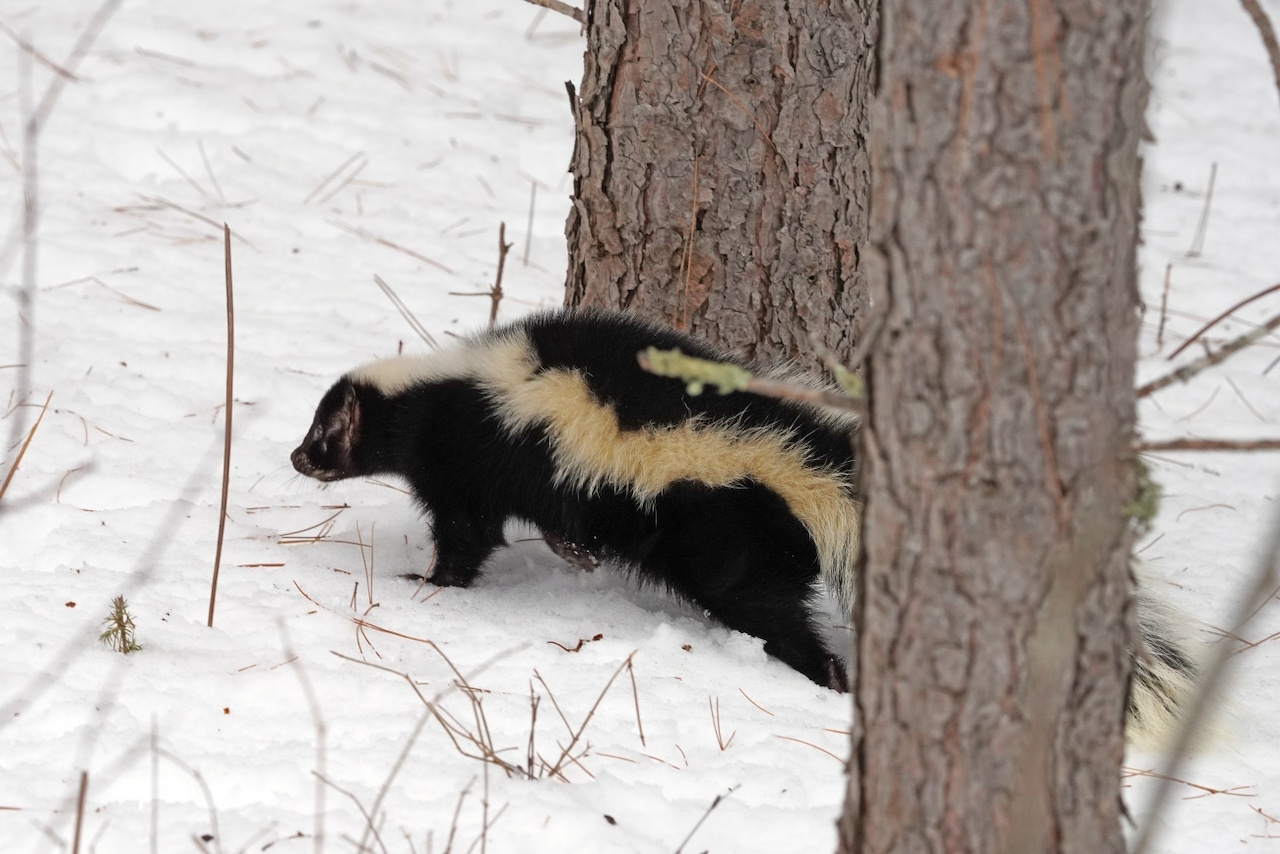
But although it’s currently above freezing, on one of our really cold recent nights I was woken up by the smell of a skunk — something I don’t usually think about in the winter. Somewhere outside the bedroom window, this little mammal in the weasel family had discharged its musk at something.
Just about everyone knows what a skunk smells like. Its intense scent contains butyl mercaptan, and when it sprays it out of the glands under its tail the smell stays around for a long time. I’ve read descriptions of its musk as smelling like many different things, but they all mention rotten eggs combined with other foul odors. One reference says the musk smells like the tiger house in a zoo.
In the winter, it’s actually not all that unusual to smell a skunk. Males often leave a winter den to go out and search for food while females usually stay denned up until warmer weather and mating occurs. Skunks go into torpor in the cold months but they don’t actually hibernate.
As snow melted with the warmer temperatures, I was able to see animal footprints previously hidden under ice. And I picked out several five-toed skunk tracks that also showed claw marks. Unlike some other animals, skunks put their entire foot on the ground as they walk.
I also saw what looked to be coyote tracks in the snow that showed claw marks because they don’t retract them. Coyote tracks are more oval than those of other dogs, but to see this you’d have to have both kinds present.
And, of course, there were white-tailed deer tracks at a lot of places, including next to one of the bird baths that often gets emptied overnight. I’d assumed it was deer doing this, but without seeing the tracks I couldn’t be sure.
At this time of the year there aren’t a lot of wild animals to be seen, but there are always American and fish crows around. There’s one local one that often comes onto the deck posts and eats some of the peanut butter/lard mixture I put out for the birds.
David always gives names to animals that frequent the yard, so he refers to this one as “Mr. Crow.” But be it a Mr. or Mrs., it’s entertaining to watch. Every time it takes some of the peanut butter mixture, it then goes to a bird bath and dunks it before eating it.
Crows do this a lot, sometimes to make the food easier for nestlings to eat, but that’s not the case right now. Making the food wet also provides hydration for their sustenance and possibly also makes it more palatable.
A male yellow-bellied sapsucker is also coming in for the peanut butter mixture, and yes, that’s its proper name. Sapsuckers are woodpeckers only normally seen around here in the winter.