
Odd-man rushes, including the game-winning goal, a first-period breakaway goal, and an aggressive opponent that did not lack size.
The Pittsburgh Penguins weren’t their best for the first period and more. And they struggled to deal with the Calgary Flames’ man-to-man defensive attack, eventually losing 2-1 to Calgary at PPG Paints Arena.
It was a disappointing loss as the Penguins’ six-game winning streak ended, but also losing to a team well under .500 that had lost four straight and scored only three goals in their previous three games.
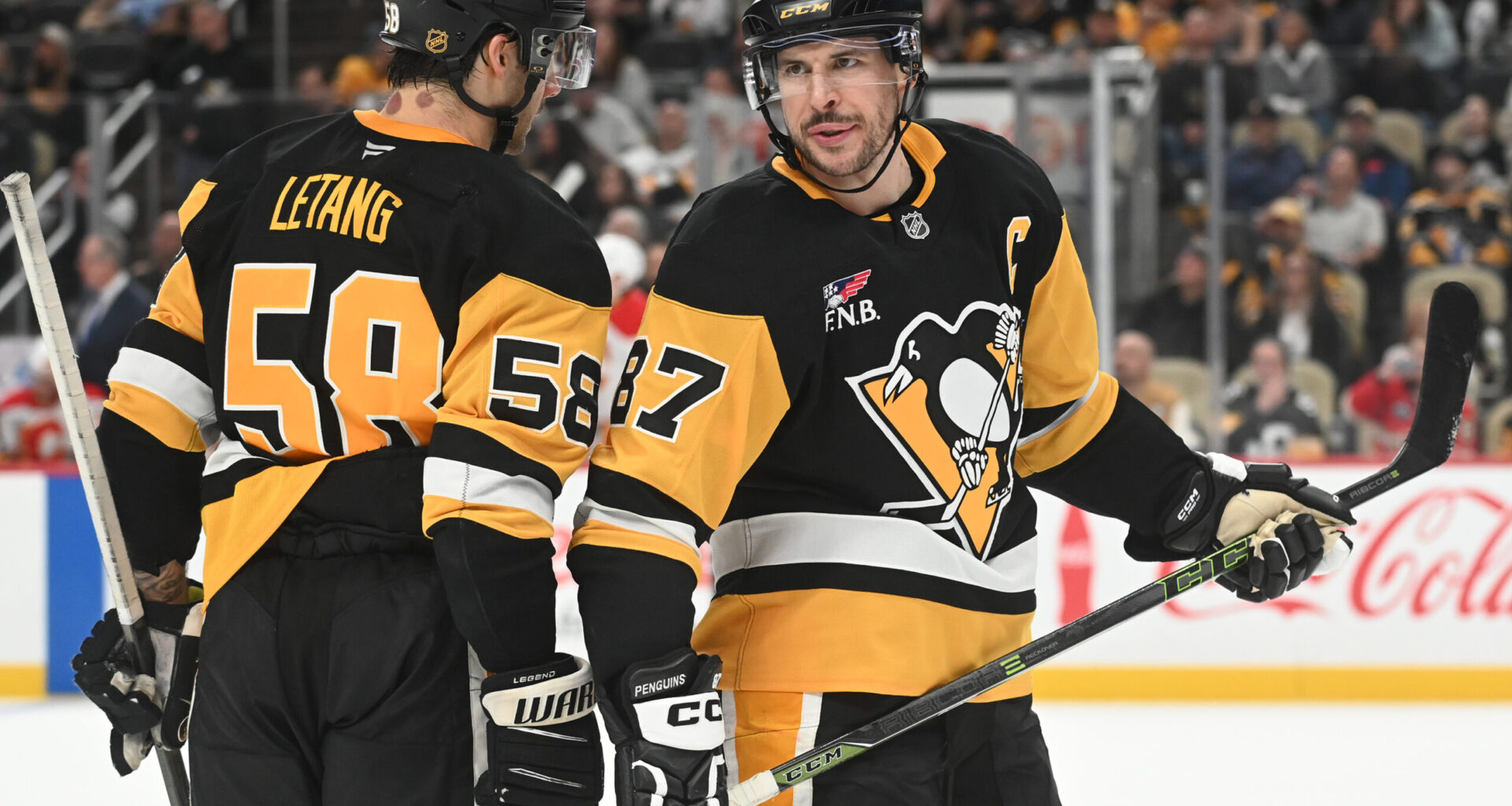
“I just don’t think we brought it for 60 minutes. So it’s hard to win in this league when
you don’t,” said Kris Letang.
The first 20 minutes weren’t as ugly as they were listless. Lifeless. Flat.
The Penguins not only had just five shots in the first 20 minutes, but they nary approached the middle of the ice. In a dramatic change from their recent play, the Penguins lounged on the perimeter, even on their first-period power play in which they had just one shot–a not necessarily dangerous high-slot wrister by Rickard Rakell.
Coach Dan Muse’s pregame breakdown proved to be prophetic.
“I think they got some guys up front where, if you give them any kind of time and space, even in transition, you’ll see they can get going,” Muse said before the game. “They look to work above you, and they look to create–(Calgary will) try to get behind, try to create odd man rushes or time and space situations. So I think (we have) got to do a really good job on the defensive side, making sure we’re not giving them that type of room.”
The Penguins did give them that room, as well as the rushes. And didn’t do well with puck management, giving them more.
Egor Chinakhov (who corrected the five-year mispelling of his name from Yegor to Egor earlier this week) scored the lone Penguins goal when he buried a pass from Evgeni Malkin on a two-on-one.
The Penguins’ offensive push, as well as their response to Calgary’s high-pressure defense, was the difference.
Sidney Crosby: Goalie Interference
However, there was a moment when the Penguins thought they tied the game 2-2 later in the third period as Tommy Novak put the puck into the net past a sprawled Calgary goalie, Devin Cooley. Referees immediately waved off the goal, ruling Sidney Crosby had interfered with Cooley moments before.
Well, yes and no.
Even Crosby admitted the replays looked definitive, but had a little jab for Cooley, too.
“I think it looked bad, but being in the play, I felt like I did my best to try to avoid the goalie, and I got pushed into him. So, maybe the explanation had something to do with being in the crease,” said Crosby. “But you’re allowed to be in the crease. I was trying to get through there and got pushed back. (Cooley) did a good job of selling it. I grazed him, and he went down pretty easy.”
Penguins Analysis
The tactical analysis section belonged to Calgary, not the Penguins Saturday. It was Calgary’s aggressive attack at the top of their defensive zone that befuddled the Penguins’ defensemen and limited the Penguins’ chances.
It was Calgary’s quick counterstrike mentality that kept the Penguins chasing for a good chunk of the game.
“We got away from what was working in the second. The odd man rushes, not just on the goal against, but then also the follow up shifts afterwards, where we allowed multiple opportunities. And now it’s just more momentum on their way,” said Muse. “And so we we got away from it. I didn’t think we were able to really find it there till maybe a little bit more in the back half of the third period. We’ve got to play a more consistent game than we did.
“I mean, the first period. I didn’t look at it as a lack of work. I thought it was a lack of execution, sometimes, positional play, just getting off of it. We gave them a lot to start the game. And then we gave them a lot at the start of the third.”
What Calgary did so effectively was similar to the Carolina Hurricanes’ defensive scheme. Calgary not only guarded the Penguins at the top of the zone, they confronted them. They didn’t just take away space; they took away time and vision while pressuring the puck.
The result was more errant passes than the Penguins have made in a few weeks, and Calgary collected those confidence-boosting odd-man rushes.
Whereas the Penguins were able to sidestep Carolina’s tight pressure at the top of the zone with speed and getting behind the defense, Calgary was much better (and bigger) at keeping the Penguins to the perimeter.
The Penguins really didn’t penetrate the middle of the zone for any significant length of the game.
Further, the Penguins seemed to err with their offensive attack. What worked against Calgary was a chip-n-chase game. The Penguins’ fourth line was the only line able to get behind Calgary’s defense and break up the stranglehold on the interior.
The Crosby line did some of that, too.
However, the Penguins also tried to possess the puck, which is their strength, but Calgary was too aggressive, and the Penguins didn’t force them to take a step back by winning enough individual battles.
In that sense, the Penguins were a little slow to change Saturday. And–this should be factored–they didn’t have the personnel to hunt pucks without Bryan Rust in the lineup.
Tommy Novak was fine on the top line, but the game demanded Rust’s superior corner play and gritty low-zone offensive ability.
Not only was the top line missing Rust, but Muse’s cascading changes to the Penguins’ top nine also created a few inequities that worked against them.
As a result, Calgary was better for most of Saturday.
“In the first period, we were second on every puck,” said Anthony Mantha. “If there was a battle, we weren’t coming out with it, which lately, we’ve been doing the opposite of that, and it has been really good for our team.”
Penguins Report Card
Team: C
The turnovers, the failure to adjust to the pressure, and ultimately the lack of goals against an inferior opponent rightfully left a sour taste with plenty of players. For the first time since the break, the Penguins returned to that soft default around the perimeter.
Arturs Silovs: B+
“You saw how many odd man rushes he had to face. I thought he played — he kept the game close for us,” Muse said. “I thought early in the game, he had to make some huge saves.”
It could have been 3-0 by the end of the first period.
Fourth Line: A
The Penguins’ best line, all day. The line was the only one to hold onto pucks deep in the offensive zone consistently. They pressured Calgary in the offensive zone; Connor Dewar and Noel Acciari each had good chances in the third period, and Blake Lizotte won more battles than anyone else.
Rough Performances
Ben Kindel: He was especially out of sorts. Calgary’s size and tight gaps kept him off balance. He had a few turnovers and was caught too deep in the offensive zone, leading to a couple of Calgary odd-man rushes.
Kris Letang: Conor Zary (who had an A+ game, including a breakaway goal in the first period) walked Letang in the first period, and it was Letang’s pinch that launched Calgary’s three-on-two for the game winner in the first minute of the third period.
Kevin Hayes: Muse didn’t show much faith in Hayes as the third-line center. He played only 7:45 and didn’t make much of an impact. He was a step behind Anthony Mantha and Justin Brazeau in the offensive zone and didn’t provide enough support to keep the play going.
Penguins Power Play: F
The unit has been a strength this season, but Saturday, the man advantage was a microcosm of the misfirings of the top players. The Penguins’ power play failed to generate good pressure or momentum, instead succumbing to Calgary’s heavy pressure and retreating to the perimeter–and staying on the perimeter.
Tags: Calgary Flames Penguins Analysis Penguins game Pittsburgh Penguins
Categorized: Penguins Analysis