
Eight Archbald residents are taking their borough council to court over data centers.
The residents filed a land use appeal late last month in the Lackawanna County Court of Common Pleas, asking the court to invalidate a controversial data center zoning amendment over alleged procedural issues.
Attorney Donald G. Karpowich filed the appeal against Archbald Borough Council on Dec. 23 on behalf of residents Phillip Sardo, Jack and Amy Swingle, Marilyn Jones, Robert and Phyliss Paone, Joseph Sabia and Justin Healey. Every appellant except Healey, who lives on North Main Street, resides on North or South Cougar Drive in a housing development off Eynon Jermyn Road, less than a mile from proposed data centers. Karpowich has previously represented local municipalities in legal battles over environmental issues, including serving as Jessup’s special counsel in a zoning challenge with the Lackawanna Energy Center and as special counsel for Fell Twp. during a dispute over an experimental mine reclamation project by Pioneer Aggregates.
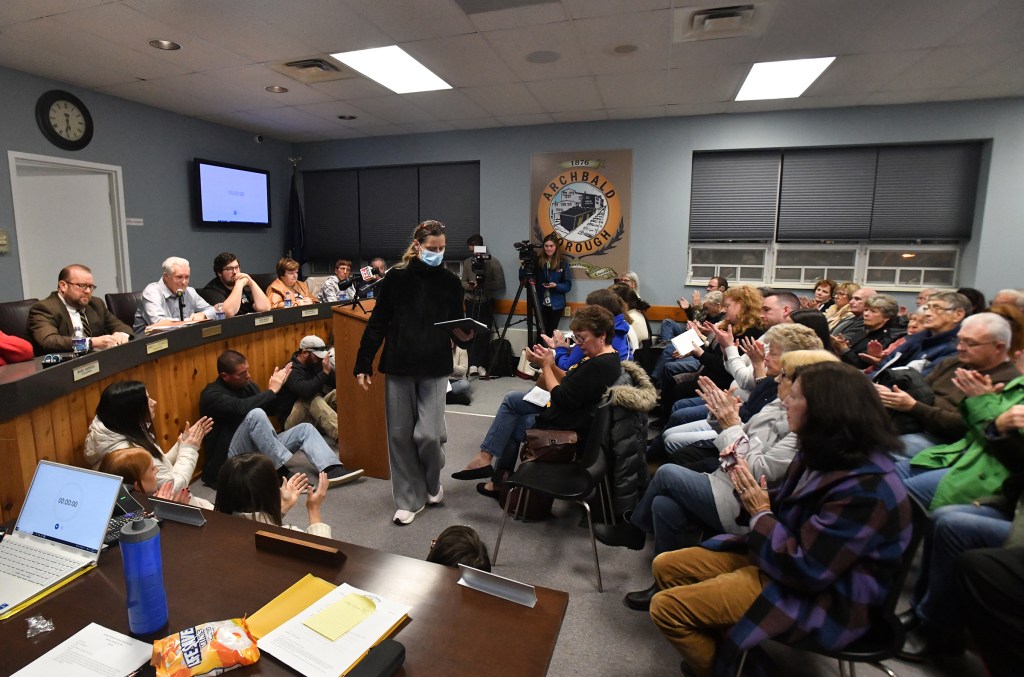
The land use appeal challenges Archbald’s data center zoning ordinance, which council adopted with a 4-2 vote during a packed meeting Nov. 24 that had residents flooding the council chambers, sitting on the floor and spilling out into the hallway with standing-room-only crowd.
Prior to the vote, at least 200 residents filled the St. Thomas Aquinas Church basement on Sept. 29 for a zoning hearing on the proposed ordinance, where more than two dozen people testified, many of whom criticized the proposal. Council then met Oct. 3 to vote on the ordinance, but the legislation didn’t pass after a motion to consider it failed to receive a second, preventing council from even voting.
The ordinance was intended to define and regulate data centers in the borough by tying conditions to their approval and designating where they could be built. It amended Archbald’s March 2023 zoning ordinance that had principally permitted data centers in large sections of the borough without defining them or providing additional safeguards. The zoning amendment restricted data centers as conditional uses in four overlay districts, requiring developers to attend a public hearing and adhere to conditions established by the town before council considers approving their requests.
While the ordinance restricted data centers in some parts of town, it allowed the proposed Wildcat Ridge AI Data Center Campus to move forward with the conditional use process to build 14 three-story-tall data centers across nearly 400 mountainside acres along Business Route 6 and Route 247, or Wildcat Road. Previously the developer needed zoning relief because the land was zoned for resource conservation and medium/high density residential uses. Wildcat Ridge was Archbald’s first data center proposal when the firm approached council during a January 2025 work session to pitch a 17.2-million-square-foot data center campus costing an estimated $2.1 billion.
The land use appeal argues that the ordinance expands where data centers were permitted from four to nine zoning districts “at the request of and for the benefit of data center developers who paid for the costs of preparing and adopting the Ordinance,” Karpowich wrote in the legal filing.
The appeal further contends that the ordinance does not adequately protect the appellants because it “increases building heights and decibel levels; allows data center development in areas where they would not otherwise be allowed; increased allowable impervious coverage; and exempts the development of data centers from the steep slope requirements under the Archbald Borough Subdivision and Land Development Ordinance.”
The appeal maintains that borough council failed to strictly comply with the procedural requirements in the Pennsylvania Municipalities Planning Code and its own zoning ordinance, including:
• Not setting forth all the provisions of the ordinance in reasonable detail in public notices, like stating they are amending three sections of the borough zoning ordinance when the legislation actually amended nine sections.
• Failing to identify or describe the properties being rezoned, nor referencing the underlying zoning districts of the properties.
• Failing to conspicuously post the affected tracts of land.
• Not mailing notices to borough land owners within the area of the rezone.
The appeal also points to other procedural defects beyond public notices, including that the ordinance was not prepared by the borough planning commission, and that council failed to submit the ordinance to the planning commission at least 30 days prior to the public hearing to give the commission an opportunity to submit recommendations; not submitting the ordinance to the county planning commission at least 30 days prior to the hearing; not prominently posting the ordinance at the borough’s principal office and instead putting it in a locked or inaccessible vestibule in the Borough Building; and holding the Nov. 24 meeting in a space that was “severely overcrowded” with residents unable to enter the council chambers and others forced into the vestibule or to remain outside the Borough Building while ignoring a written request to relocate the meeting to a larger venue.
Karpowich also notes the proposed amendment “may have been substantially changed during the process,” and if it was, it was not resubmitted to the municipal or county planning commissions, readvertised or considered with another hearing.
The appeal concludes by asking the court to deem the ordinance void from the beginning, invalid and of no force or effect.
Attempts to reach Archbald solicitor Jay O’Connor were unsuccessful by press time Wednesday.